// Contents
The most expensive version of Tesla’s new Roadster has fuel tanks, but there is no gasoline in them. They hold compressed gas: two vessels totaling 600 liters, feeding ten nozzles that throw the car into the air. On October 15, 2026, at SpaceX’s test site in Texas, the Roadster drove up a curved wall until it was nearly upside down, leapt over a row of other Teslas and settled softly in a cloud of condensation. A mannequin sat behind the wheel while automation flew the car. Tesla calls this version “air ready,” but does not say how long it can stay off the ground on one tank. We did the math: about eight seconds, and ten and a half in the most generous case. Refilling that tank currently takes six to seven hours, roughly 45 minutes at the compressor for every second in the air.
What sits in the trunk instead of fuel
The new Roadster comes in three versions. The base Performance has no thrusters and stays glued to the road with fans that suck air from under the floor. Thrust adds rear nozzles for acceleration and a 200-liter tank. Only Rocket flies: a single-seater, invitation only, with nozzles around its perimeter, according to TechCrunch . It adds another 400 liters to the Thrust tank, for 600 in total. Musk says production starts in 2028.
On stage, the car was explained by Tesla’s vice president of vehicle engineering Lars Moravy. He gave the tank volume and the mass of gas inside, and the rear thrusters, according to the company , could hold eight tonnes against gravity. Moravy called the car’s own weight an estimate: final numbers are not in yet.
// What we know
The gas is called air in some places and nitrogen in others, and the pressure is quoted as either 380 or 690 atmospheres. For the math this barely matters: air is 80% nitrogen, and we will check both pressures.
How fast cold gas leaves a nozzle
The Roadster’s nozzles burn nothing. Adding a fuel that has to burn to a car “just doesn’t feel quite right,” Moravy explained in an interview with Hagerty. Gas rushes out of the tank, expands and pushes the car the other way, like a balloon you let go of. Engineers call this a cold gas thruster. Satellites use them when they need to turn gently, not to go fast.
The exhaust speed of cold nitrogen comes out of high school thermodynamics. Room-temperature gas compressed to 380 to 690 atmospheres and expanded to normal pressure in an ideal nozzle reaches about 700 meters per second. That is a specific impulse of about 72 seconds, the upper end for nitrogen. A real nozzle will do worse, but let’s be generous.
Two seconds at full thrust
Start with the showiest mode. At 80 kN and 700 m/s, the nozzles throw out about 113 kg of gas per second. So 250 kg is gone in roughly two seconds. That is enough for the stunt shown on October 15: Tesla says the car jumped 27 feet, more than 8 meters, NBC News reports , and rolled around its own axis in midair.
Hovering would rely on other nozzles. The 80 kN comes from the rear ones that push the car forward, while the corner nozzles point down, and Tesla has not given their thrust. We do know what they need: a 1.7-tonne car presses on the ground with about 16.7 kN, roughly a fifth of 80.
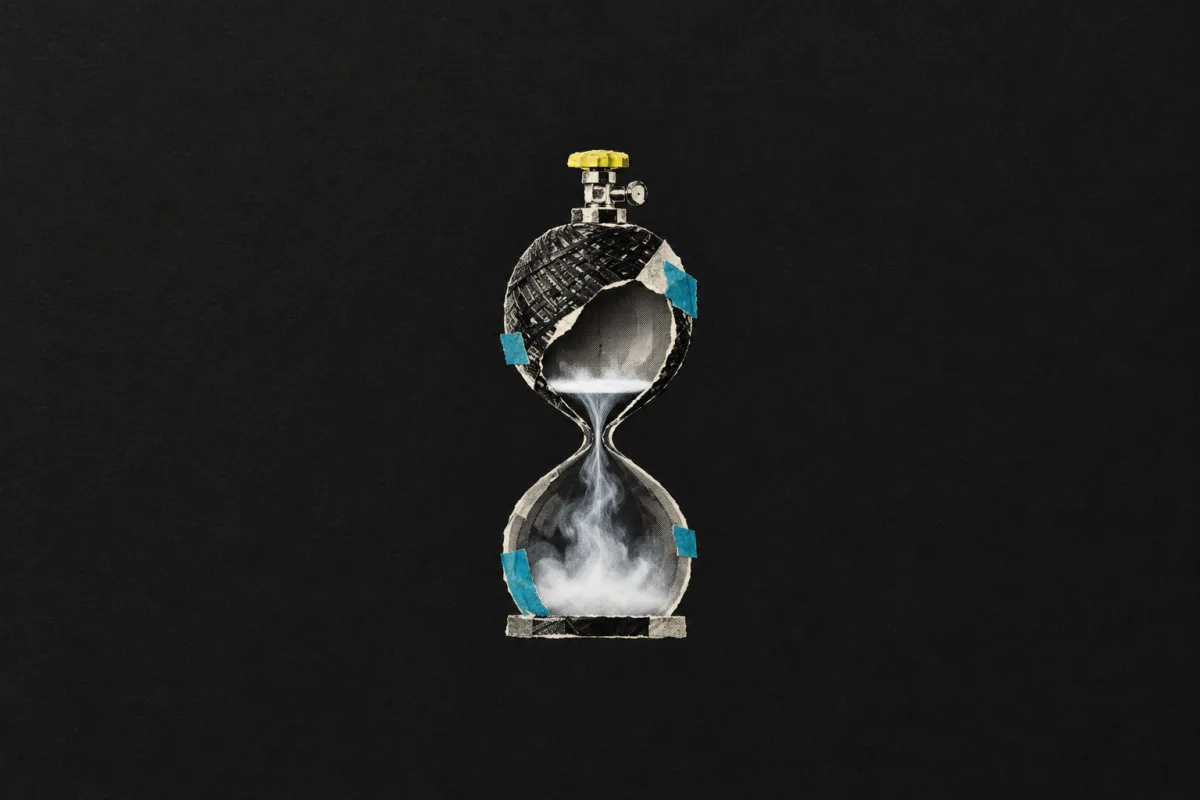
Now back to specific impulse. 72 seconds means a kilogram of nitrogen can hold itself up for 72 seconds. A 1,700 kg car is almost seven times heavier than 250 kg of gas, so it stays up about seven times less: around 10.5 seconds.
But the gas in the tank does not stay at room temperature. As the pressure drops, the remaining nitrogen expands and cools. You have seen this with a can of compressed air for cleaning a keyboard, which frosts over. Colder gas leaves more slowly, and near the end the pressure no longer accelerates the jet properly. Correcting for that, the car stays up for 8.3 seconds at 380 atmospheres and 8.5 at 690. Pressure barely changes the result because we take the mass of gas from Moravy. If 690 atmospheres squeezed more nitrogen into the same tanks, the flight would be longer, but then the 250 kg figure would be wrong.
Forty minutes at the compressor per second in the air
Now the other side. Moravy says filling all 600 liters takes six to seven hours today, and Tesla hopes to bring that down to half an hour.
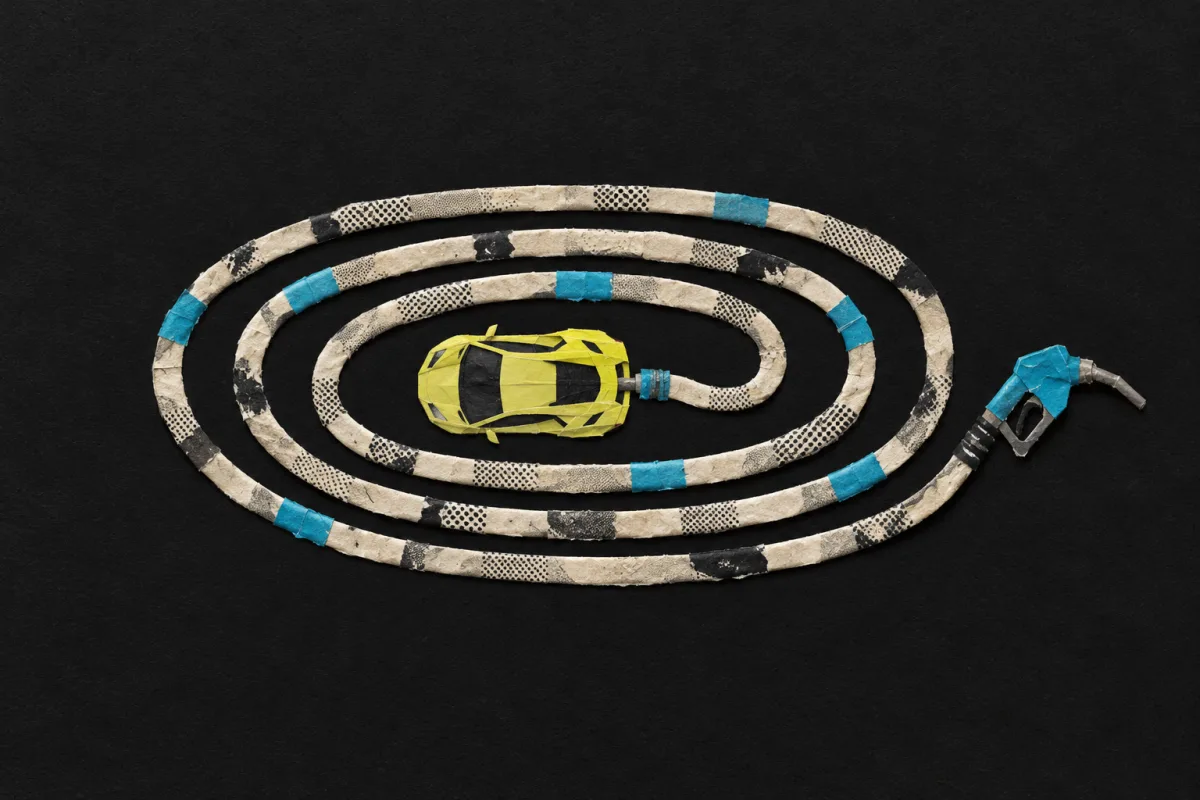
Six hours of refilling for eight and a half seconds of flight comes to just over 40 minutes at the compressor for every second off the ground. At seven hours it is about 50.
The energy is not small either. Even a perfect, lossless compressor would spend 36 to 39 kWh squeezing 250 kg of nitrogen, depending on the pressure. Real compressors heat up and use more. For scale, the average American home bought about 30 kWh of electricity a day in 2022. One tank for eight seconds of flight costs more energy than a house uses in a day.
What we don’t know
The math rests on assumptions. Tesla has not published the working pressure or the exact gas. The 1,700 kg figure probably describes a version without the extra 400-liter tank, and Rocket weighs more with it. The exhaust speed is generous. Some gas goes to the nozzles that keep the car level and turn it. Every one of these corrections only shortens the flight.
Tesla has not given a flight time per tank. After the first stunt, Elon Musk said it is “not necessarily a safety-optimized car,” and Tesla says Rocket is not approved for public roads.
Hopping over a traffic jam is out too. Suppose flying forward were free and the gas only had to keep the car aloft. Eight seconds at 60 km/h covers about 130 meters, half a city block. The Wright Flyer’s first flight on December 17, 1903, lasted 12 seconds. A plane of wood and fabric stayed in the air longer 123 years ago than a flying car does in 2026.