// Contents
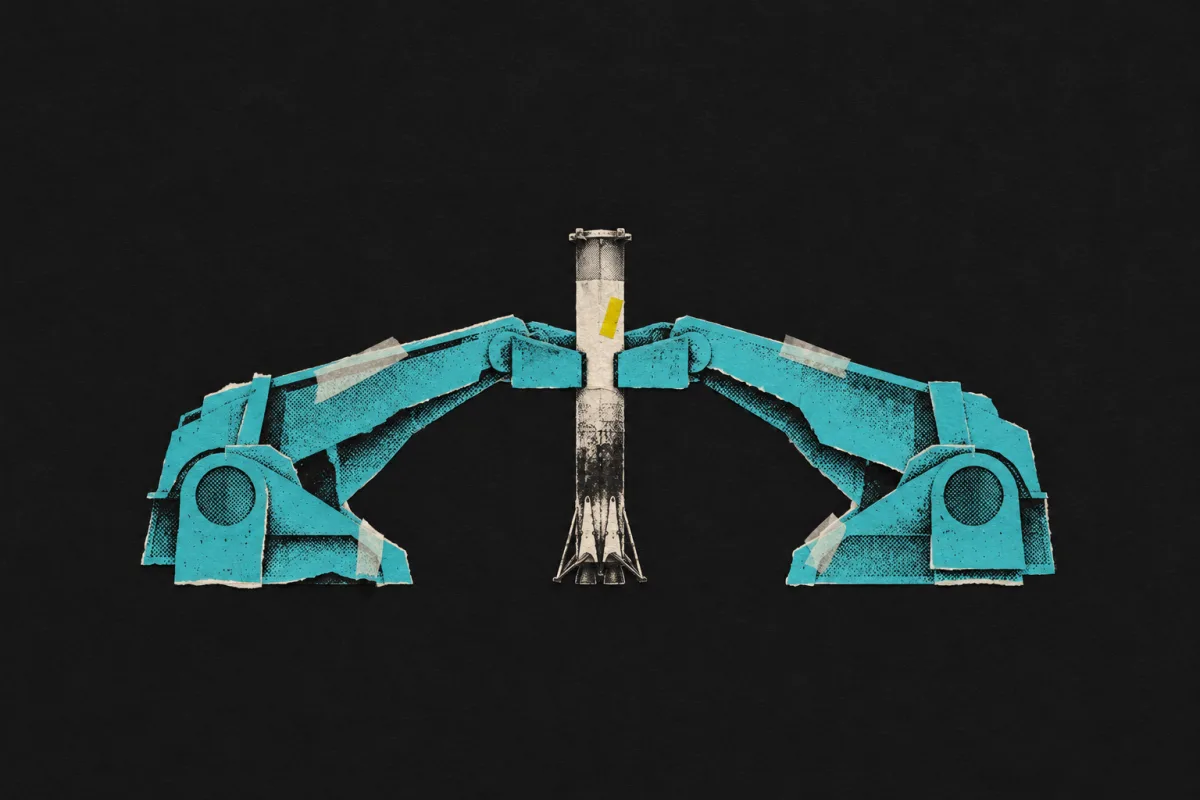
November 14, 2026, 3:20 p.m. Texas time. A steel spacecraft drops out of the low clouds over Boca Chica, lights its engines, hovers above the launch pad and settles slowly between two metal arms on the tower. SpaceX calls them chopsticks. The chopsticks hold. SpaceX’s webcast is playing “Baby Come Back,” and company spokesperson Dan Huot sounds choked up: “That was the holy grail of spaceflight, plummeting through fire to be snatched out of the air by steel. We caught a Starship, and now everything changes.”
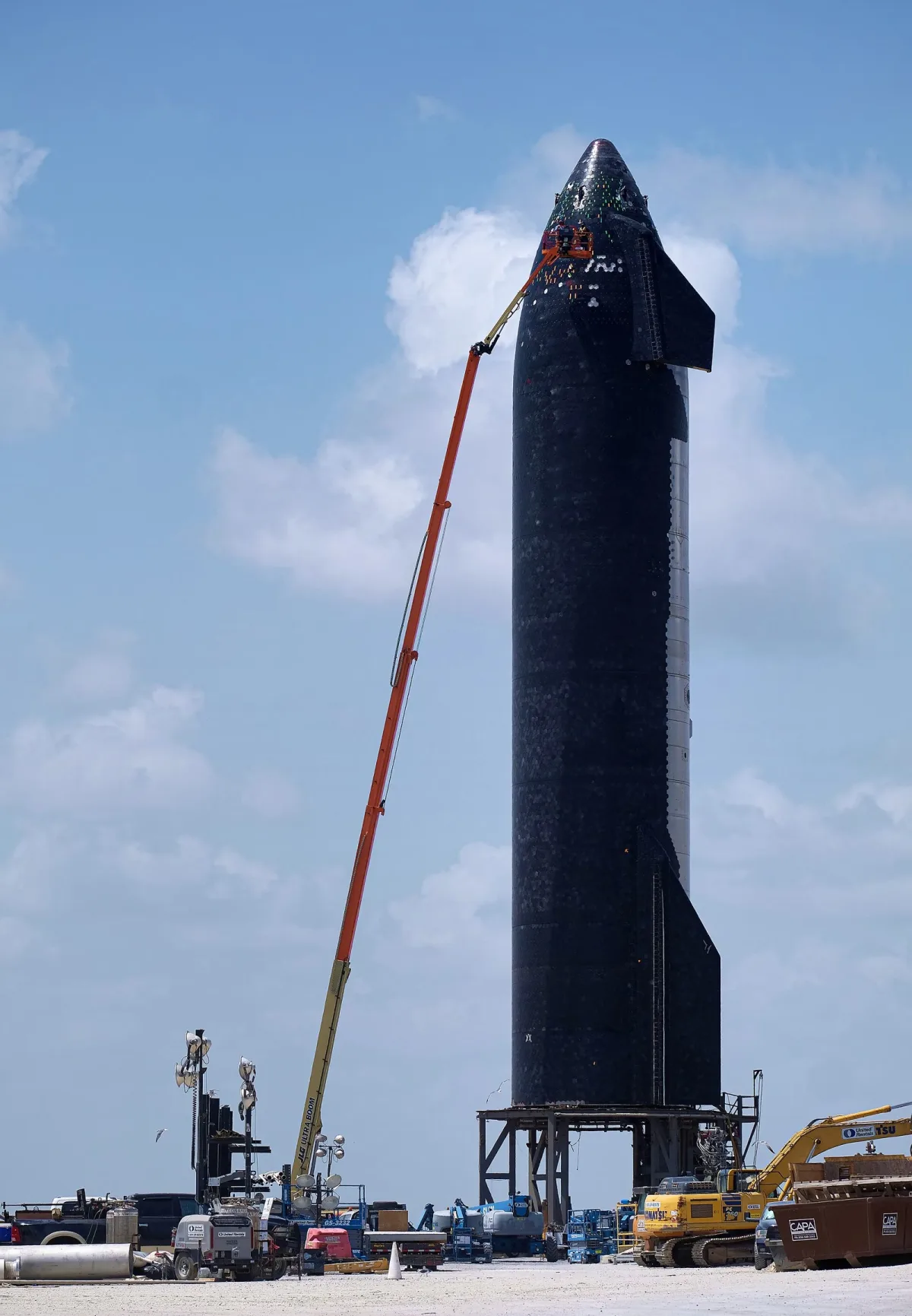
The vehicle, Ship 42, had been flying for 22.5 hours and had circled Earth 14 times. No one had ever caught the upper stage of an orbital rocket in midair at the pad it launched from. But the plan was twice as bold. The day before, the same tower was supposed to catch the Super Heavy booster, the rocket’s first stage. SpaceX had caught boosters three times already and had never even tried with a ship. It turned out the other way around. The proven half of the rocket blew up over the Gulf of Mexico, and the rookie came home.
Why catch a rocket at all instead of landing it on legs? Legs are heavy, and every kilogram the rocket carries for itself is a kilogram of cargo it can’t carry. When a tower does the catching, the heavy hardware stays on the ground, and the rocket gets picked up with chopsticks like a piece of sushi.
The half they knew how to catch
Starship’s 15th test flight lifted off on November 13 at 4:47 p.m. Texas time. Booster 22 pushed the rocket up on 33 Raptor 3 engines, separated about two and a half minutes in and turned for home. It was the first third-generation booster SpaceX had trusted with a catch. The three boosters caught before it were all first-version models: the tower grabbed one for the first time on October 13, 2024, then two more in January and March 2025.
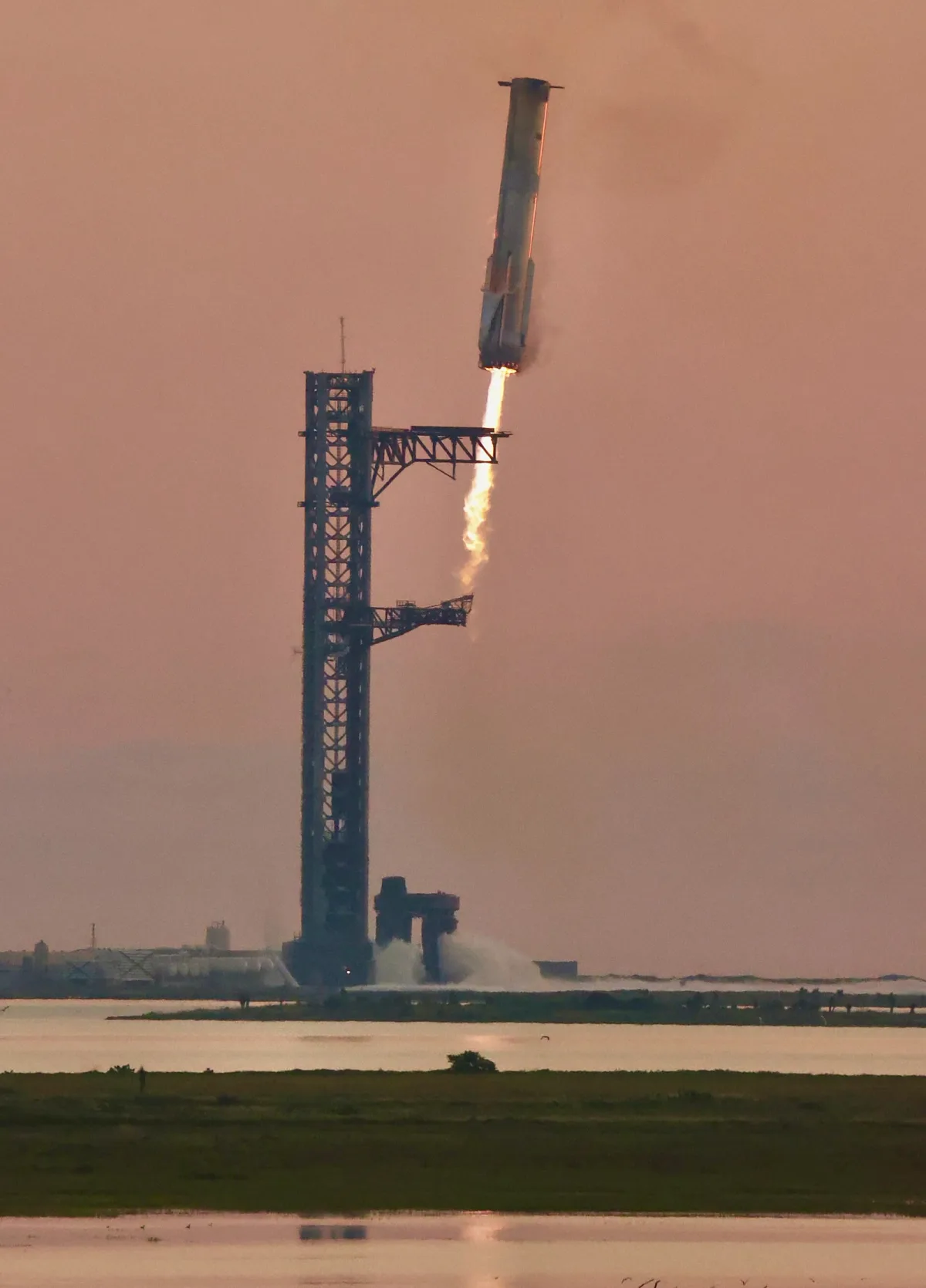
On the way back, things went wrong. One of the 33 engines dropped out after separation, so 32 lit for the burn that turns the booster back toward shore. Then a sensor reported less fuel in the tanks than there should have been. SpaceX’s Kate Tice said on the webcast that the alarm made the booster cut its turnaround burn short. The guidance system saw that the stage was not where it needed to be to approach the tower. On its own, it called off the catch and steered the rocket to a backup zone over the sea. There the booster hovered above the water and shut off its engines. Then its self-destruct system blew it apart. About 6.5 minutes had passed since liftoff.
The explanation shifted overnight. On the evening of November 13, Huot blamed a guidance problem. The next morning he took it back: “I did a disservice to our booster GNC guys last night.” GNC stands for guidance, navigation and control, and that team’s software had done its job. It noticed the stage was out of position and refused to fly it to the tower. Why the fuel ran low is still under investigation.
For a test flight, that is a sensible outcome. A multi-ton stage that isn’t sure where it is should head out to sea, not toward a launch site on the Texas coast with people living nearby. The software did exactly what it was written to do.
Why the ship is harder to catch
A booster works for a few minutes. It lifts the rocket, separates and comes back without ever reaching orbit. The ship flies higher, farther and faster. Ship 42 reached an orbit about 275 kilometers (170 miles) up and raced along at roughly 26,000 km/h, a little over 7 kilometers every second. To come home, it has to shed that speed against the air, survive the heat and arrive exactly at the tower.
Only an intact heat shield can survive that: the skin of tiles that takes the brunt of reentry. So before sending Ship 42 to the tower, SpaceX spent almost a full day checking it. The ship carried 26 third-generation Starlink satellites. After release, three of them turned their cameras back on the ship and photographed its tiles. Their photos, along with views from long-range cameras on the ground, showed the shield was intact. One of those tiles had been installed before launch by none other than the YouTuber MrBeast.
// Timeline
- Liftoff from Starbase in South Texas.
- The booster calls off the catch and explodes over the Gulf of Mexico.
- The ship enters orbit about 275 km up.
- All 26 satellites are out; three of them photograph the ship’s heat shield.
- The team skips an early ocean landing off Hawaii, making this the longest Starship flight ever.
- Final check: every team, from heat shield to tower, polls “go.”
- A 10-second single-engine burn takes the ship out of orbit.
- The tower’s chopsticks catch the ship.
For those 22.5 hours, you could see the ship from the ground without a telescope. Skywatching columnist Joe Rao had predicted it would pass overhead as a bright, fast-moving star, much like the International Space Station.
The first descent over land
The flight crossed another line that got less attention. Until now, Starship upper stages ended their flights in the open ocean. Ship 42 was the first to reenter over inhabited land: its descent path was routed over sparsely populated parts of northern Mexico and southern Texas. A ship heading back to a tower on the Texas coast has to cross land on the way in, so the catch and the overland descent were one and the same problem.
Less than two years ago, that route would have been hard to picture. In January and March 2025, two ships in a row exploded soon after launch. After the March failure, falling debris threatened an area stretching to the Bahamas and the Turks and Caicos Islands. Airports in Miami, Fort Lauderdale, Palm Beach and Orlando held flights until the danger passed. SpaceX asked anyone who found pieces to report them to its debris hotline.
This time the ship had several ways out. Right up to the final check, controllers could have sent the ship to an ocean landing off Hawaii or Chile. On the last approach, a backup splashdown zone waited in the Gulf of Mexico. None was needed. NASA Administrator Jared Isaacman called the catch “almost magic.”

Catching it is only half the job
A rocket that has been caught is not yet a rocket that has flown again. And flying again is the whole point: catching stages at the tower, SpaceX says, lets the company inspect them, refurbish them and send them back up faster.
The pace SpaceX is aiming for is hard to picture. Elon Musk talks about more than 30 Starship launches a day in 2030, roughly 10,000 a year, and in late October the company gave U.S. aviation regulators the same figure. For scale: in 2025, SpaceX flew 165 Falcon 9 rockets, about half of all orbital launches in the world.
The reason is satellites. By SpaceX’s math, the 26 third-generation Starlinks on a single Starship equal about ten Falcon 9 launches of the previous version. Musk has an even bigger plan called Starmind: a network of satellites that would serve as AI data centers in orbit. Networks like these need a launch rate nobody has ever reached, and the company says the double catch is the key to it.
// Why fly so often
For someone on the ground, that means more satellite internet and more moving dots in the night sky.
There is a goal beyond orbit as well. NASA picked Starship as the lander that will put astronauts on the Moon on Artemis IV, now targeted for 2028. To get there, the ship has to learn to refuel in orbit. Musk puts the number of tanker flights per lunar mission at six to eight, while outside experts’ estimates have run as high as 22. No ship has refueled in orbit yet, and if SpaceX isn’t ready, NASA could hand the landing to Blue Origin’s Blue Moon lander.
All of that is still far off. SpaceX has reflown boosters: Booster 14 flew in January 2025 and again in May, Booster 15 in March and then not until October. Caught boosters have waited months for a second flight, while Musk’s plan needs more than a launch an hour. No Starship upper stage has flown twice yet. Musk has said he wants to refly both stages, and Ship 42 could be the first. It came back to the very tower it launched from. How many weeks before it can take off from there again?