// Contents
The internet can now send the smell of coffee. More precisely, it can send the word “coffee.” Engineers at The Ohio State University and China’s Zhejiang Laboratory have built a system called Scentronic. An electronic nose in one room sniffs a cup, and a wristband in another puffs out a little cloud of coffee aroma. That other room could, in principle, be on another continent. Not a single molecule makes the trip. What travels is a one-word label, and the receiver pulls the scent from a vial it already carries.
It carries five of them: beer, cake, coffee, orange and red wine. Volunteers in the trial named the smell correctly about three times out of four. The work appeared in Science Advances on October 21, 2026. The idea has a long history, and it smells of failure. For sixty years, almost everyone who promised smell on demand either went broke or never left the lab. The Ohio team bet on modesty instead.
What actually travels down the wire
Chunyu Yang, the lead author and a materials science doctoral student at Ohio State, summed up the idea in one line: the system connects “smelling something here” with “recreating the corresponding smell somewhere else,” Reuters reported. The key word is “corresponding.”
Networks send sound and pictures as recordings. A microphone turns vibrations in the air into numbers, and a speaker turns the numbers back into vibrations. Smell doesn’t work that way. To rebuild a scent from data, you would need a machine that can mix any substance to any recipe. And smell has no universal recipe.
A phone screen shows millions of shades by mixing just three: red, green and blue. That matches how our eyes work: the retina has three types of cone cells. The nose is messier. Humans have more than 400 types of smell receptors, neuroscientist Joel Mainland of the Monell Chemical Senses Center pointed out in 2015. For most of them, scientists still didn’t know the basics: which molecules they respond to, and how. That’s why no one has found a set of “primary odors” that could be mixed into any other smell.

Scentronic sidesteps the problem the way people did long before the internet. It recognizes a smell and says its name, a bit like a friend on the phone telling you the coffee is ready.
That approach has one pleasant side effect. The label “coffee” weighs a few bytes, and it doesn’t care whether it crosses a room or an ocean.
A nose made of six sensors
The sending half looks like a saucer: a round circuit board about 15 centimeters (6 inches) across. Nobody meant for it to be worn. It holds six metal-oxide gas sensors, mostly tin dioxide, as New Atlas describes the device. Airborne molecules change each sensor’s electrical resistance: ethanol from beer, limonene from orange peel, diacetyl with its buttery bakery smell. Every sensor reacts a little differently, and the six readings together form a kind of fingerprint for the scent.
Then the fingerprint has to be read. The nose “sniffed” each of the five foods and drinks 50 times, for a little over three minutes each time. After that training, it named them almost flawlessly, 96% to 100% of the time.
That sounds impressive, but the exam was easy. The nose chose among five familiar options, and each option was one specific product. It had never met a different brand of beer or a cup of coffee with cinnamon.
A jukebox with five records
The receiving end is Scentronic proper. Inside are tiny chambers of premixed scented liquid, each with its own release channel. A piezoelectric element vibrates about 110,000 times per second and turns the liquid into a fine fragrant mist. A microcontroller sets how often it sprays, which sets how strong the smell is. Channels can open together to make blends.
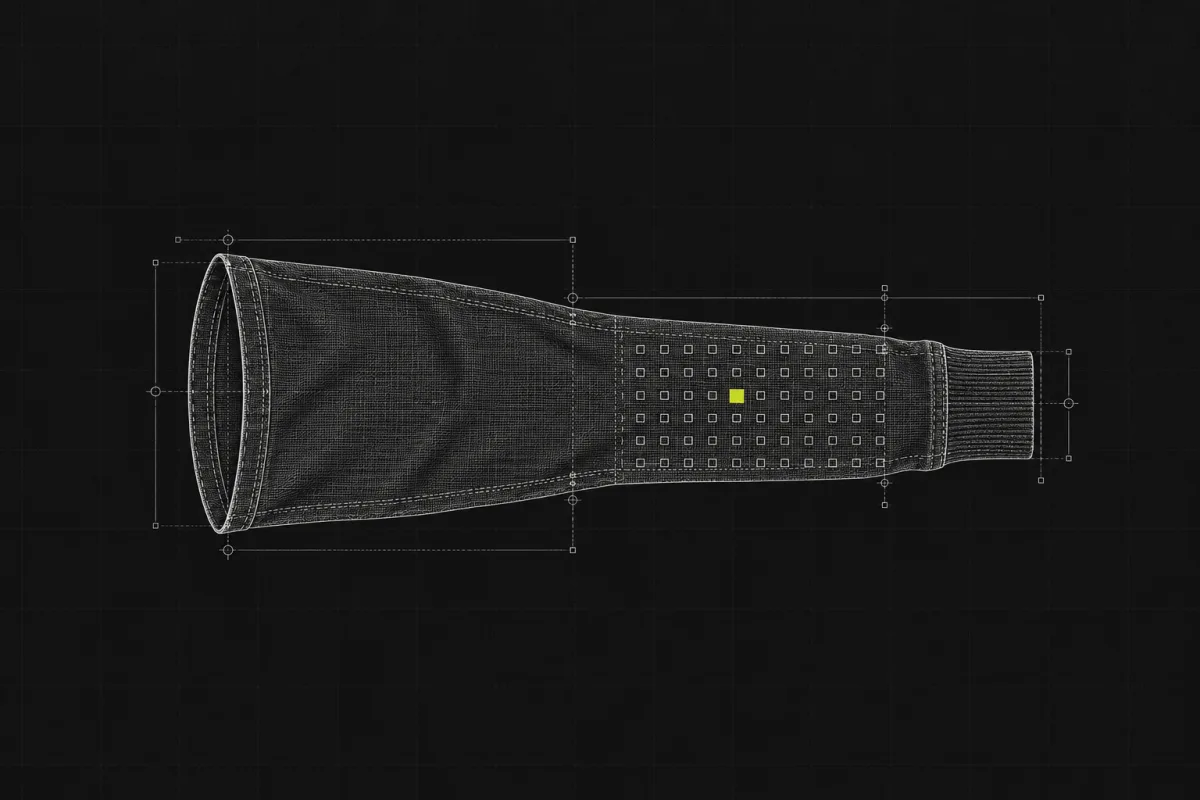
The team built three versions of the receiver: a wristband with two channels, a necklace with five that the authors compare to “pearls on a string,” and a handheld unit, also with five.

Put simply, it’s a jukebox. It can’t play any tune you like. It plays one of the records loaded in advance, and the nose at the other end presses the button with the right name. A sixth smell means retraining the nose and adding another liquid to the receiver. Yang says plainly that the system can’t yet send the smell of hot dogs on a grill, or the exact mix of smells at a tailgate party before a football game.
Three times out of four
The receiver was tested on people. In a trial with the handheld unit, 14 volunteers sniffed a puff and named the smell. They got single scents right about 73% of the time and pairs of scents about 71% of the time. Random guessing among five options would score 20%, so the device clearly beats chance. Still, one time in four, a person smells something other than what was “sent.”
Intensity proved harder. When volunteers were asked to rank puffs by intensity, they got it right about 59% of the time. Reports on the study don’t say how many puffs were compared at once, so it’s unclear how much better that is than guessing. For a cup of coffee, that hardly matters. For a doctor who might one day want to test a patient’s sense of smell with scents of different strengths, it isn’t good enough yet. The authors list exactly that kind of test among the future uses.
The other uses in the AAAS news release are more down to earth: a pleasant smell added to meals for patients who struggle to eat, and for astronauts and soldiers who live on bland supplements and field rations. For virtual reality, the team also built a cup that drips flavoring into plain water while a person in a headset “drinks” a beer or a coffee. The cup hasn’t been tested on people yet.
// Scentronic in numbers
Sixty years of failed smells
The idea is older than the internet. In 1960, the film Scent of Mystery opened in Smell-O-Vision, a system by inventor Hans Laube that released smells into the audience as the plot unfolded. Audiences shrugged. Laube’s daughter later recalled that her father had planned an emitter at every seat, with a neutralizer after each scent. The producers ended up pumping the smells through the theater’s air conditioning instead. “He lost all his money, my mom went to work,” she wrote.
Forty years later, it was the internet’s turn. DigiScents, an American company founded in 1999, came up with iSmell, a shark-fin-shaped box that plugged into a computer by USB. A website or an email sent a smell file, and the device mixed it from a cartridge of 128 substances, as Wikipedia recounts. Investors reportedly put in about $20 million. By 2001 the money was gone, and iSmell never got past the prototype. In 2006, PC World ranked it 24th on its list of the worst tech products of all time, noting that few products literally stink.
// Timeline
- Scent of Mystery in Smell-O-Vision: scents in the theater, a flop at the box office
- DigiScents runs out of money, and iSmell never goes on sale
- American company Osmo describes how it “teleported” the smell of a coconut slice
- Scentronic sends five smells over the internet
What separates Scentronic from iSmell is a modest goal. iSmell promised to build any smell from stock ingredients. Scentronic doesn’t even try. It synthesizes nothing and simply opens the right vial. The task shrank, and in exchange it became solvable.
A lab at every end
With no primary odors to mix, the only other option is to rebuild each smell from scratch, molecule by molecule. Osmo, an American company, has taken that road. In the fall of 2024, its CEO Alex Wiltschko described how his lab “teleported” the scent of a coconut slice. The sample goes through a gas chromatograph-mass spectrometer, a lab instrument that reports which substances float above a sample and in what amounts. The data goes to the cloud, the company’s AI turns it into a recipe using its “odor map,” and a robot mixes the ingredients.
Wiltschko lists the problems himself. Sulfur compounds in tropical fruit are hard to detect and hard to reproduce, some molecules in everyday smells are still unidentified, and turning data into a recipe needs some human guidance.
So there are two roads. Osmo puts a lab at every end and tries to print any smell. Scentronic hangs five vials around your neck and prints only those. The first road is universal but expensive and bulky. The second is cheap and wearable, but it knows five words.
Yang calls Scentronic a research prototype, built with no company involved. A product is a long way off, he says: it needs far more training data and the ability to pick apart mixtures, and in real life nearly every smell arrives as a mixture. No one knows yet what years of breathing scented mist would mean. And if a receiver ever ships, its vocabulary will still be finite.
Who decides which words make the cut: coffee and orange, or the smell of your grandmother’s pie that no lab has ever recorded?