// Contents
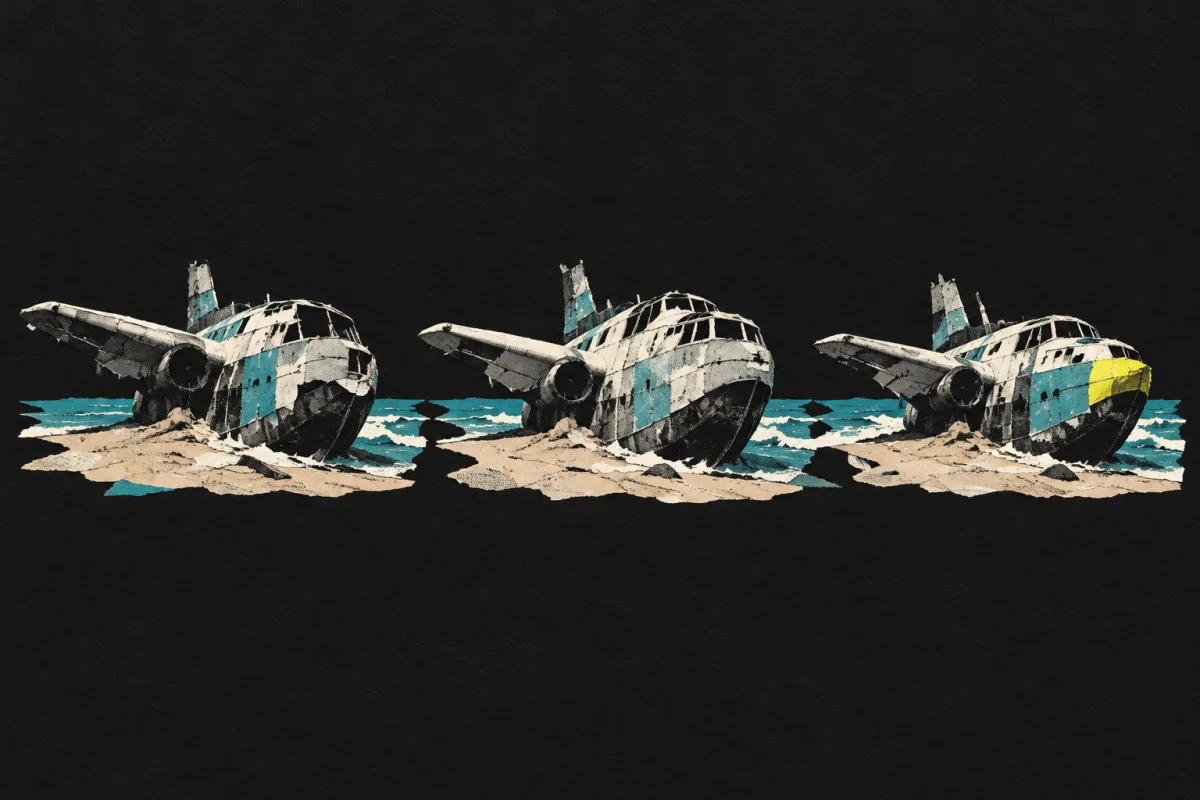
On a beach near Derbent, a city on Russia’s Caspian coast, sits a ship with wings. It is more than 70 meters (230 feet) long. Six launch tubes for Moskit anti-ship missiles ride on its back, and eight jet engines cluster near its nose. This is the Lun ekranoplan, the only craft of its kind ever deployed as a warship. In the summer of 2020 it was towed out of the naval town of Kaspiysk toward a planned theme park, got stuck in the surf on the way, and only made it onto dry land at the end of 2021.
Meanwhile, in Rhode Island’s Narragansett Bay, a distant relative has started to fly. REGENT’s all-electric Viceroy lifted off the water on September 2, 2026, with two captains at the controls; the company has not named them. Captains, not pilots: a machine designed for 180 mph counts as a vessel, not an aircraft, under US and international rules. A licensed mariner with a short add-on course will be able to drive it, and the Coast Guard, not the Federal Aviation Administration, will police it.
An idea that died with the Soviet Union is coming back on batteries. A lot has changed in sixty years. Some of it is still only a promise.
A wing riding its own cushion
Every pilot knows ground effect. When a wing travels very close to the ground or water, the air beneath it gets squeezed and can’t escape down and sideways fast enough. Lift goes up, drag goes down, and flying gets cheaper. In effect, the wing rides on a cushion of air it inflates itself. The effect holds as long as the craft stays within about one wingspan of the surface, and it is strongest much lower than that.
Soviet engineers saw a new kind of vehicle in it. Chief designer Rostislav Alexeyev built a machine the West nicknamed the Caspian Sea Monster. It first flew on October 16, 1966: 92 meters (about 300 feet) long, 544 tonnes at takeoff, ten turbojet engines. Until the Antonov An-225 flew in 1988, it was the largest aircraft in the world. US intelligence spotted it in spy satellite images and spent years trying to work out what it was for.
The most telling detail is the engine count. Eight of the ten sat near the nose and ran only during the takeoff run: tearing 500 tonnes free of the water took far more thrust than carrying them once airborne. Once aloft, those eight shut down. For the rest of the flight, most of the machine’s engines were dead weight, hauled along for the sake of the takeoff.
Why the monsters never caught on
The whole breed shared one weakness: waves. Ground effect works only close to the water. An ekranoplan cannot climb and wait out a storm from above, so even moderately rough seas kept it in port. As New Atlas notes, ekranoplans also pitched unstably and handled poorly at low speeds in open water. The Caspian Sea Monster crashed in 1980. It sank. The Lun served with the Caspian Flotilla from 1987 until the late 1990s, and the ekranoplan era, as IEEE Spectrum puts it, ended with the USSR. REGENT’s new craft is designed to handle swells of up to 1.5 meters (about 5 feet). The answer lies in how it is built.
Float, foil, fly
REGENT, based in Rhode Island, was founded in 2020, the same year the Lun was dragged toward Derbent. Its CEO, Billy Thalheimer, studied aerospace engineering at MIT, flies aerobatic planes, and has worked at Aurora Flight Sciences, Blue Origin and Virgin Galactic. He describes the mission as “dusting off” ground-effect technology and putting it to work along coastlines.
Where the Monster needed eight extra engines, the Viceroy has hydrofoils. The Monster’s hardest moment was tearing a heavy hull out of the water. The Viceroy lifts its hull out early, at boat speed: it floats when slow, then rises onto underwater wings as it speeds up. Water drag drops, and, Thalheimer says, the transition to flight gets smoother. The company does not say how much thrust this saves, but the craft takes off from its foils, not from the water. REGENT sums up the whole sequence in three words: float, foil, fly.
A dozen electric motors along the leading edge of the wing drive it. They draw on a battery of roughly 500 kWh, about as much as five Tesla Model S packs hold. The cabin seats 12 passengers plus two crew.
The hardest part is the switch from foiling to flying, at roughly 60 to 84 km/h (37 to 52 mph). At that point the craft, in the words of IEEE Spectrum reporter Lawrence Ulrich, is “moving fast for a boat but extremely slow for an aircraft.” Ulrich climbed into a two-seat Viceroy simulator with wraparound screens at REGENT’s plant and guided the craft through a virtual harbor off Maui. A central lever set the speed, and a joystick steered. The modes switched almost on their own: in foil mode the hull rose above the simulated waves, and then the craft lifted into flight at about 10 meters (33 feet). That is roughly half its wingspan and the craft’s preferred cruising height. During the transition, Ulrich admits, he was just a bystander: a triple-redundant digital control system keeps the craft level and at the right height.
Thirty seconds over the bay
The first crewed flight was short. Very short. According to REGENT itself, the Viceroy covered 596 meters in 30 seconds at about 10 meters above the water. Divide one by the other and you get an average of about 72 km/h, or 45 mph. The company gave no speed; the figure is simple arithmetic. But it lands right inside the foil-to-flight window: the first crewed flight barely got past the hardest moment, and the craft has not yet been pushed anywhere near the promised 180 mph. Still, by the company’s account, it is the largest all-electric ground-effect craft ever to carry people.
“This is the moment we have been envisioning and tirelessly pursuing for the past five and a half years,” Thalheimer said after the flight. His cofounder and CTO Mike Klinker added that the craft flew as smoothly and safely as designed.
Four weeks later, on September 30, the Viceroy made its fifth flight, this time in public. More than 600 people came to watch the demonstration at the company’s new factory in North Kingstown. The 255,000-square-foot plant is meant to turn out 75 passenger Viceroys and 300 uncrewed Squire drones a year at full rate. “We proved the technology and the demand; now we build,” Thalheimer said.
// Then and now
Caspian Sea Monster, 1966
- Ten turbojet engines, eight of them only for the takeoff run
- Breaks free of the water on the thrust of its takeoff engines
- Flown by test pilots
Viceroy, 2026
- Twelve electric motors on the wing
- Rises onto hydrofoils and takes off from them
- Driven by a licensed ship captain, overseen by the Coast Guard
The plane that is legally a boat
The strangest part of this story happens on paper, not over the water. A mariner will sit at the Viceroy’s controls, the Coast Guard will inspect it, and it needs no airport. This all follows from the rules of the International Maritime Organization: a craft that stays in ground effect, leaving it only for brief hops, falls under maritime law. It follows the same collision rules as ships and gives way to boats and ferries. Aviation rules kick in only for machines that can fly high for long stretches.
In the US, that means the Coast Guard, not aviation regulators, will inspect passenger seagliders. In April 2026, Congress directed the Coast Guard to build the capacity to certify and inspect such craft, and added $2.5 million above the budget request for the job. REGENT expects the Viceroy to be certified as a small passenger vessel.
For the company, the difference is huge. Electric vertical-takeoff air taxis keep getting bogged down in aviation certification and fights over airspace. REGENT can hire Viceroy captains from among master mariners, who hold the highest deck officer license, and give them extra training. An airline pilot takes far longer and costs far more to train. The matter is not fully settled, though: the 2024 law that reauthorized the FAA requires the agency and the Coast Guard to agree on who is responsible for what.
Big promises, slipping dates
Ground-effect craft attract big numbers, and REGENT is no exception. In April 2021, when the company raised its first $9 million, it planned to fly its first passengers by 2025, with routes such as Boston to New York. Now 2026 is nearly over, and REGENT promises first deliveries no earlier than late 2027.
The company says its order book spans six continents, but it gives no unit count. IEEE Spectrum cites a $10 billion backlog, a figure that again comes from REGENT. The most concrete customer, The Twenty Five, a US luxury coastal travel company, ordered “up to 60” Viceroys for routes in the Northeast and Florida. Investors have put in or pledged more than $340 million.
The niche itself makes sense. Thalheimer talks about routes that are “too long to drive but too short to fly”: New York to the beach towns of the Hamptons, say, or hops between Hawaiian islands. A standard passenger ferry, by IEEE Spectrum’s count, is about nine times slower than the Viceroy promises to be. But the battery limits range to about 180 miles, while the jet-powered Lun could cover roughly 1,200.
Always over the runway
The last Lun got stuck in the surf, and the Viceroy’s real test will come in the same place: on the waves, in open sea, with passengers and bad weather. Thirty seconds over a calm bay prove nothing about that yet.
A seaglider does have one argument no airplane can make. It keeps no reserve for a dash to the nearest airport: if something goes wrong, it lands on whatever it is flying over. Thalheimer puts it in one line: “You’re always over your landing area.”