// Contents
60 seconds. For several years, the frequency of Europe’s power grid sagged briefly on exactly that beat, and nobody could say why. The dip was tiny and harmless, but far too regular to be chance: every minute, starting at the same second. On October 30, 2026, physicists at Forschungszentrum Jülich in Germany published the answer in Nature Energy. The nudge comes from thousands of backup batteries that test themselves at the start of every minute. They do it in unison, because they all read the same clock.
“It really was years of detective work,” says Dirk Witthaut, who led the study, in the center’s press release. But he wasn’t the first to notice. TenneT, Germany’s largest transmission grid operator, had seen the one-minute rhythm in its data for years without being able to explain it. The same rhythm later turned up in the grids of Britain, the United States, Australia, Iceland, South Korea and Malaysia. And in spring 2020, as industry slowed down, it didn’t fade. It grew.
A grid that spins like one flywheel
To see how a battery testing itself in one building can register across a continent, you need one idea.
That makes frequency an extremely sensitive gauge of balance. A dip means that somewhere in a vast system, a lot of load just switched on at once. Europe learned how sensitive in 2018. A dispute between Serbia and Kosovo left the grid short of energy, and for weeks the average frequency hovered around 49.996 Hz. A deviation of four thousandths of a hertz was plenty. Clocks in microwaves and ovens count time by the swings of the current, and in 25 countries they ran nearly six minutes slow.
The one-minute dip works differently. The frequency falls for the first half of the minute and then recovers, so clocks stay on time. It is so small that in any single minute it gets lost among the grid’s usual wobbles. Stack many minutes on top of each other, though, and the same shape emerges every time: a sag at the top of the minute, recovery by the middle. The eye can’t see it. Statistics can.
Eighty power meters and Building 3
The first clue was the regularity itself. “It quickly became clear to us that the cause must be something controlled by the clock,” Witthaut says. The second clue: the dip is visible across an entire country, so no single factory or power plant could produce it. It takes thousands of devices drawing power at the same moment.
The search began at home. Jülich’s campus runs like a small town, with its own power network and a test bed called the Living Lab Energy Campus. A team led by the paper’s first author, Carsten Hartmann, fitted more than 80 power quality meters to the campus transformers and recorded consumption for several months in 2024.
The one-minute rhythm didn’t turn up everywhere. It appeared only in buildings fed through battery-based uninterruptible power supplies, the units that keep servers and labs alive during a blackout. Buildings full of computers but without such batteries showed no rhythm.
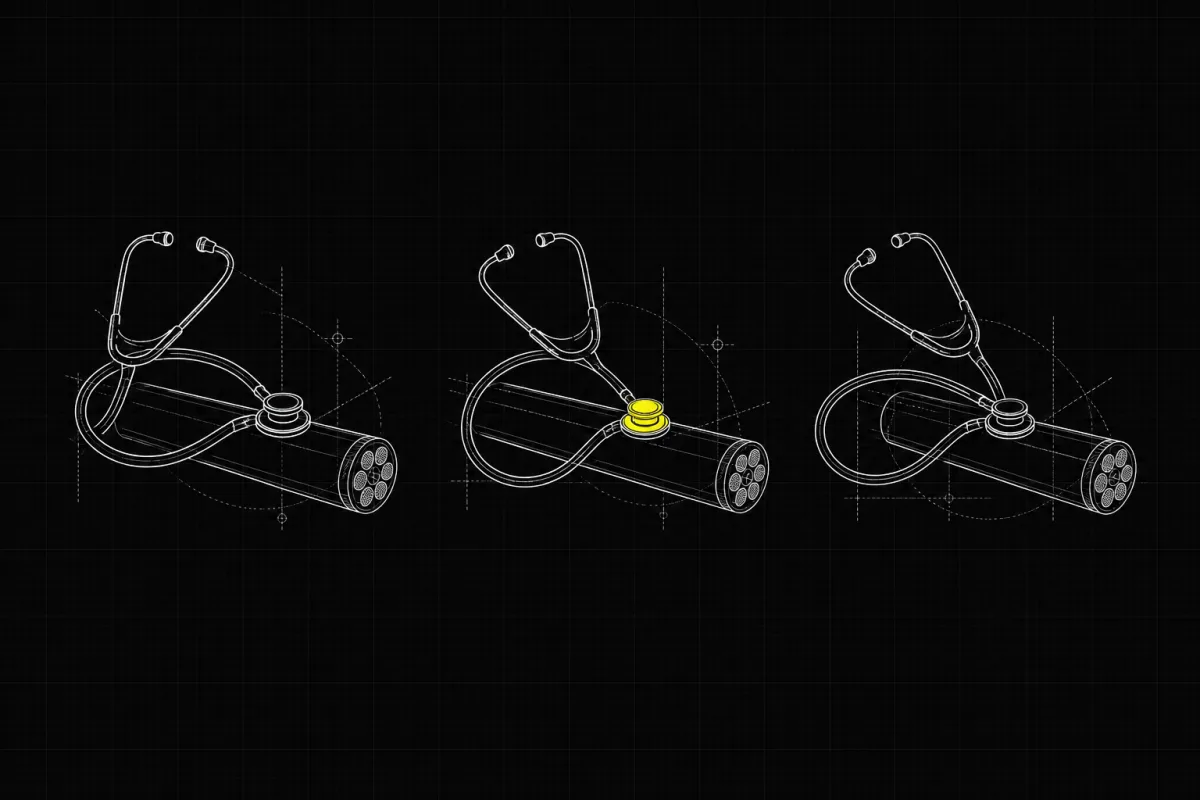
Next, Hartmann and his colleagues zeroed in on one installation in Building 3: cabinets of batteries rated at 1.5 megawatts, there to keep the building running if the power fails. At the battery terminals they found a short spike of current at the very start of every minute. The manufacturer confirmed it was a self-test: once a minute, the management system checks the condition of the cells. Then the team traced the spike through several transformers to the exact point where the campus meets the public grid.
One battery on one campus won’t rock a power system, of course. But the world now has a great many of these installations, and they all do the same thing in the same second.
Clocks that are too good
Why the same second? Witthaut suspects most manufacturers settled on a minute as a sensible interval and scheduled the test at its very start, at zero seconds. On its own, each battery behaves perfectly.
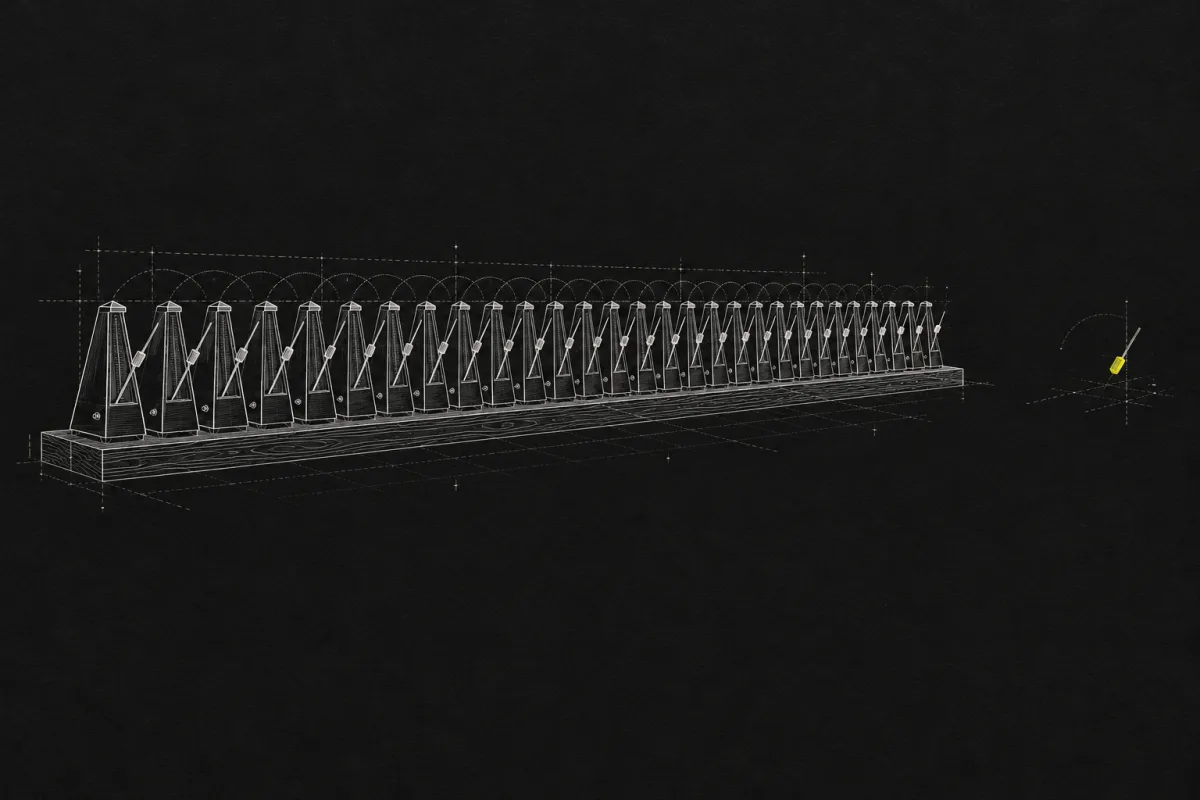
The trouble is the clock. Modern devices set their time from internet time servers (via the Network Time Protocol, or NTP), so for thousands of batteries with different owners, “the top of the minute” arrives at almost the same instant. Machines that know nothing about each other have fallen into step without anyone planning it. The authors call this unintended synchronization.
// The one-minute dip in numbers
The study’s preprint adds a few household examples. A “smart” oven that syncs its clock online also draws power in a steady one-minute pattern, but only when it runs on a timer. A Thermomix kitchen machine draws power in recurring peaks, but not on a strict minute. The laptop they tested showed no one-minute rhythm. Witthaut is careful here: air conditioners, heat pumps, washing machines and dishwashers might behave similarly, but nobody has checked yet.
The Mallorca clue
The one-minute rhythm is strongest in large interconnected grids, such as those of Europe, the United States and Australia. But the real smoking gun came from a small island.
Mallorca, a Spanish island in the Mediterranean, isn’t synchronized with mainland Europe: its grid keeps its own frequency. In late 2019 that frequency showed no one-minute rhythm. By 2025 the rhythm was plain to see.
In between, the Balearic Islands had installed battery storage.
When a tiny wobble stops being tiny
For now the dip poses no danger to the grid: it hasn’t reached a dangerous level, and the authors don’t describe it as an imminent blackout threat. What worries them is that grids are getting lighter. The heavy spinning turbines of coal and gas plants used to absorb jolts with sheer mass, the way a heavy wheel shrugs off a bump. Solar panels, wind turbines and batteries connect through electronics and add no such mass. In a lighter grid, the same jolt swings the frequency harder.
Britain’s numbers show it. The one-minute jolts there have barely grown in power, but the frequency swings have, because the grid has lost some of its heavy spinning plants.
In spring 2020, the one-minute signal, averaged by week, grew to about 1.3 to 1.4 times its earlier size, even as industrial output fell. The authors link this to the surge in internet traffic and possibly to heavier use of data centers, where such batteries are especially common. In Ireland, where the signal quadrupled, data centers already take 23% of the country’s metered electricity.
The cost is already real. Each dip briefly slows the turbines of hydroelectric plants; they spin back up, and the metal wears faster. In the Nordic grid, power plants respond to even the tiniest change in frequency, so every minute they have to nudge their output up and down. The authors expect the swings to keep growing as batteries and smart devices multiply, and say they could one day reach a level that matters for grid security.
A one-line cure
The fix, Witthaut says, is surprisingly simple: “You would simply have to distribute the checks randomly, rather than always starting them at the same time.” If every battery tested itself not at zero seconds but at its own random second, thousands of small jolts would smear across the minute instead of stacking into one big one.
One manufacturer already offsets its test time and changes the offset every day. The rest still test on a strict one-minute schedule, and nothing obliges them to change: no standard tells a battery which second to check itself.
Power grids have spent decades learning to survive outages, storms and evening peaks. Now they have to cope with the flawless punctuality of machines that are just doing their jobs on time.