// Contents
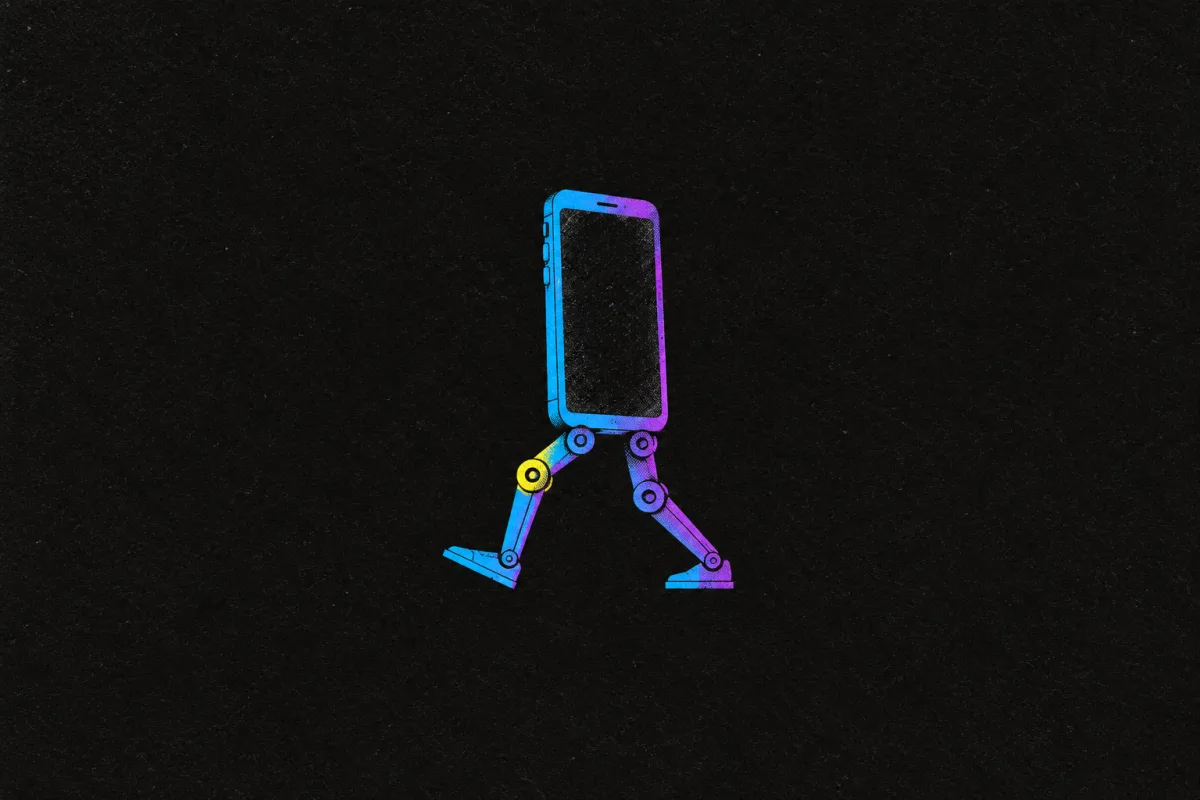
A phone slots into a plastic torso above the hips, the way it would clip into a bike mount. A small two-legged robot comes alive, stands up and starts following a person around. There are no wires between them: pull the smartphone out and it’s an ordinary phone again, ready to take a call. The robot is called PhoneBot. It stands 19 inches (48.3 cm) tall and weighs about 4 pounds (1.8 kg). Its parts cost about $400, and the cheapest phone it has walked with cost $50. Walking uses less than a tenth of that phone’s processing power.
It was built in Dennis Hong’s RoMeLa lab at the University of California, Los Angeles (UCLA); Ruochen Hou is first author of the preprint. The same lab showed off a robot of almost the same height, DARwIn-OP, at a conference in Nashville in December 2010. Hong called it his “new baby,” as IEEE Spectrum reported at the time. DARwIn-OP carried its own computer, and an assembled unit cost $12,000.
What a phone does better than a robot
Every smartphone already carries the parts that robot builders spent years buying one by one. A camera to see. A processor to think. Wi-Fi to take orders. A screen to show a face or a menu. And the one sensor a two-legged robot can’t take a single step without. That’s the inertial measurement unit, an accelerometer paired with a gyroscope. It rotates the picture when you turn your phone sideways, and it’s what tells a robot that its body is leaning and a foot needs to move.
Inside PhoneBot, the phone does nearly all the work. It reads its tilt sensor 200 times a second, decides 50 times a second where each of the 13 joints should go, and sends those decisions over Wi-Fi to a small board at the bottom. The board just relays commands to the motors.
This is easiest to see when the robot follows someone. The phone’s camera tracks the person, and as they drift to one side, PhoneBot simply swivels at the waist without moving its feet. It only starts stepping once the person is more than 55 degrees off to the side. If it ends up face down, it gets back up on its own, just as its 2010 predecessor could.
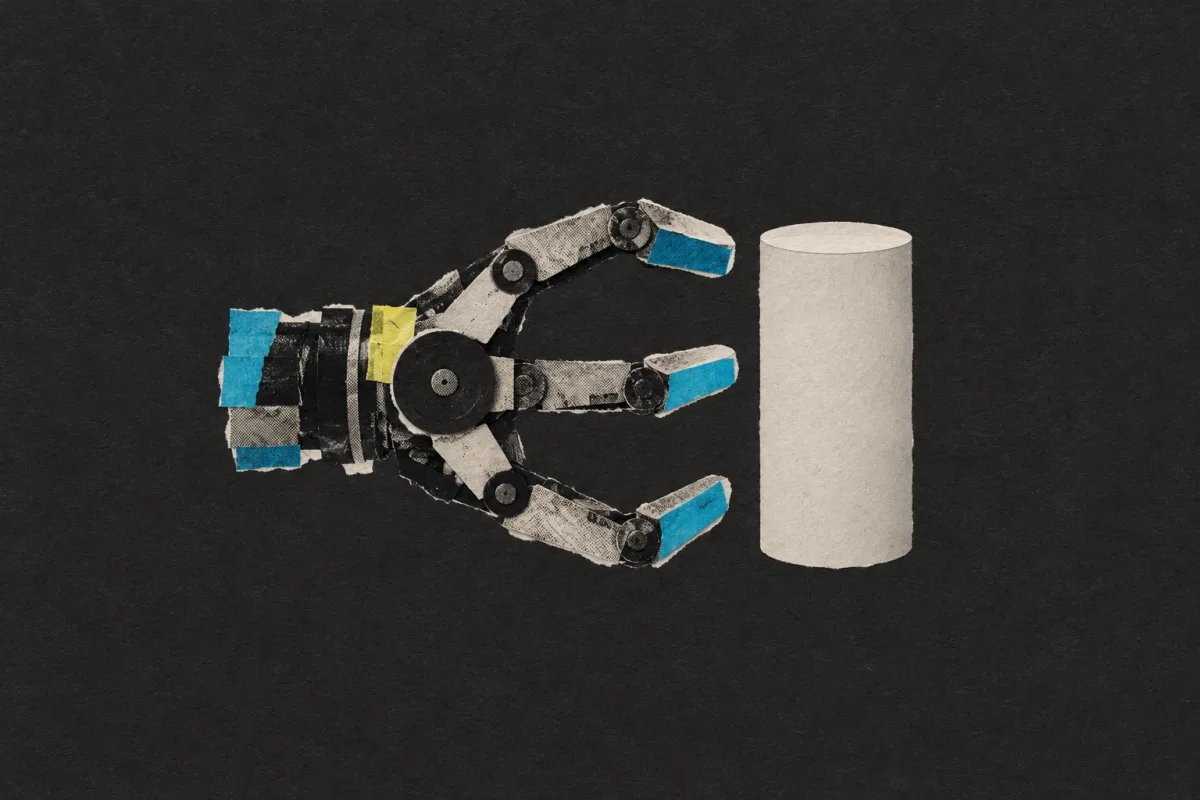
Almost the entire budget goes into the legs. Each of the 13 servo motors costs $23.90, about $310 in total. Roughly $90 more covers the plastic body and the electronics with a battery. The body is 3D-printed, and the drawings and shopping list are on the project’s website.
Walking takes a tenth of the phone
PhoneBot learned to walk in a simulator, not on the floor. The method is reinforcement learning: a virtual PhoneBot runs through hundreds of millions of simulation steps, earning rewards for moves that work, until a gait emerges. Only then does the program go into the real robot.
One trick in the paper is almost childlike. The researchers showed the program every attempt twice: as it happened and mirrored, with left and right legs swapped. Without this trick, the gait came out lopsided, with one leg doing noticeably more work than the other. With the mirror, the load evened out almost completely.
You’d think balancing on two legs would be the hardest job. For the phone, it’s the easiest: on a moto g 2024, the walking program uses about 6% of the processor. Looking around is far heavier: spotting a person on camera and mapping the room. Add up every row of the load table and a budget phone is only about 60% busy, with headroom to spare.

Technical details for anyone who wants to build one
- Motors: DYNAMIXEL XL430-W250-T, 1.4 N·m, 57 g each.
- Joints: six in each leg plus one that swivels the waist.
- Training: PPO algorithm in the MuJoCo simulator, with speeds of up to 0.5 m/s forward and sideways during training.
- Processor load: walking 6–10%, people detection 16–18%, room mapping (ARCore) a quarter to a third.
- The drawings are licensed CC BY-NC 4.0: you can build, modify and share, but not sell without permission.
A grandparent in the comparison table
To show how cheap PhoneBot is, the authors lined up five small research humanoids priced from $3,500 to $13,800. The priciest, ROBOTIS OP3, is a grandchild of that same DARwIn-OP. According to its maker’s manual, DARwIn-OP was later sold as the ROBOTIS OP, followed by the OP2 and then the OP3. Another entry, the $9,000 BRUCE, also came out of Hong’s lab in 2022. The new robot is competing with its own family tree.
// Two robots from one lab
DARwIn-OP, 2010
17.9 in (45.5 cm) tall, 6.3 lb (2.8 kg). Its own Intel Atom computer. Twenty joints, arms included. Cost $12,000 assembled, $9,600 for schools and universities. Open drawings and software.
PhoneBot, 2026
19 in (48.3 cm) tall, about 4 lb (1.8 kg). A smartphone instead of a computer. Thirteen joints, no arms. About $400 in parts plus a phone. Open drawings, but assembled robots can’t be sold without permission.
The comparison isn’t fair, and the authors say so. The OP3 has twenty joints, arms and a powerful computer, and PhoneBot can do less. But a roughly thirtyfold price gap makes the main point: a school robotics club can afford a $400 robot and can’t afford a $13,000 one.
An old phone or a new $50 one
The tech site New Atlas wrote that your old, dusty phone could serve as the robot’s brain. That’s half true. The researchers tested four phones, and only one was old: a 2017 Honor 9 bought secondhand. The other three were bought new in September 2026: a moto g 2025 for $50, plus a Galaxy A16 5G and a moto g 2024 for $50–90. These are budget prepaid phones locked to a single US carrier, which is why they sell so cheaply.
All four could walk and pick out a person on camera. The old Honor couldn’t build a room map, and the processor wasn’t to blame. Mapping needs Google services, which that model doesn’t offer in the US. The authors don’t promise PhoneBot will run on every Android phone.
Still, the drawer idea isn’t baseless. According to an estimate by the UN and the WEEE Forum, about 5.3 billion phones were expected to go out of use in 2022 alone, and most of them were likely to end up in drawers, closets or landfill. In a survey of nearly nine thousand European households, 46% gave the same reason for keeping unused electronics: “I might use it again.” A robot that needs a phone with a camera and Wi-Fi is exactly that “again.”

The laptop behind the curtain
PhoneBot’s weakest spot shows up when you talk to it. The phone records your speech, but a laptop nearby does the listening and the thinking, running speech recognition and a language model. The paper doesn’t say which one. Its reply goes back to the phone, which speaks it in a synthetic voice. Without the laptop, the robot still walks and follows a person, but it stays silent.
The authors list the other limits themselves. There are no arms, so PhoneBot can’t pick anything up. It learned to walk only on flat floors, and its cheap, weak motors rule out carrying loads or jumping. Filming and “telepresence” get a mention at the start of the paper but aren’t tested. And this is a preprint, not yet vetted by independent reviewers. Next up: lightweight arms and a language model running on the phone itself, so the laptop can go.
The computer is already in your pocket
In 2010, the computer was a small robot’s most expensive and smartest part. Sixteen years flipped that. Now the brain costs $50, less than dinner for two, and the priciest part of PhoneBot is thirteen motors that do nothing but turn to a set angle: $310 of the $400.
The preprint doesn’t ask the obvious next question: what will people build with robots like this once the legs get cheap too?