// Contents
For more than 90% of its 45.22 kilometers, Perseverance picked its own way: the rocks, pits and slopes ahead were judged by an onboard autopilot, not by people on Earth. With that tally, NASA’s rover broke the record of its predecessor Opportunity on October 11, 2026, the 2,006th Martian day of its mission. Opportunity had driven 45.16 kilometers across Mars.
The margin is 60 meters, about half a football pitch. The interesting part is elsewhere. Opportunity needed more than 14 years to build up its mileage; Perseverance did it in five and a half. And Opportunity’s early autopilot chose the path for only 5% of the distance. The three off-world distance records of the past half century add up to a story about people handing the steering wheel to a machine. Oddly, the first record holder still doesn’t know its own mileage: depending on who counts, it is 37, 39 or 42 kilometers.
Five people at the screens near Simferopol
The first record belonged to the Soviet Lunokhod 2. Its landing stage came down in Le Monnier crater on January 15, 1973, and the rover rolled onto the surface on January 16. It was driven from a deep-space communications center near Simferopol in Crimea, where a crew of five watched a television feed and sent commands almost in real time.
Almost, because a radio signal took about three seconds to reach the Moon and come back, so the driver saw the result of each turn late. Between two commands the machine could cover anywhere from 2.3 to 8.3 meters, depending on the mode. That was on Lunokhod 1, writes Mikhail Malenkov, who designed its chassis, citing driver Vyacheslav Dovgan. The second rover was driven far more boldly than the first: Lunokhod 1 covered about 10.5 kilometers in 11 months, Lunokhod 2 nearly four times as much in four.
Once, the machine refused to give up the wheel. On February 11, 1973, as the rover set off again after the long lunar night, the crew saw a crater dead ahead on the screen and sent a stop command. Lunokhod 2 kept rolling. It halted only after the third such command. The culprit turned out to be a signal scrambler in the radio system, and controllers switched to the backup.
Lunokhod 2 worked for about four months. On May 9 it drove into a crater, dust settled on its solar panel and radiator, and the machine overheated. In early June the Soviet Union announced that the program was over.
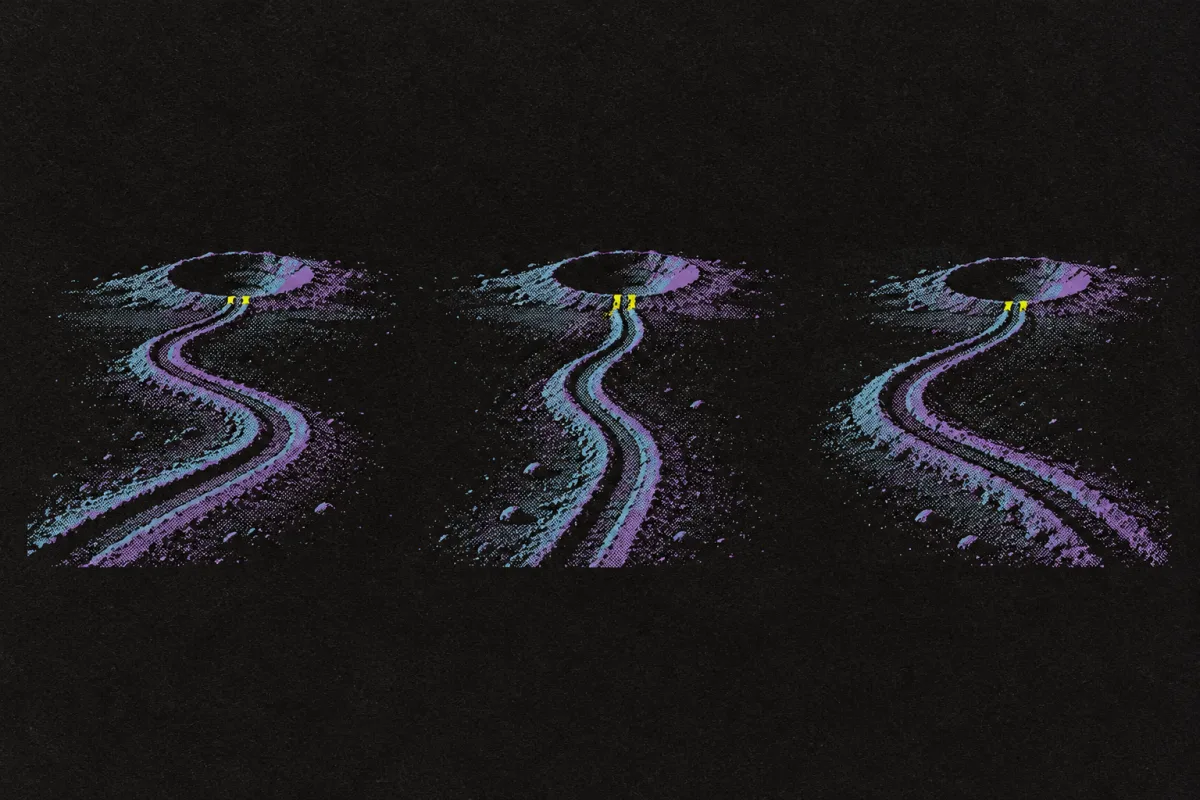
The strangest part of the record came later. Counting wheel turns gave 37 kilometers. Forty years on, cartographer Irina Karachevtseva and her colleagues at MIIGAiK in Moscow retraced the route on images from NASA’s Lunar Reconnaissance Orbiter and got about 42 kilometers . After talks between Russian and American researchers, the figure settled at 39. One machine, one route, three different mileages.
A marathon planned as a stroll
Opportunity landed on Mars in January 2004 and was meant to work for 90 days. “It’s remarkable, considering Opportunity was intended to drive about one kilometer and was never designed for distance,” project manager John Callas said .
You can’t talk to Mars in real time. A signal takes between 3 and 22 minutes to get there one way, depending on where the planets are. By the time a driver saw a rock, the rover could already be tipping over it. So Mars rovers are driven differently. People study the images, plot a route and send a package of commands once per Martian day. Opportunity could steer around obstacles on its own, with the same simple autopilot as its twin Spirit, but people made most of the decisions.
By 2013 the rover was closing in on Lunokhod 2, and the Soviet figure suddenly looked shaky. Principal investigator Steve Squyres acknowledged that the old 37 kilometers had been estimated without good orbital images and was in no hurry to claim victory. “We have enormous respect for what the Soviets managed to accomplish in 1973 with the technology of that day,” he said. Opportunity took the record on July 27, 2014, at 40.25 kilometers. The team named a small crater near its route “Lunokhod 2.”
In June 2018 a planet-wide dust storm rose on Mars. Opportunity’s solar panels almost stopped producing power, and on June 10 the rover called home for the last time. The mission was declared over in February 2019. The odometer stopped at 45.16 kilometers, and that record stood for more than eight years.
A machine that thinks on the move
Perseverance landed in Jezero crater on February 18, 2021. Its route is set on Earth: people mark points on images where it should go. Where to put each wheel in between, the rover decides itself. Its AutoNav system photographs the terrain ahead and stitches the pictures into a 3D map that flags dangerous rocks and slopes.
The key difference from its predecessors sounds mundane. Curiosity drives in a cycle: take pictures, think, drive, take pictures again. That’s a driver in fog who stops before every bend. Perseverance reads the road without taking its foot off the gas. “We have a capability called ’thinking while driving,’” JPL engineer and rover driver Vandi Verma explained in 2021. “The rover is thinking about the autonomous drive while its wheels are turning.” The thinking runs on a dedicated onboard computer that also helped pick a landing spot.
Perseverance’s top speed is about 120 meters per hour. That’s some forty times slower than a person walking. But Curiosity manages only about 20 meters per hour, and after 14 years on Mars it had logged 38.07 kilometers as of October 11, 2026.
// Three record holders
Lunokhod 2, 1973
Driven directly by a crew of five. A round trip signal took about three seconds. Covered about 39 km in four months.
Opportunity, 2004–2018
People plotted the route from images and sent commands once a day. The autopilot chose the path for 5% of the distance. Logged 45.16 km over 14-plus years.
Perseverance, since 2021
People set waypoints, and the rover judges the terrain itself for 90% of the distance. By October 11, 2026, after five and a half years, it had driven 45.22 km.
Sometimes the autopilot sees more than people do. In summer 2023 Perseverance crossed a boulder field near a hill called Snowdrift Peak. Using orbital images, planners mapped a 520-meter route; the rover ended up driving 759 , detouring around rocks that the orbital images had not shown.
Earlier, in spring 2022, on the flat crater floor, it drove 699.9 meters over three straight Martian days without anyone on Earth correcting its path. On June 19, 2025, the rover set a single-day record of 411.7 meters.
A hundred kilometers on wheels built for twenty
Perseverance was designed for about 20 kilometers of driving. Its drivers now talk about a different limit. JPL’s Mark Maimone told Space.com the rover is “looking really good to go for up to 100 kilometers total.” Its wheels are larger and tougher than Curiosity’s, whose wheels picked up punctures on sharp rocks, and the designers took note. Tests showed that the wheel steering actuators should last at least another 60 kilometers.
For Earth, the story lands in an unexpected place. Here people argue over whether a car can be trusted with an intersection. Mars left no choice: with a twenty-minute delay a joystick is useless, so the autopilot had to learn to cross rocks without hints. In 1973, people told Lunokhod how many degrees to turn, and when it ignored a stop command, that was a malfunction. Perseverance is told where to arrive, and the decisions along the way are built into its design. The next rover may be told only where to look. Then the record books will face a question that sounds like a joke today: who was driving?