// Contents
In a video MIT released on November 18, 2026, a four-winged machine settles onto a sunflower. An operator guides it with a joystick, and an external computer processes readings from the robot’s sensors. The lab cameras can’t track it there.
In a separate test, the robot hovered for 10 seconds while its onboard computer calculated how to adjust its wingbeats. The computer and sensors weighed a quarter gram. Power came through a wire. Researchers at MIT and Cornell University described both experiments in Science Robotics.
During the sunflower flight, the robot relied on its sensors to detect drift and changes in the surface below. The joystick set its course. The external computer worked out how to keep it steady between commands.
Taking the tracking system along
A drone hovering over a table has to make constant corrections. If it tilts, its controls need to straighten it out before the tilt carries it sideways. MIT’s smaller, twitchier machine also needs to know how far it has drifted.
MIT’s previous flapping-wing robot could already change course sharply. Cameras around the lab tracked its position and fed coordinates to a computer. That’s a handy setup for tuning the wings or measuring a maneuver. It works as long as the cameras can see the robot.
The new robot splits the job across three sensors. An inertial sensor measures acceleration and rotation to help the computer work out how much the robot has tilted. Another sensor tracks the pattern on the floor as it shifts in view, much like an optical mouse tracking movement across a desk. A third sensor sends out a pulse of light and times the return to measure the distance to the surface below.
The controller adds up small estimates of sideways motion to work out where the robot is. If each reading is slightly off, the errors can add up until the robot hovers to one side of its target. The lab cameras gave researchers an independent record of where it actually flew.
The higher the robot flies, the smaller the shift it sees in the floor pattern for the same sideways movement. That makes the height reading important for estimating speed. Turning in place can also make the floor appear to slide by, so the computer uses the rotation readings to correct for it. When the team flight-tested the sensors together with an offboard computer, doubling the target height increased sideways error while the height error barely changed.
Making room for a quarter gram
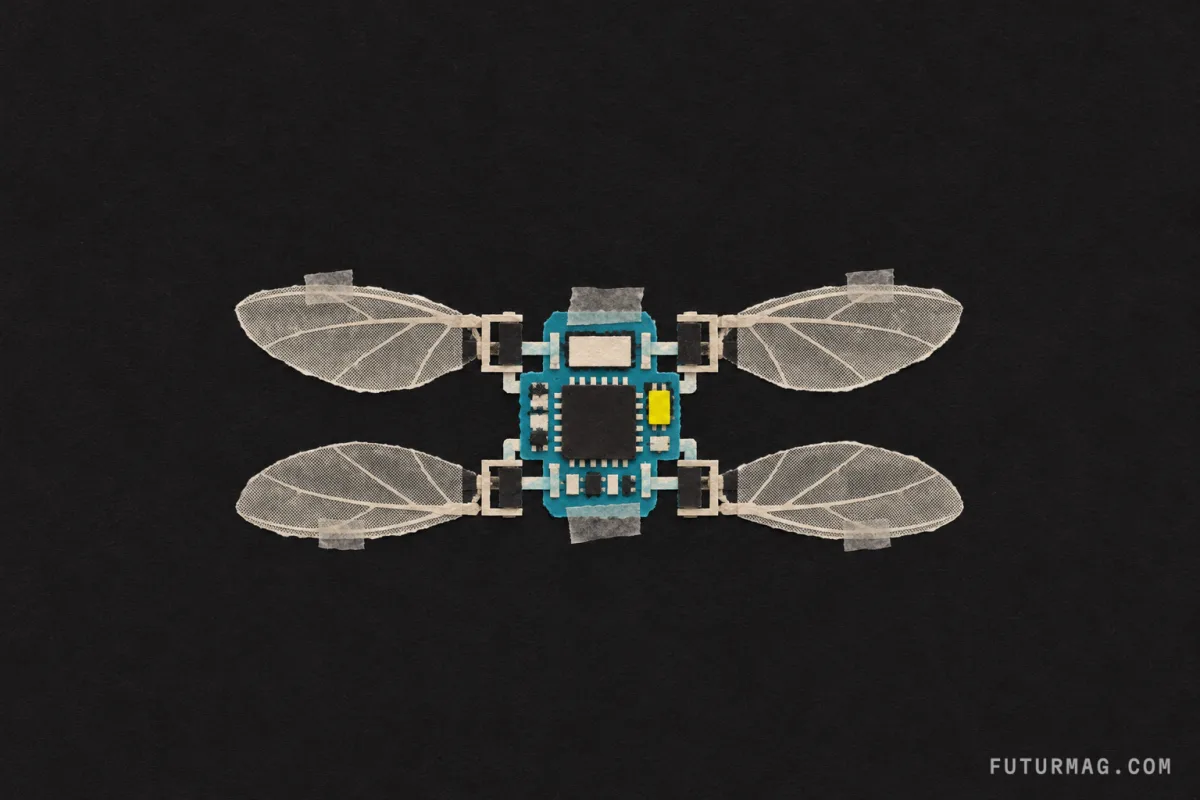
Flexible actuators called artificial muscles drive the wings. The team lengthened the muscles and changed how they move the wings. Each of the four units delivered 46% more net lift than its predecessor, enough for the robot to carry the full 244-milligram electronics package.
With the sensors and computer in place, the robot weighed 1.29 grams. The wings beat 330 times a second, shaking the body and interfering with the inertial sensor’s measurements. The team used a fiberglass substrate under that sensor to reduce the effect.
Three boards can fit in a stack at the center of the body. The inertial sensor sits up top, near the center of the frame. Both the optical motion sensor and range sensor go underneath, where each has a clear view of the surface below the wings. The microcontroller board slots in between. With an offboard computer handling the flight, the researchers could fly with just the two sensor boards.
At each update the computer takes in the sensor readings, estimates where the robot is and tells the actuators what to do. More precision takes more time. By the time that estimate is ready, the robot may already have tilted enough to start sliding sideways.
The team told MIT News it found that frequent estimates kept the robot steadier, even when those estimates were less precise. By working out tilt, height and sideways motion separately, the team simplified the calculations. The onboard controller updated its commands 480 times a second.
A sunflower and two points
Landing on a flower is one skill a robot would need to help pollinate plants. In the first sunflower flight, the robot cleared a curved obstacle on its own after takeoff, using the range sensor to hold its height above the surface. The pilot used the joystick to set waypoints, then raised the target height as the robot neared the flower. Then it touched down. In the second flight, the range sensor picked up the change in distance to the surface near the flower, and the control system adjusted the height automatically.
The sunflower itself made that first approach difficult. Air from the wings flows differently near the flower, and the flower head comes into view where the motion sensor had been tracking the floor. Flying higher gave the robot more clearance and made it less likely to misjudge its sideways speed.
The team ran two separate trials with the computer aboard. In the first, the robot hovered for 10 seconds with a couple of centimeters of sideways tracking error. In the second, it spent 7 seconds maneuvering between two preset points 30 centimeters apart. Lab cameras recorded both flights so the team could measure the errors afterward. An external supply generated the voltage for the wing actuators and delivered it by wire.
The robot can steady itself and hold its height using its own sensors. Picking a route around the plants and onto the sunflower was the pilot’s job. The team is considering a compact camera to help the robot recognize objects ahead and extra range sensors to spot obstacles to either side.
How much power the wings need
At maximum load, the sensors and onboard computer drew 120 milliwatts, about 6% of the 2.04 watts the wing actuators drew in a hover. Even if the team cut the power those electronics use, the wings would still account for most of the power draw.
The researchers estimate that a battery and its power electronics would add 1 to 1.5 grams, roughly the weight of the entire robot they’ve built. Carrying that load would require making the robot 15–35% larger. To reach the sunflower on its own, the robot would also have to take over the pilot’s job of deciding where to go next.