// Contents
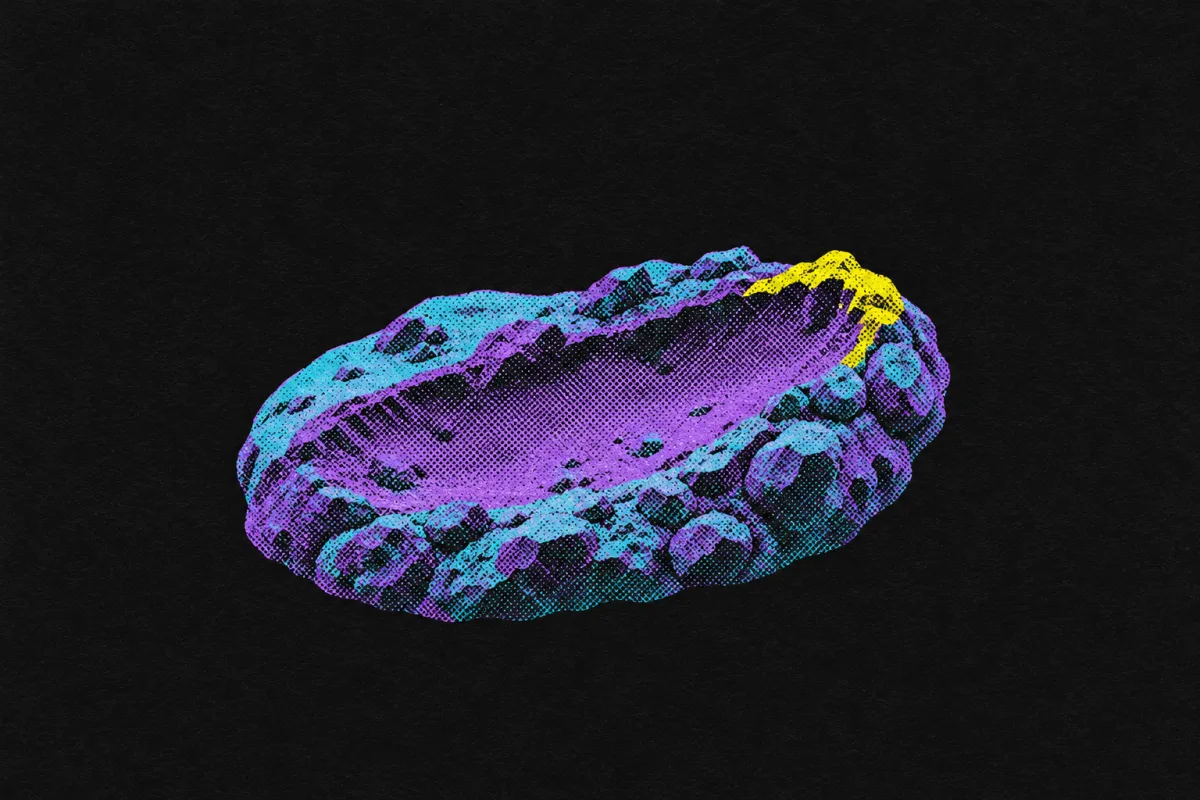
A 151-meter asteroid now has a crater the size of a sports stadium. The depression spans the face of Dimorphos where NASA deliberately crashed its DART spacecraft four years ago. Ian Carnelli manages the Hera mission for the European Space Agency (ESA). He showed the first detailed photographs in the dinosaur hall of Berlin’s natural history museum. At the November 25, 2026, unveiling, he recalled how a single asteroid impact had changed the course of life on Earth.
After the impact, Dimorphos took about 33 minutes less to complete one lap around its larger neighbor, Didymos. Astronomers measured it from Earth. Hera’s photographs show where the surface buckled and how much of the old terrain survived. Those images, along with measurements of the asteroid’s mass and interior, will help explain why the orbit changed as much as it did.
An asteroid makes a good clock
Dimorphos was a convenient target for a deflection test. It circles Didymos much as our Moon circles Earth. The pair posed no threat to Earth and aligned in a way that let astronomers time the smaller object’s orbits even before the test.
From Earth, the two asteroids sometimes pass in front of each other or cast shadows on each other. Their combined light dips. By timing those dips, astronomers can work out how long Dimorphos takes to go around its neighbor. Before the collision, a lap lasted about 11 hours and 55 minutes. A few weeks after the impact, it took about 11 hours and 22 minutes. On average, the two asteroids were about 37 meters closer together, NASA’s model showed.
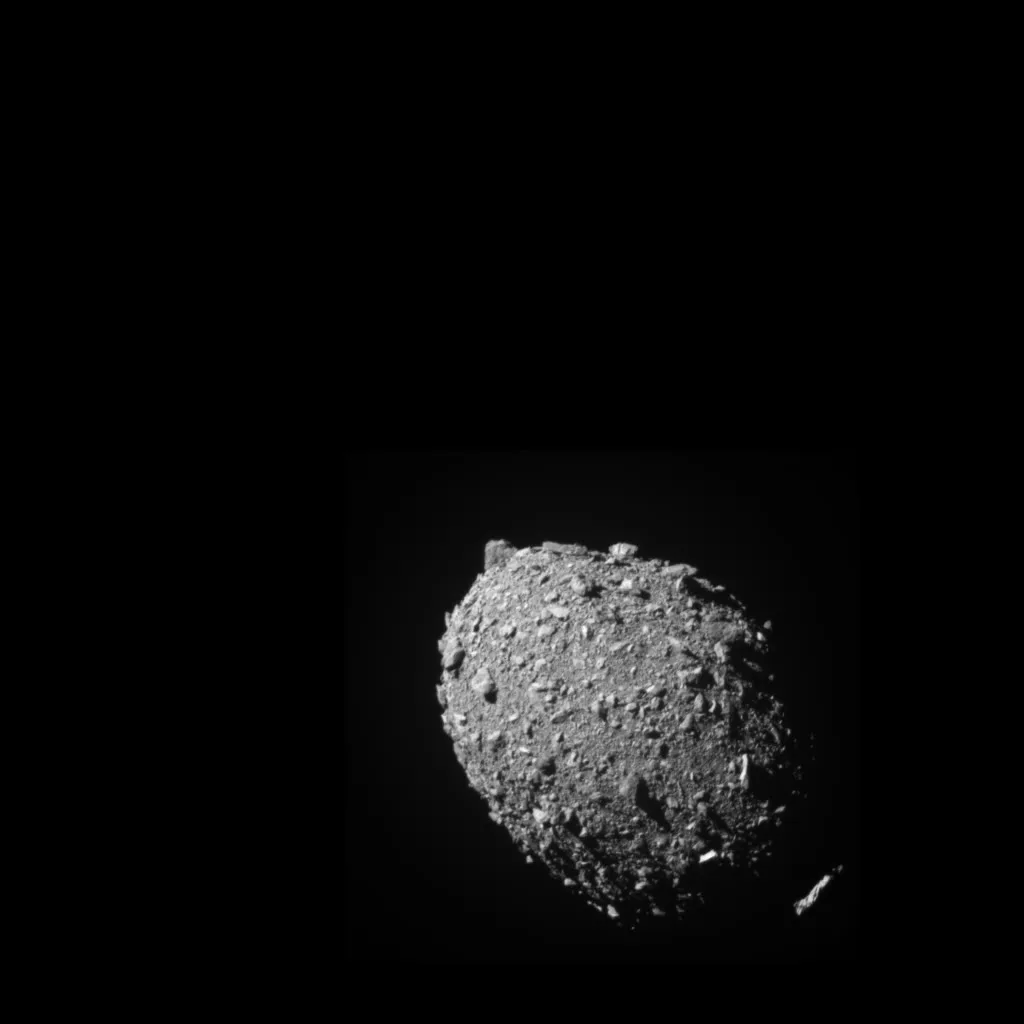
DART hit Dimorphos on September 26, 2022, cutting the transmission in the middle of a frame. Only part of that last image made it back to Earth. In the preceding frames, rocks on the surface loom larger as the spacecraft closes in.
A crater across one face
Hera’s principal investigator, Patrick Michel, remembers the different possibilities scientists had considered. The impact could leave a crater, reshape Dimorphos, or leave it looking much as it had before. Hera found traces of all three. A crater spans the flattened face where DART struck. Elsewhere, boulder fields look much as they did in the 2022 images.
Hera also caught Dimorphos tumbling along its orbit. Hundreds of boulders, each several meters across, orbit the pair. They turned up in a long exposure, which let the camera collect more light. Hera’s team will have to account for those rocks when planning closer passes.
Some boulders had turned up in earlier observations. In December 2022, the Hubble Space Telescope picked out 37 rocks drifting away from Dimorphos at roughly a kilometer an hour, the walking pace of a giant tortoise. Researchers used those rocks to estimate the size of the patch they might have come from.
Why Hera needs to weigh an asteroid
Dimorphos finishes a lap sooner on its tighter orbit. The shorter lap gives scientists a way to work out how its motion changed. At the moment of impact, Dimorphos slowed by about 2.7 millimeters per second along its path, a study in Nature estimates.
The team’s next step is to weigh Dimorphos. A heavier asteroid takes a bigger push to change its speed by the same amount. To estimate how much momentum the collision transferred, Hera needs to pin down Dimorphos’s mass.
DART delivered the first push. Rock flying off the surface pushed back on the asteroid too. The direction and strength of that recoil depend on how the debris flies. That, in turn, depends on how easily the rock breaks up and how much empty space it contains. Engineers need those details to predict how a different asteroid might respond to the same kind of hit, the DART team explains.
ESA plans to bring Hera within about 13 kilometers of the pair in December 2026 to take sharper pictures. In January 2027, it plans to release two shoebox-sized spacecraft. One of them, Juventas, will use radar to probe the asteroid’s interior. The readings could help explain how the material beneath the surface shaped the crater.
Dimorphos got its name two years before the crash. Planetary scientist Kleomenis Tsiganis proposed it because DART would see one version of the asteroid and Hera another. The name means “having two forms” in Greek. Now there are pictures to put side by side.