// Contents
Two NASA probes spent nearly a year on a loop that brought them back to Earth. Blue and Gold left the launchpad in November 2025. They headed for Mars in November 2026, after swinging past Earth and firing their engines. Launch day and departure day belonged to different years.
A year in the waiting loop
Mars moves along its orbit while a spacecraft is in flight. The spacecraft has to aim for where Mars will be months later. The planets line up for a direct trip roughly every two years. If a rocket misses that window, it usually has a long wait on Earth.
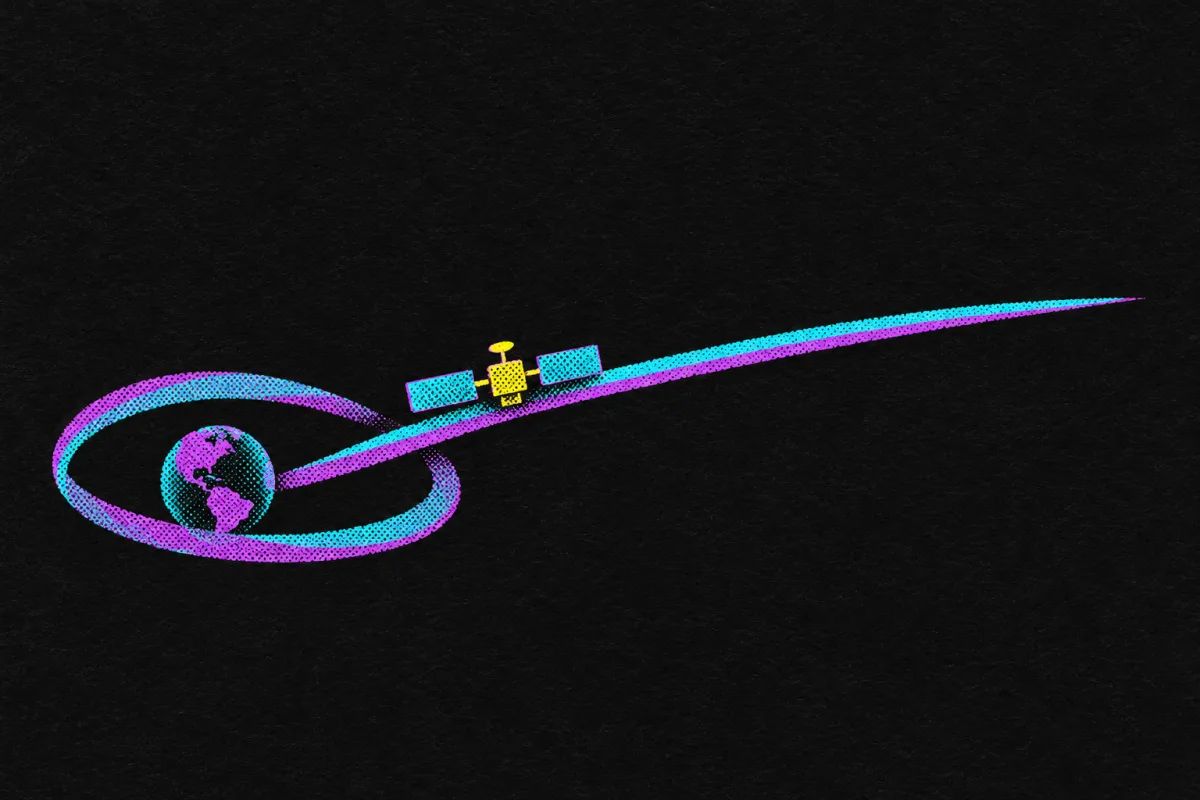
The ESCAPADE team moved the wait into space. A New Glenn rocket launched both probes on November 13, 2025, with Mars on the other side of the Sun. The probes took a loop shaped like a kidney bean around a point called L2, about 1.5 million kilometers past Earth in the direction away from the Sun. Engineers timed the loop to bring the probes back past Earth when the planets lined up for the trip to Mars.
Blue and Gold put the wait to use. The solar wind, a stream of particles from the Sun, stretches Earth’s magnetic field out behind the planet. The probes crossed that region several times and took measurements with the same instruments they’ll use at Mars.
Engines on at Earth
Each spacecraft needed to fire its engine continuously as it passed Earth. Short bursts wouldn’t do. Each probe handled the maneuver on its own. In a NASA photo dated November 7, 2026, mission lead Robert Lillis sits with colleagues in Berkeley’s control room. Blue has fired its engine, and Lillis is waiting for word from the probe. Blue made it through, and Gold followed on November 9. Both were headed for Mars. Blue passed about 1,600 kilometers above Earth’s surface; Gold flew lower, at about 1,050 kilometers.
Earth’s gravity bent both flight paths, helping aim the probes toward Mars. Each engine fired near its probe’s closest approach, when the spacecraft was moving especially fast relative to Earth. From Earth’s point of view, an engine burn adds more kinetic energy for the same boost in speed when the spacecraft is already moving fast. The mission designers put the Oberth effect to work to get more out of each burn.
Jeff Parker, the lead mission designer, sees the route as a way to open up more launch dates. The planets still need to line up for the trip, but the spacecraft can wait in space instead of on a launchpad. That flexibility came at a cost. The probes had to spend nearly a year in space before they could head for Mars. In the meantime, their operators adjusted their paths to set up two carefully timed flybys.
Why Mars needs both probes
Blue and Gold should reach Mars in September 2027. The science takes two. Say a probe passes through a stream of charged particles and sees a spike. A single reading can’t tell the team whether the stream grew stronger or the spacecraft moved into a denser patch. Readings from a second probe elsewhere help tell the difference.
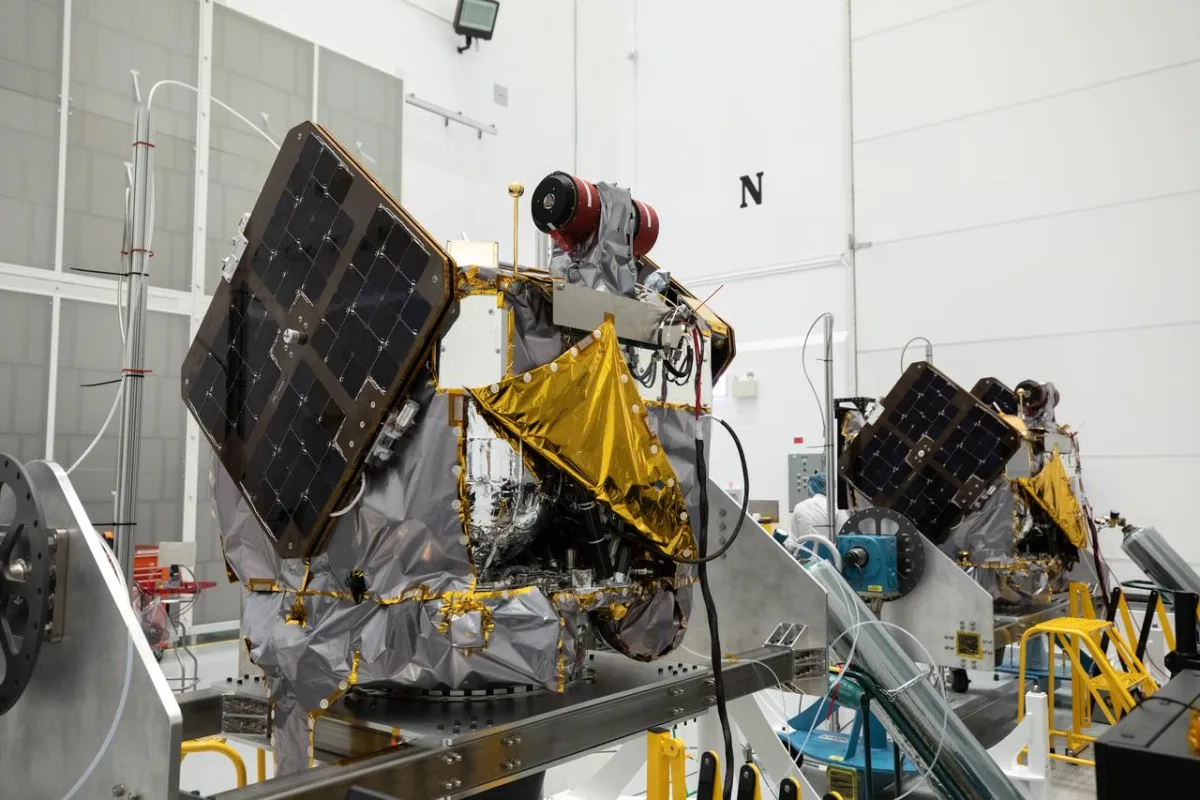
The team plans to begin science operations in June 2028. In one part of the mission, the probes will move into different orbits. One will measure the incoming solar wind while the other observes how Mars’s upper atmosphere responds. Comparing those readings should help the team see how the wind strips charged particles from that layer. Watching that process today could help explain how Mars, which once had thicker air, lost so much of it.
Near Earth, each engine fired for about nine minutes to send its probe toward Mars. After ten months in transit, each engine will need to fire for about eleven minutes to slow the probe and put it into orbit around Mars.