// Contents
16 megawatts. According to Pablo López, who runs Buquebus operations in Colonia del Sacramento, Uruguay, that is roughly what the whole town draws. It is also what two chargers in the local port deliver, and they were built for a single ferry. “That’s the power the entire city of Colonia needs, which is why a separate line had to be built,” López explained in the autumn of 2025, when installation began.
The ferry is called China Zorrilla, after the Uruguayan actress who was a close friend of Buquebus founder Juan Carlos López Mena, and it is the largest battery-powered ship ever built. On October 22, 2026, it began commercial service across the River Plate between Buenos Aires and Colonia, carrying more than 700 passengers on its first trip. It was built by the Australian yard Incat. Building a ship that runs on batteries turned out to be doable. The hard part was everything around it. The ferry crossed the ocean as cargo on another vessel’s deck, which is no surprise: its batteries last for only about an hour and a half of running. And on shore it needed a plug the size of a town.
Two hundred and fifty tonnes in four rooms
The ferry is 130 metres long and 32 metres wide. It takes 2,100 passengers and 225 cars, and below deck, in four separate battery rooms, sit 5,016 battery modules weighing about 250 tonnes in total. They store more than 40 megawatt-hours. Incat says that is four times larger than any previous battery installed on a ship.
Forty megawatt-hours is easier to picture in cars. If a large electric car has a 75 kWh pack, the ferry holds the energy of roughly 530 of them. It is a rough estimate, but the scale is clear: 225 cars ride in the hold, while the batteries carry the charge of a fleet more than twice that size.
By Incat’s estimate, that is enough for about 90 minutes of operation. The roughly 55 km crossing of the River Plate takes 75 minutes, so the ferry has to charge after every trip, in both ports. Eight electric motors turn eight waterjets, and there is no diesel engine for propulsion.
What struck the first passengers most was the quiet. According to Perfil, the 700-plus people on the first crossing travelled without engine noise or uncomfortable mechanical vibration. Incat managing director Craig Clifford, who was on board, expected exactly that: what would surprise people most, he said, is that the familiar engine hum is simply gone.
The fastest ferry and its slow successor
Buquebus has an obvious point of comparison. Before China Zorrilla, its largest vessel was Francisco, another Incat build, famous for speed. Guinness World Records lists it as the fastest ferry in the world, at 58.1 knots, or about 107 km/h. China Zorrilla carries twice as many people as Francisco.
The new ferry was meant to be similar. The 2019 design had four engines burning liquefied natural gas and was meant to reach about 37.5 knots. Then Buquebus asked the yard to study a battery version, and in 2023 the design was switched mid-build. Incat chairman Robert Clifford called it an intentional leap rather than an incremental step: fuel prices swung, batteries got cheaper, and charging got much faster.
López Mena himself put it more simply. “When the chance to build an electric ship came up, we didn’t want to wait for the next one. We wanted it to be this one,” he said in September 2026.
The leap was paid for in speed: the electric ferry’s service speed is capped at 25 knots, about 46 km/h, and the gap is easy to see next to its two gas-powered siblings.
// Three ferries, one company
Francisco
two gas turbines, 58.1 knots (about 107 km/h), a Guinness record
The 2019 design
four engines on liquefied natural gas, about 37.5 knots
China Zorrilla
40 MWh of batteries, up to 25 knots, 2,100 passengers
The ship could technically go faster, Pablo López said, but energy use would become too high. In water, drag climbs faster than speed, so every extra knot eats a disproportionate share of the charge.
Across the ocean on someone else’s deck
The largest electric ship in the world cannot cross an ocean under its own power. Its batteries are good for one short crossing, and the trip from Tasmania to Uruguay, according to Infobae, covered more than 15,000 km by sea.
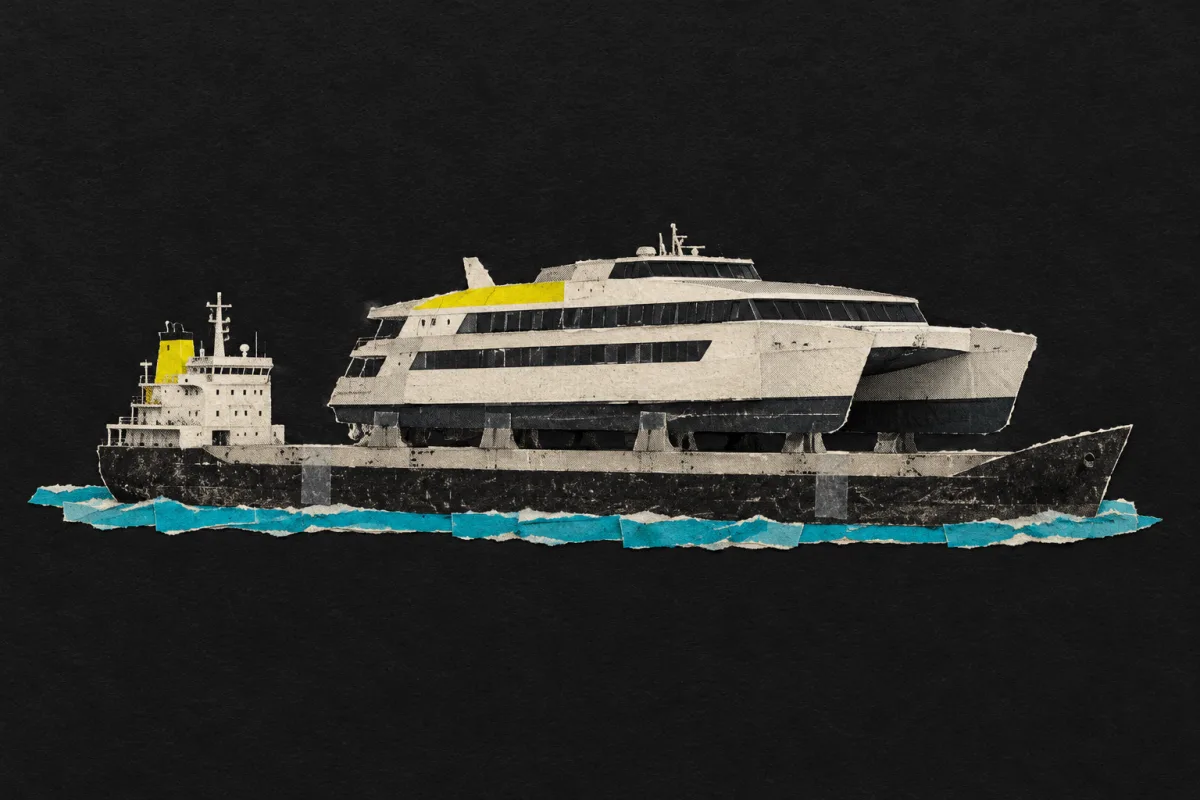
So the ferry travelled on another ship. The 217-metre semi-submersible Black Marlin lowered its cargo deck into the River Derwent near Hobart, the ferry was positioned above it, and the ballast was pumped out to lift it clear of the water. The voyage took about 40 days. It left months later than planned, because Black Marlin’s arrival had been delayed by disruption in the Strait of Hormuz. On September 12, 2026, the ferry was floated off at the Uruguayan port of Nueva Palmira, and two tugs escorted it on to Colonia. It entered service more than a year after the date the yard had given in 2023.
A town on the plug
In this story the docks matter as much as the ship. For a single vessel, Colonia got chargers, a new cable and a substation for about $20 million, and in the end the operator pays, partly through future electricity bills.
A full charge takes about 40 minutes, by Incat’s estimate. Pablo López said charging fits into the passenger turnaround. The ferry charges while cars roll off and tickets are checked, and the timetable barely changes.
For Uruguay, a customer like this is even useful. UTE president Andrea Cabrera reminded the audience at the ferry’s presentation that 98% of the country’s electricity comes from renewable sources. Back in 2024, López Mena explained that Uruguay’s generation sometimes reaches 120% of demand, with nowhere to store the surplus. A ferry that charges after every crossing can turn some of that surplus into trips.
There are days when it’s 120%, but you can’t store it.
What this ferry proves, and what it doesn’t
So far it proves one thing. A large passenger ferry can run on batteries to a timetable, as long as the route is short and both shores have powerful chargers. Incat says it is already building three more electric ferries, each 129 metres long, for the Danish operator Molslinjen.
Long routes are still out of reach, and so is the open ocean. Citing the operators, New Atlas reports fuel savings of $4.5 million a year and a payback period of five to eight years. Those are projections, not results. Even Buquebus won’t name an exact range. “In practice we’ll see the real autonomy. At sea it varies more than on land,” Pablo López warned.
For passengers, the fare matters more than any record. That fare now includes a whole town’s worth of power drawn at the dock, and the price of that power is set by the utility. The operator’s main supplier used to be the fuel company. Now it is the grid. López Mena understood that back in 2024, while the ship was still being built. “I need to ask for a discount: with lower costs we can bring fares down,” he said at the time.