// Contents
A few months before August 2019, a Belgian engineer named Bert Celis had a young rider called Bjorg Lambrecht in his wind tunnel . For his lab it was routine work: find the position and the kit that would save a rider a few watts. Then, on 5 August, on the third stage of the Tour de Pologne, the 22-year-old Lambrecht left the tarmac and hit a concrete culvert. He could not be saved.
“I wondered why cyclists still have so little protection beyond a helmet,” Celis recalls . In October 2026 his answer made TIME’s list of the best inventions of the year . It is an airbag weighing about half a kilo that hides in the straps of cycling bib shorts and opens in 100 milliseconds. The oddest part of the story is something else. A man who spent his career shaving grams and watts off riders now wants to hang extra weight on them. And he insists the stopwatch cannot see it. To decide when to fire, the airbag was trained on an archive of other people’s crashes kept by a Belgian news agency.
The watt accountant
Celis is an engineer by training and an aerodynamicist by trade. He co-founded Flanders Bike Valley, a Flemish cycling lab built around a wind tunnel, and worked with many professional teams.
The work resembles bookkeeping. A rider sits on a bike in a stream of air, sensors measure the drag, and engineers move an elbow by a centimetre or swap the fabric on the shoulders. Five watts counts as a serious haul. For crumbs like that, teams order special socks, reshape their helmets and spend heavily on wheels.
After Lambrecht’s death, Celis turned to Sam Ratajczak, who ran research and development at the Belgian kit maker Bioracer and had built its wind tunnel. Bioracer makes racing clothing, including for professional teams. In 2020–2021, Ratajczak and an industrial design intern, Stijn Vanvolsem, worked up a concept : an airbag tucked into the straps of ordinary race bibs that would cover the neck, chest, back and hips in a crash.
The concept worked. The customers did not show up. As late as 2024, Ratajczak, by then running his own design studio, called the idea a potential turning point for rider safety and admitted that teams had shown limited interest.
A helmet forced through by a death
The peloton’s coolness is easy to explain. For decades professional cycling fought off any protection that cost comfort or speed.
In 1991 the Union Cycliste Internationale (UCI) tried to make helmets compulsory. The riders went on strike, and the rule was shelved. It came back only in 2003, after Kazakh rider Andrei Kivilev crashed without a helmet at Paris–Nice and died the next day. The UCI then declared helmets mandatory , yet even that was a compromise: the first version of the rule let riders take their helmets off on final climbs longer than five kilometres. That loophole was closed later.
Protective clothing went the same way. Bioracer said it could make race kit that softens the most common crash injuries. Riders, as road.cc reported , preferred the comfort and speed they were used to.
The lesson is one any salesman would grasp: in the peloton, safety only sells when it costs nothing on the stopwatch. That is exactly how Celis tried to sell his airbag.
Half a kilo that once promised speed
In March 2024, while the system was still a prototype, Celis told Belgian broadcaster Sporza that the airbag adds 500 to 600 grams, roughly one extra full bottle. Pros had so far turned it down, worried about comfort and weight, so Celis played the aerodynamicist’s card. A rider wearing the system, he said, becomes more “teardrop-shaped”, and on a flat course at 50 km/h the difference came to 5 to 15 watts. “The weight gain is then irrelevant,” he said.
To the peloton that sounded tempting: protection thrown in with speed. Today the company speaks more carefully. In the material around the TIME list, the developers promise something else: the airbag has no effect on aerodynamics and is nearly invisible under a jersey. The watt gain is no longer mentioned, and neither claim has been independently measured. There is a second caveat: on a mountain pass, half a kilo weighs half a kilo however smoothly air flows around it.
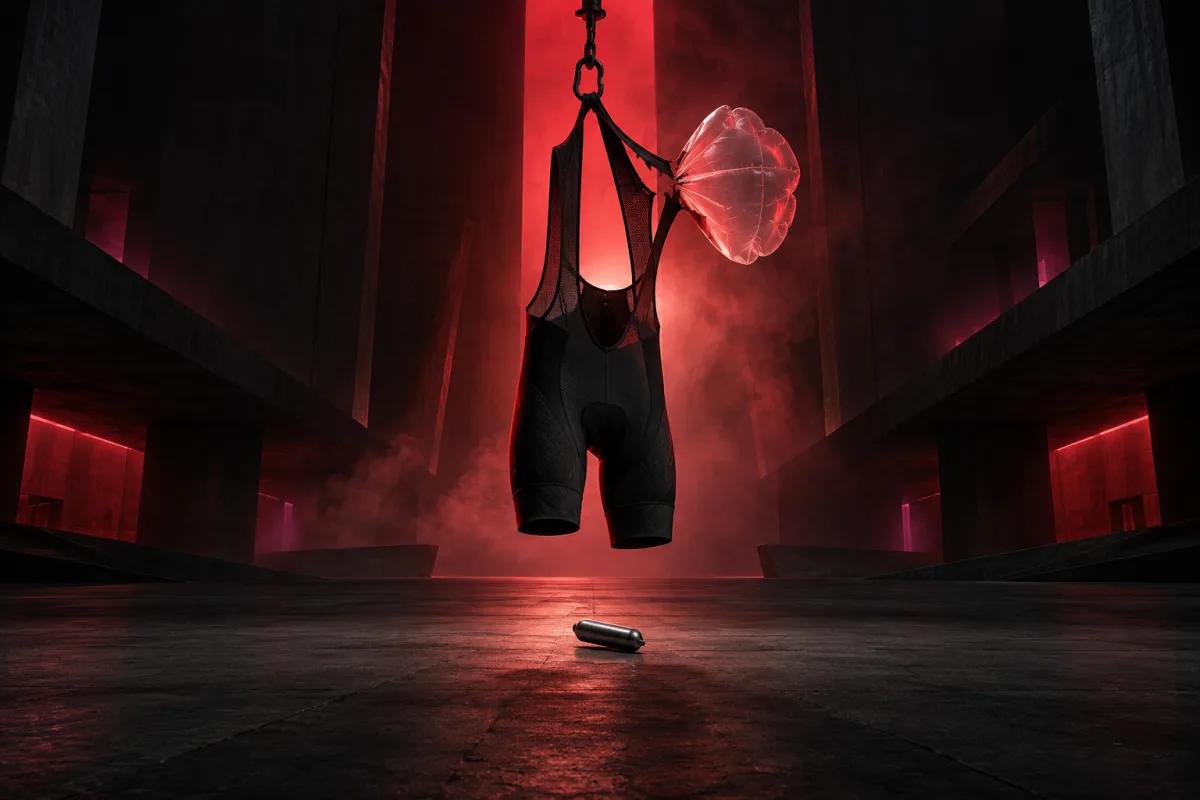
The device itself looks modest. A small pouch on the back holds the electronics and a CO₂ canister, and thin tubes of thermoplastic polyurethane run through the bib straps.
// How Aerobag works
The system does not cover the head or the shoulders, and that is deliberate. Ratajczak has explained that after a crash a rider must be able to get back on the bike and finish the race. So about ten seconds after firing the airbag starts to deflate on its own and folds back into the straps. To reuse it, you replace the canister and its igniter, about €35 . A car airbag, by contrast, gets replaced as a whole unit.
What other people’s crashes teach
The hardest part of an airbag is not the fabric or the gas. It is deciding when to fire.
A rider throws the bike at the finish line, a sprinter rocks the machine side to side, a commuter hops a kerb. None of those is a crash, yet to a sensor they are all violent. A false trigger in the middle of a sprint is dangerous in itself, and an airbag that fails to fire is worse than none, because it breeds false confidence. Sporza describes the threshold logic this way: a rider who merely slides along the tarmac will not set it off, but if he is then thrown over a crash barrier, it fires.
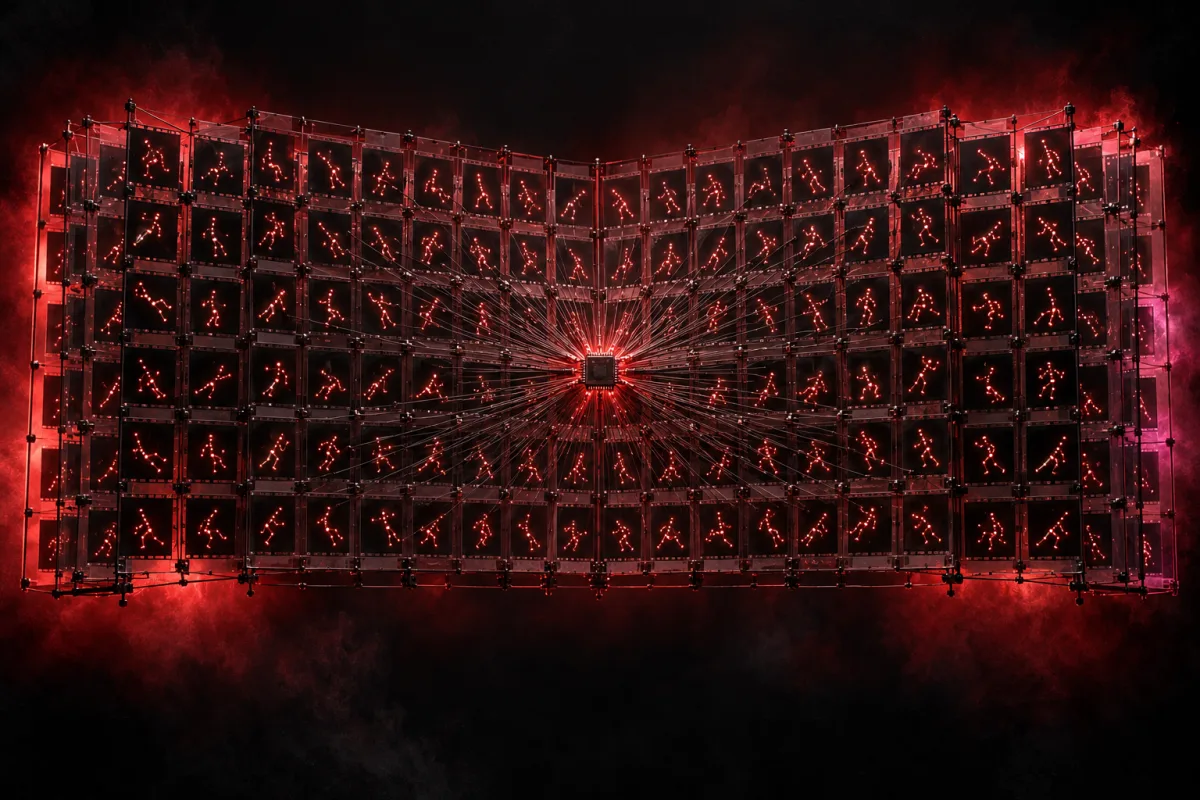
Aerobag’s algorithm was built on other people’s accidents. The Belgian news agency Belga keeps a large archive of race crash footage, and the developers ran that footage through an AI model. It reconstructed body movement from visible joints such as shoulders, hips and elbows, and those trajectories were used to tune the trigger threshold. Put simply, the system learned from crashes nobody would ever stage for an experiment.
The Swedish company Hövding knows the price of getting this wrong. Its airbag collar for city cyclists inflated around the head and was sold as a replacement for a helmet. In November 2023 the Swedish Consumer Agency halted sales of the Hövding 3 over a defect that could stop the collar from deploying in a crash. On 21 December 2023 the company filed for bankruptcy . A court had suspended the ban by then, but the board decided that after a month without sales the company could not be saved. An airbag is judged by the one time it does not open.
Aerobag is heading into the same market. For city riders it designed Aerobelt, a belt that carries the same module so it can be worn over everyday clothes. Fundracer, a fund that invests in micromobility, took a minority stake in the company . The system is not on sale yet. Aerobag co-founder Quinton Van Loggerenberg puts its price at €700–850 , more than a good helmet and less than many sets of race wheels.
For now, the Hövding lesson is theoretical. The system has been crash-tested with 3D-printed rider figures , and the next steps named are human falls onto soft landing surfaces and crash-test dummies. There is no published data yet on how much it reduces injuries in real accidents.
Learning to fall again
// Timeline
- Bjorg Lambrecht dies on stage three of the Tour de Pologne
- Ratajczak and intern Vanvolsem sketch an airbag inside bib straps at Bioracer
- A working prototype exists, but teams show little interest
- Four co-founders launch Aerobag in Turnhout, and the EU puts about €249,000 into the work
- The UCI decides to draw up rules for airbags in cycling
- Aerobag makes TIME’s list of the best inventions of the year
In words, the interest appeared as early as 2024. Celis told Sporza that the British team Ineos Grenadiers wanted to put the airbag to use, especially after Egan Bernal’s terrible crash, when in January 2022 the Tour de France winner rode into a parked bus during a training ride.
In deeds, the first to take the system was the Dutch squad Picnic PostNL. Behind the project there is former pro Piet Rooijakkers. The team had already dealt with road rash using abrasion-resistant clothing, and he named broken ribs, pelvises and collarbones as the next target. The idea came from an Instagram video of an airbag for motorcyclists, which led Rooijakkers to Celis. He keeps his expectations sober . The airbag will save a collarbone only if the rider truly trusts it and keeps his arms in, while most riders throw their hands out when they fall. It seems riders will have to learn to fall all over again. In 2026 Picnic PostNL and Visma–Lease a Bike received systems for training, and the Italian kit maker Nalini invested in the project with plans for the first Aerobag-certified bib shorts.
Celis is not alone in this race. In spring 2026 Van Rysel, Decathlon’s cycling brand, unveiled a race skinsuit with a built-in airbag: the skinsuit, airbag included, weighs about 700 grams, and the airbag deploys, according to the maker, in 60 milliseconds, almost twice as fast as Aerobag’s. “In cycling, you had to choose between performance and safety,” Van Rysel said .
You will not see the airbag in races yet. In early 2026 the UCI began gathering manufacturers and labs to write standards for such systems, and until those exist, nobody can start a race wearing one. Celis hopes to see it racing in 2027.
The helmet reached professional cycling through a strike and through a death that came twelve years later. Celis’s airbag does not need another tragedy. It needs a rider who, while falling, trusts it more than his own hands.