// Contents
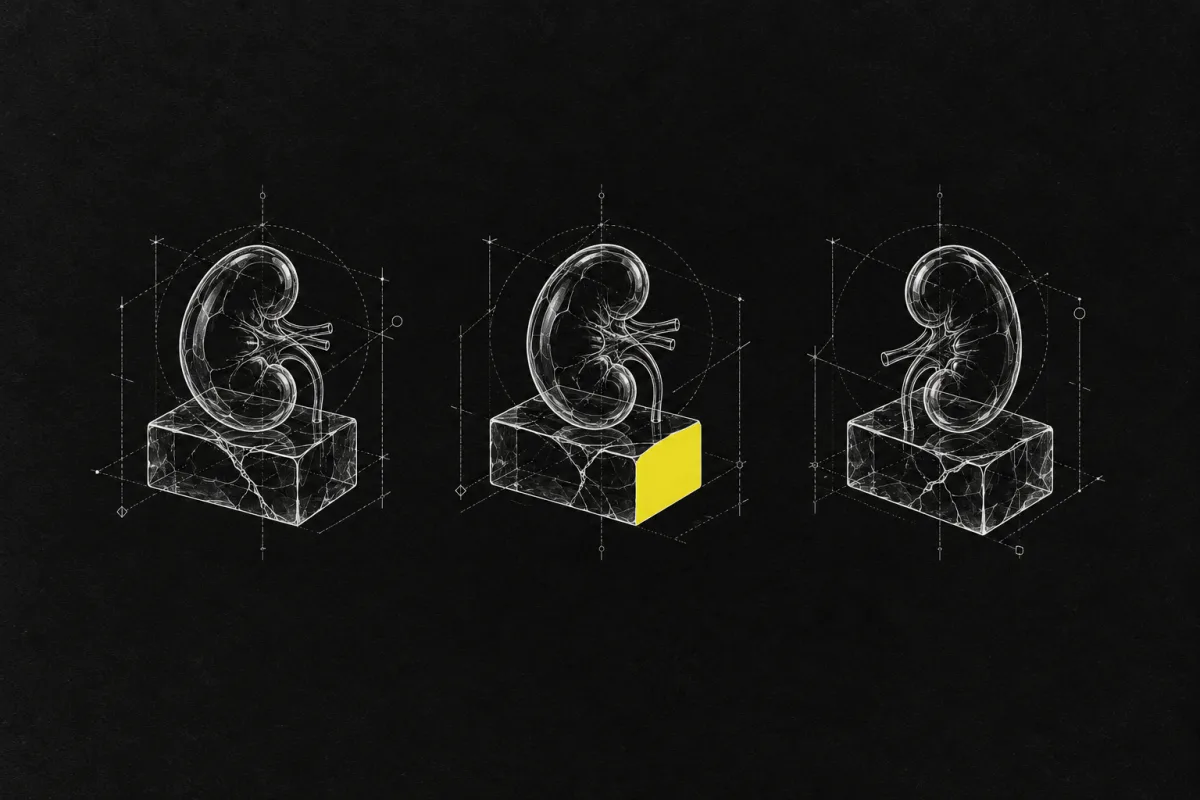
For a year and a day, a pig kidney sat at minus 150 °C. According to the authors’ imaging and temperature readings, no ice grew inside it: the tissue set like glass. Then it was rewarmed in about six minutes, from the inside. Particles of iron oxide, rust in plain terms, had been pumped into its blood vessels beforehand, and then a magnetic field was switched on: a microwave that heats rust instead of water. On a perfusion machine, the kidney stored for a year made urine. Three other vitrified kidneys were transplanted into pigs, and they turned pink right away. A team at the University of Minnesota describes the experiment in a preprint on bioRxiv dated October 14, 2026.
But while these kidneys make urine, in the first hours they clean waste from the blood nearly 50 times worse than fresh ones. The main suspect is the antifreeze the kidney is soaked in before cooling. It is still a step: a pig kidney weighs about 100 grams and is close to a human one in size, while until now the only kidneys transplanted after nanowarming were rat kidneys of about a gram.
Thirty-six hours on ice
A donor organ today travels in a cooler full of ice, and its clock is running. Hearts and lungs last six to eight hours, a liver about 12, a kidney up to 36. Those were the figures STAT cited in 2023, when it also noted that about 100,000 people in the US were on the waiting list and 17 of them died each day.
Those hours turn every transplant into a race. An organ often goes to whoever lives closest rather than to the best match. There is no time to prepare the recipient’s immune system either, and almost everyone with a donor kidney takes anti-rejection drugs for life. Those drugs raise the risk of infection and cancer.
Now picture a warehouse instead of a race. A kidney waits in storage for months while doctors calmly look for the most compatible recipient and get them ready. Kevin Myer, who runs the Texas organ procurement organization LifeGift, told MIT Technology Review that storing organs for a year would transform transplantation. He imagines banks of all kinds of organs, not just kidneys, where the right one is available on demand when a patient cannot wait, such as after some drug overdoses or gunshot wounds.
Ice cuts, heat cracks
Ice is the enemy. Ordinary freezing kills an organ. Water in the cells turns into crystals that tear the tissue apart. So instead of freezing organs, researchers try to turn them into glass.
To keep ice from forming, the tissue is soaked in cryoprotectants. They work as a kind of antifreeze, and they are toxic. One of the main ingredients, ethylene glycol, is the same stuff drivers pour into car radiators. The stronger the solution, the better it blocks ice and the more it damages cells.
Cooling is half the job. Rewarming is harder. Heat it from the outside, like a frozen chicken thawing in the sink, and the outer layers warm up before the core. Ice can then grow in the slowly warming middle, and the temperature difference can crack the glass. It is the same reason an ice cube splits when you drop it into a warm drink.
The team led by Erik Finger and John Bischof handles this with nanowarming. A solution of iron oxide nanoparticles is pumped through the kidney’s blood vessels, and then an alternating magnetic field is switched on. The particles heat up, so warmth appears throughout the organ at once instead of creeping in from the surface. No part of the kidney lags behind the rest.
A rabbit, five rats and a pig
This story has a forerunner. In 2009 the cryobiologist Gregory Fahy described a rabbit that got its own kidney back after the organ had been cooled to about minus 130 °C. The other kidney was removed, and the animal lived on the vitrified one for 48 days before it was euthanized for examination. It was the only rabbit out of several to survive, and the authors themselves called the result anecdotal.
The next step came from Minnesota in 2023. Rat kidneys weighing about a gram sat at minus 150 °C for up to 100 days. After nanowarming, they were transplanted. All five rats survived, and within a month the kidneys were fully working. The same Fahy told STAT at the time that the kidneys had been badly damaged: “These were kidneys in the peak of life, in perfect health, and they barely made it.”
Going from one gram to a hundred took three years. Cold moves more slowly through a large kidney, and the old solution could not protect it from ice in time. The team had to design a new mixture and a new cooling schedule.
What is in the solution and how the cooling works
The solution is called PEZ42 and has a concentration of 60%. It contains 22.3% dimethyl sulfoxide, 20.8% ethylene glycol, 12.9% propylene glycol and two synthetic ice blockers. The kidney is loaded with it at minus 15 °C, and then a nanoparticle solution is run through for 7 to 7.5 minutes.
The core of the kidney cooled by an average of 3.15 °C per minute. At about minus 114 °C it was held steady for 100 minutes to relieve stress in the glass, then cooled by half a degree per minute down to minus 150 °C. Rewarming ran in two stages, at roughly 23 and 32 °C per minute, and took 340 to 350 seconds. That is 14 times faster than the threshold below which ice starts to grow in a slightly diluted solution during warming.
What 32 kidneys showed
Finger, a transplant surgeon and one of the leaders of the work, told MIT Technology Review that ten years ago he did not have high hopes. After the last transplant he walked out of the room and said: “This is a big deal.” About the rewarmed kidneys he puts it simply: “They pink right up.”
The experiment used 32 kidneys in four groups: fresh, a day on ice, soaked in cryoprotectant only, and vitrified. Eight were vitrified. Most of those spent one to seven days in the cold, and one spent 366 days. The kidney stored for a year was not transplanted. It was tested on a perfusion machine, which pumps warm oxygenated fluid through the organ. It made urine, though less than the others.
Three vitrified kidneys were transplanted into pigs and watched for two hours. Blood flowed through them evenly and urine appeared right away. They even made more urine than kidneys kept on ice for a day, though less than half as much as fresh ones (an average of 181 ml per 100 grams of tissue, against 73 and 411).
But urine is not the real test. A working kidney has to clean the blood, and that is measured by creatinine clearance: how much blood the kidney clears of this waste product per minute. Here the vitrified kidneys did nearly 50 times worse than fresh ones and three times worse than kidneys from ice (1.0 against 47.8 and 3.6). A kidney from ice also barely works in its first hours, so that is the fair comparison. Even so, the gap is wide.
Under the microscope, the vitrified kidneys showed damage to their tubules. These are the tiny pipes where the kidney returns water and useful substances to the blood. After transplant, the blood vessel walls were damaged too. The researchers’ main suspect is the toxic solution: kidneys that were only soaked in it, never frozen, show nearly as much damage. That cannot be fully proven, because those kidneys were never transplanted into pigs.
Half a breakthrough
Colleagues read the result differently. Cryobiologist Peter Kilbride, a cofounder of the company Kyros Kairos, called it a breakthrough that solves half the problem. Judging by the numbers above, storage and rewarming without ice are solved, while the kidney’s main job, cleaning the blood, is not. Harvard professor Mehmet Toner is closer to the work. He is deputy director of ATP-Bio, the center through which the US National Science Foundation funds it. He told Gizmodo that biological time in a complex organ can now be safely put on pause.
What the experiment has not shown yet
The authors listed the limits themselves. It is a preprint. No peer review yet. There were three transplants per group, and observation lasted two hours, so nobody knows whether a pig could have lived on such a kidney for a week or a month. A year of storage was tested on a single kidney. Thermometers did not cover the whole organ, so tiny ice crystals cannot be ruled out. With three pigs, you cannot even prove that a vitrified kidney is no worse than one from ice.
Next, the team wants to transplant vitrified kidneys into pigs for the long term and follow them for weeks. It is also looking for less toxic cryoprotectants. After that come human kidneys that were declined for transplant. Finger hopes some of the damage will heal on its own or can be treated on a perfusion machine. He also thinks human kidneys may tolerate the process better than pig kidneys.
The strictest judge, once again, is Fahy, the man whose rabbit lived on a vitrified kidney for 48 days in 2009. He calls the restored blood flow very important, but the damage worries him. His verdict: “We can’t tell from these experiments whether these kidneys might have supported life or not.”