// Contents
Sabi, a California startup, says it can fit 100,000 sensors that pick up the brain’s electrical activity into an ordinary cap. The cap is supposed to read the words you say silently in your head, right through your hair, and type them on a screen. Give the company every benefit of the doubt: take the smallest sensor size in its own press release, 1 mm, and lay the sensors edge to edge with no gaps at all. A hundred thousand of those squares cover 1,000 square centimeters. That’s roughly two heads.
And two heads is the best case, by this article’s own math. Dominic Borkelmans, editor-in-chief of the neurotech trade outlet Neurofounders, ran the same comparison and came out harsher. On October 28, 2026, he published an investigation into Sabi. By his figures, an adult scalp offers about 500 cm². Sensors spaced the way a real device needs them would take around 4,000 cm². Eight heads for one cap.
Three weeks earlier, Sabi had raised a $50 million seed round. Khosla Ventures led it, and according to Forbes, the round valued the company at $600 million. No one outside the company has tested the cap, and no scientific paper describes it: everything known about its performance comes from Sabi itself. And the data used to train a cap that reads thoughts through hair came from volunteers with shaved heads.
Five millimeters of hair
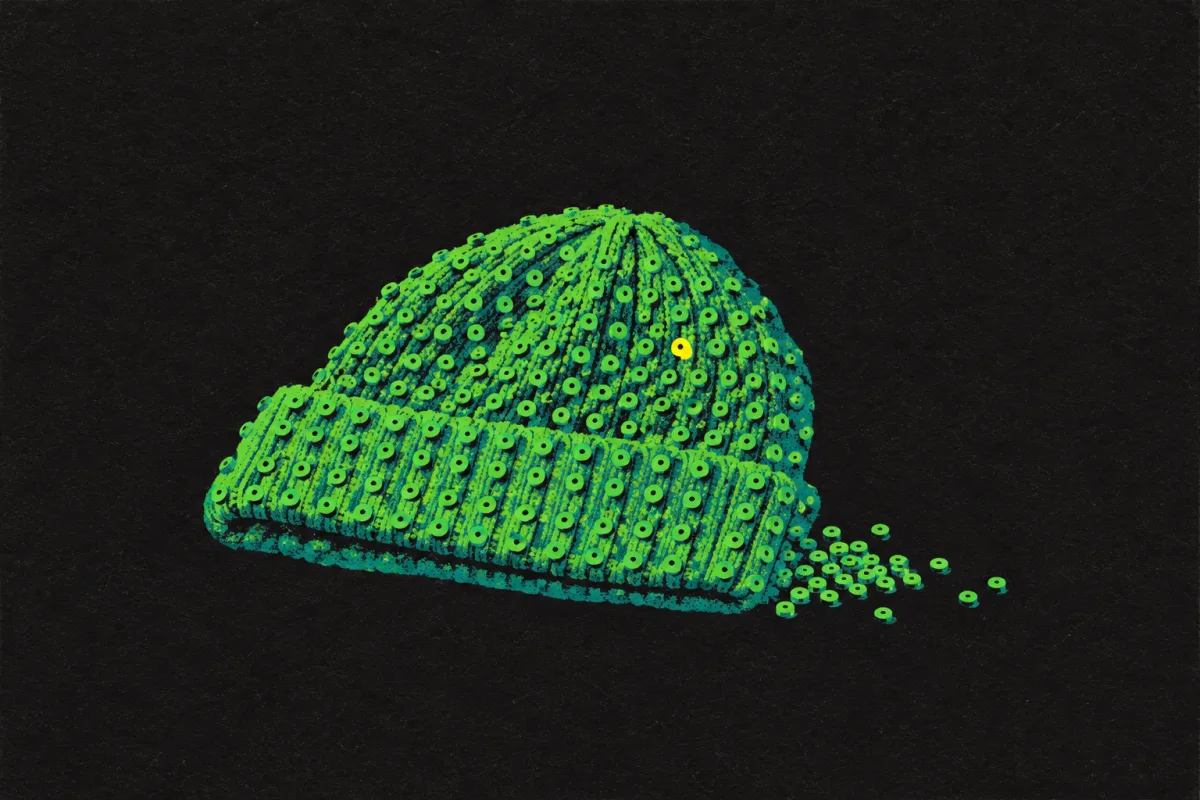
Sabi came out of stealth on April 16, 2026. At the time, it showed off a knit beanie with 70,000 to 100,000 miniature sensors and promised thought-typing at about 30 words per minute, shipping by the end of the year (New Atlas). By fall, the beanie had become a baseball cap. According to an October 9 press release, its sensors measure 1 to 5 mm, need no gel and never touch the skin. They pick up signals across a gap of up to 5 mm, straight through hair. A neural network the company calls a “Brain Foundation Model” does the decoding; Sabi says it was trained on more than 100,000 hours of labeled recordings.
Electroencephalography, or EEG, records faint electrical ripples on the surface of the head, the kind that appear when millions of neurons fire together. On its way out, the signal crosses the membranes around the brain, the skull and the skin, and comes out badly smeared. It’s like listening to the neighbors through an apartment wall: you can tell they’re arguing, but you can’t make out a single word.
Sabi is betting that a dense enough grid of sensors can bring the picture back into focus. In an April interview, CEO Rahul Chhabra called this a “spatial scaling law for neural decoding.” For scale, the densest research EEG systems top out at around 1,024 sensors.
Investors were sold on a different argument. “You cannot perform a billion brain surgeries to replace a billion keyboards,” Vinod Khosla, the fund’s founder, said in the press release. Accel, DST Global and Kevin Weil, OpenAI’s former chief product officer, also put money in.
Shaved heads in Bengaluru
The investigation also digs into the company’s past. Its predecessor, Neuralace, was incorporated in Delaware on May 9, 2024, and that July, data collection moved to Bengaluru, India. Ads on a local gig-work platform sought English-speaking men aged 25 to 35 for EEG recording sessions. Volunteers did tasks built around video, audio and text and could earn up to 42,000 rupees a month, about €400. One requirement: a shaved head.
Chhabra told Forbes the company hired more than 100 such contractors. In other words, a cap meant to work through hair was trained on heads without any. The ads don’t say why the razor. A cleaner training signal is one plausible reason. If so, the open question is how the model copes with the very thing the whole project is about: an ordinary head of hair.
The numbers also kept shifting from one public appearance to the next.
// Timeline
- Neuralace, the future Sabi, is incorporated in Delaware.
- Launch: a beanie, 70,000–100,000 sensors, 100,000 hours of recordings from about 100 volunteers, an accuracy goal above 90%.
- Khosla Ventures shows a slide claiming 1 million hours of EEG data.
- Sabi raises $50 million. The beanie becomes a baseball cap, back to 100,000 hours, accuracy “up to 77%,” launch pushed to 2027 with a prototype demo at CES.
- The Neurofounders investigation. Chhabra calls the million hours “an aspirational product specification.”
What EEG can actually do
The best published benchmark comes from a Meta lab. In February 2025, its researchers described an experiment with 35 healthy volunteers. They typed short memorized sentences on a regular keyboard while a neural network tried to tell from their brain activity which letters they were hitting. With EEG, it got 67% of characters wrong on average: two letters out of three. A bulky magnetic scanner in a shielded room did better and still missed about one letter in three.
One detail is easy to miss. The volunteers were actually pressing keys, so the model could lean on the signals the brain uses to move the fingers. Sabi promises to read words a person neither types nor says.
So far, only electrodes inside the skull have decoded inner speech. In August 2025, a Stanford team reported decoding sentences that four people with paralysis spoke silently in their heads, with up to 74% accuracy. All four had microelectrodes implanted in the motor cortex. Neuralink’s implant reaches 75 words per minute, but it decodes attempts to speak, not silent thought.
Against that backdrop, Sabi spoke in April of 30 words per minute “with reasonable accuracy.” In October, Chhabra finally offered a number, according to Forbes as quoted in the Neurofounders investigation. An early helmet-like prototype, he said, decodes thoughts with “up to 77%” accuracy in people who have trained with it for more than two weeks. He didn’t say whether that meant words, letters or commands. Borkelmans asked the same question and got no answer.
// The promise and what is known
What Sabi promises
- 100,000 sensors in one cap.
- Reading thoughts nobody says out loud.
- Working through hair.
- Accuracy “up to 77%.”
What is known
- Even the densest EEG systems have about 1,024 sensors.
- In Meta’s study, EEG got two letters in three wrong even when people typed on a keyboard.
- Training data came from shaved heads.
- Sabi won’t say what the accuracy measures.
Eight million views
The launch itself looked odd. Under Chhabra’s April launch post, Borkelmans counted 52 unusual comments from 50 accounts. Many repeated each other word for word. One just said “Done.”
Atomik Growth, the agency that ran the launch campaign, claimed more than 8 million views in a case study. The same agency offered an acquaintance of Borkelmans $750 to quote-post the launch with a comment and $1,000 for a post of his own. He turned it down. The case study later vanished from the agency’s website.
The investigation never uses the word “fraud.” Borkelmans doesn’t claim the cap fails. He shows that nobody can check it yet and that the figures contradict each other. Before publishing, he sent Chhabra questions about the team, the data, the prototypes and the accuracy. Chhabra addressed the million hours, promised technical details “in the coming weeks and at CES,” and offered nothing concrete.
When the cap starts listening
Even if the cap works, one question remains that startups prefer to skip: when does it start reading? In the Stanford study, the system picked up numbers while participants silently counted pink circles on a screen, even though nobody had asked them to say anything. So the researchers locked decoding behind a password: it switched on only after a person silently said “chitty chitty bang bang.” The system recognized that phrase more than 98% of the time.
In April, Chhabra dismissed a mental password as unworkable for a consumer product. The cap, he said, would figure out on its own when someone wants to say something. Sabi also promises that data is encrypted right at the sensor and processed while still encrypted, so that nobody, “not even our team,” can see what the wearer is thinking. That can’t be verified either.
The first real test is one the company set for itself: Sabi says it will show a prototype at CES in Las Vegas in January 2027. Proof would look like this: someone with an ordinary haircut puts on the cap, skips the two weeks of training, and it types out a thought rather than text tapped on a keyboard. The accuracy should be stated in letters or words, not as “up to 77%” of something unnamed, and someone outside the company should measure it. A slick demo on stage won’t settle any of that. Borkelmans closes his investigation by asking whether such a product can exist at all. Then he adds: “I’d love to be proven wrong.”