// Contents
“There’s only, so far, I know of one patient who profited from optogenetics so … I thought it’s still too early to get this prize in medicine.” That is how Georg Nagel put it to CNN on October 5, 2026, the day he, Peter Hegemann and Karl Deisseroth won the Nobel Prize in Physiology or Medicine. Two days later, on October 7, the New England Journal of Medicine published online a trial in which ten blind people had received the same technology. None of them learned to read again. But some, wearing camera goggles, learned to find a doorway and follow a line on the floor.
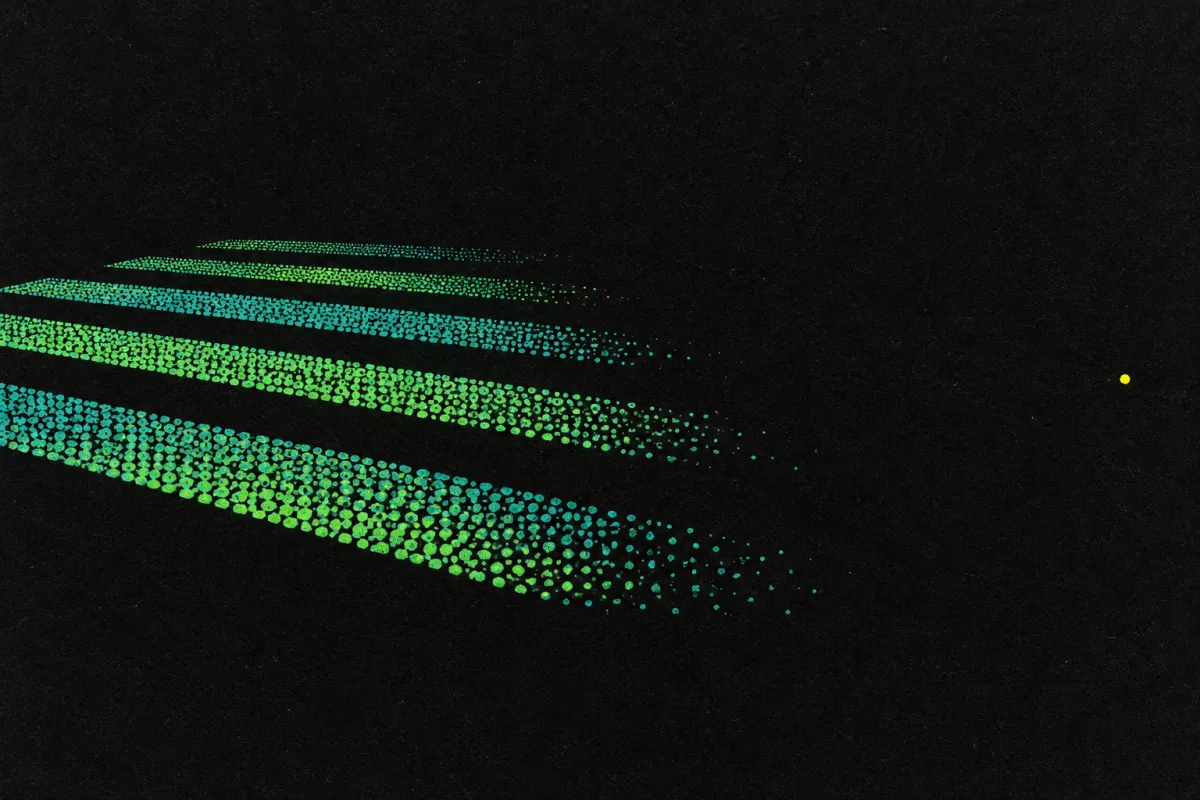
Nagel was not being coy. In an interview with the Nobel Foundation he compared optogenetics with malaria drugs and cancer checkpoint inhibitors: those prizes went to discoveries that had already helped huge numbers of people. Almost certainly he meant a 58-year-old man diagnosed with retinitis pigmentosa forty years earlier. After a few months with the goggles, that man suddenly counted the stripes of a pedestrian crossing on his own. The road to that moment starts in a puddle, with a green alga.
The eyespot of a green droplet
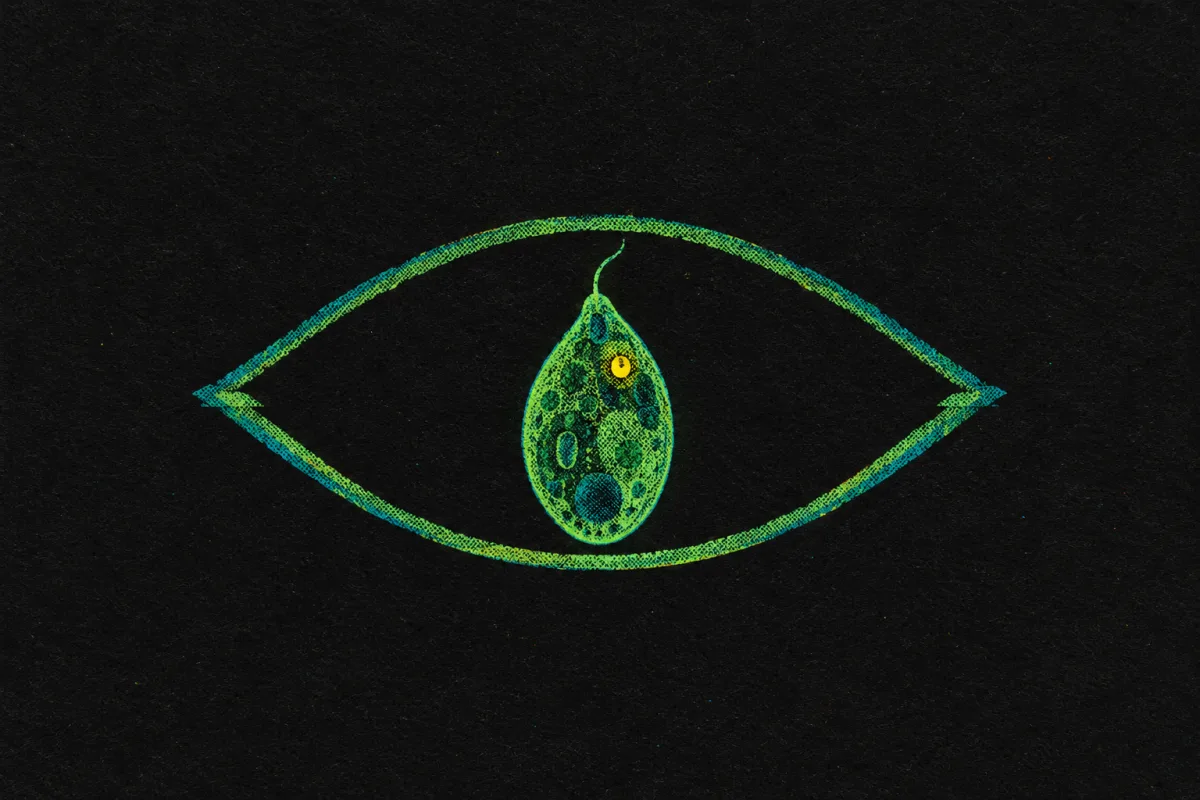
Chlamydomonas is a single-celled alga that lives in freshwater puddles. It swims toward light to photosynthesise, and it has a tiny light-sensitive spot to steer by. In the early 2000s Nagel and Hegemann found a protein called channelrhodopsin there and described how it works in 2003. Put simply, it is a door in the cell’s membrane that opens in light. Shine blue light on it and charged particles flow through.
Neurons talk in exactly that kind of current. In 2005 Deisseroth put the alga’s gene into mammalian neurons, and cells that had never needed light began firing on a flash. Optogenetics was born: a way to flick individual nerve cells on and off like switches and watch what happens to the brain and behaviour. The prize went for that research tool, which changed how the brain is studied .
Why the eye came first
As a treatment, optogenetics has an awkward requirement: light has to reach the right cells. In the brain, that means threading in optical fibre. The eye, by design, lets light in on its own.
There was a fitting disease, too. In retinitis pigmentosa, an inherited retinal disorder, the rods and cones that catch light gradually die. The ganglion cells that carry the signal on to the brain largely survive. Picture a camera with a smashed sensor but an intact cable to the computer. Teach the cable to sense light itself, and the broken part can be bypassed.
In 2006 Zhuo-Hua Pan’s group at Wayne State University tested this in mice whose photoreceptors had died. A harmless virus delivered the channelrhodopsin gene, the retina responded to light again, and the signal reached the visual cortex. The mice probably did not gain useful vision, but the principle held.
// Timeline
- Nagel and Hegemann describe channelrhodopsin, the light-sensitive protein of Chlamydomonas
- Deisseroth puts it into mammalian neurons and switches them on with light
- Blind mice respond to light again after receiving the gene
- Nature Medicine reports the first patient who sees crossing stripes through goggles
- The FDA accepts an application for the first optogenetic therapy
- Nobel Prize in Physiology or Medicine for optogenetics
- NEJM publishes a trial in ten blind patients
Stripes on the crossing
That patient was described in Nature Medicine in May 2021 . One of his eyes received the gene for ChrimsonR, a protein from the same channelrhodopsin family. It responds to amber light, which is gentler on what remains of the retina than blue light and makes the pupil constrict less.
The gene alone is not enough. ChrimsonR reacts only to very bright light, so the therapy comes with goggles. Their camera notices where brightness changes in the scene and projects matching pulses of amber light onto the retina. For the first months the goggles gave the patient almost nothing. Then, as the University of Pittsburgh recounted , he reported on his own that he could see the white stripes of a pedestrian crossing on the street and count them.
In the lab, researchers placed either a large notebook or a small box of staples on a table in front of him. He found and touched the notebook in 36 of 39 attempts, the staple box only 36% of the time. Without the goggles he could do nothing. He could not make out colours, faces or letters.
Ten eyes and a doorway
The new NEJM paper (online on October 7, in the October 8, 2026 issue ) covers ten adults with late-stage retinitis pigmentosa, treated at the Quinze-Vingts hospital in Paris, in Pittsburgh and at Moorfields Eye Hospital in London. Ophthalmologist José-Alain Sahel and neuroscientist Botond Roska led the trial. The recipe is unchanged: one injection into the eye with the ChrimsonR gene, plus projector goggles.
The main goal was safety, and the authors judge it met within the limits of the trial. Side effects in the eye were mostly mild or moderate. One event was rated severe, but it resolved within minutes after pressure-lowering eye drops.
Next come results the authors themselves call exploratory. Seven of ten treated eyes became more sensitive to light, six of them enough to count as clinically meaningful. Eight participants completed behavioural tests and four improved. Nobody could read words or recognise faces.
The tests themselves were mundane. A person puts on the projector goggles and has to notice an object, work out where it is and reach for it. Another task is to find a doorway in a room or walk along a line on the floor. Some of the four managed that too .
Those who spent longer learning to use the goggles did better . Sight does not come back at the flick of a switch. The brain has to relearn a signal it has not received for years, and an unfamiliar one at that: single-colour flashes instead of a picture.
There are plenty of caveats. The trial was open-label and not randomised: every participant knew they had received the therapy, and there was no placebo group. Nor was it designed to prove efficacy. Separating the effect of the gene from training and from the goggles themselves will take a study with a control group. GenSight Biologics, which Sahel and Roska co-founded, paid for the trial. The GS030 therapy is not approved anywhere.
Goggles everyone wants to lose
The goggles remain the method’s biggest drawback: ChrimsonR responds only to bright amber light, and without the projector the therapy does not work. Nanoscope Therapeutics, a US company, bet on a different protein. Its therapy MCO-010, branded Mogenry, is activated by ordinary ambient light without any device, and it is closest to market: on September 9, 2026 the FDA accepted its application for approval, with a decision expected in the first half of 2027.
Mogenry’s evidence is contested. ICER, an independent US drug-assessment institute, rated the data promising but inconclusive: it is unclear how long the effect lasts and what the therapy’s side effects are. Its expert panel nonetheless voted 10 to 2 that the treatment offers a net benefit over usual care.
There is also a route without genes. Science Corporation, a US company, implants PRIMA, a tiny solar-cell chip, under the retina, and with it people read letters . In July 2026 the chip was cleared for sale in Europe . But its patients have a different disease. In age-related macular degeneration only the centre of the retina burns out: people lose the ability to read but still see the room with their peripheral vision, and the chip patches the hole in the middle. Participants in the GS030 trial are almost completely blind. The approaches cannot be compared head to head.
// Three ways to bring light back to a blind eye
GS030, gene + goggles
An amber-sensitive protein gene in the ganglion cells, camera goggles project pulses. Late-stage retinitis pigmentosa. 10 people, open-label trial without a control group: light and large objects, no reading or faces. Not approved.
MCO-010 (Mogenry), gene without goggles
A different light-sensitive protein that responds to ordinary light. Same disease. Randomised RESTORE trial: 27 people, 18 treated, 9 given a sham injection. Under FDA review.
PRIMA, chip + glasses
A 2 by 2 millimetre solar chip, thinner than a hair, under the retina; glasses project the image in near-infrared light. Geographic atrophy in dry macular degeneration. Trial of 38 patients, most read letters. On sale in Europe since July 2026, expected to cost hundreds of thousands of dollars.
Light on the threshold
In a little over twenty years the protein from a puddle has travelled from an alga to the human eye, and October 2026 showed where it has stopped. Trial participants found a doorway; they did not read street signs. For someone in total darkness, even that matters: a patch of light where the exit is changes the day.
But that patch does not appear by itself. People learn to notice it, the way the first patient wore nearly useless goggles for months before he saw the stripes on the tarmac. For now, optogenetics in the eye is more a skill learned with a coach than a drug you simply inject. It stands on the threshold of the clinic, and what carries each patient across is months of training.