// Contents
Most mornings, the first face Karl sees belongs to Luna, his gray tabby cat. Then things get strange. For hours, sometimes until evening, the people he meets on the street or sees on a screen may be wearing her eyes: almond-shaped feline eye sockets, huge pupils, a striped shadow on the skin around them. If a person turns up first instead, the effect runs the other way. That person’s eyes show up on other people, and on Luna herself.
Karl is 28. Two years ago, surgeons removed part of his right temporal lobe to get rid of a knot of tangled arteries and veins that could have ruptured and bled into his brain. Since then, the faces around him sometimes assemble themselves wrong. Brad Duchaine, a Dartmouth College psychologist who has spent years studying face perception, described the case with two colleagues in the journal Cortex.
This is one man’s story, not a study of hundreds of patients. But it exposes something a healthy brain keeps hidden: the face across the table is built from parts, and some of those parts come from memory.
Borrowed eyes that turn with the head
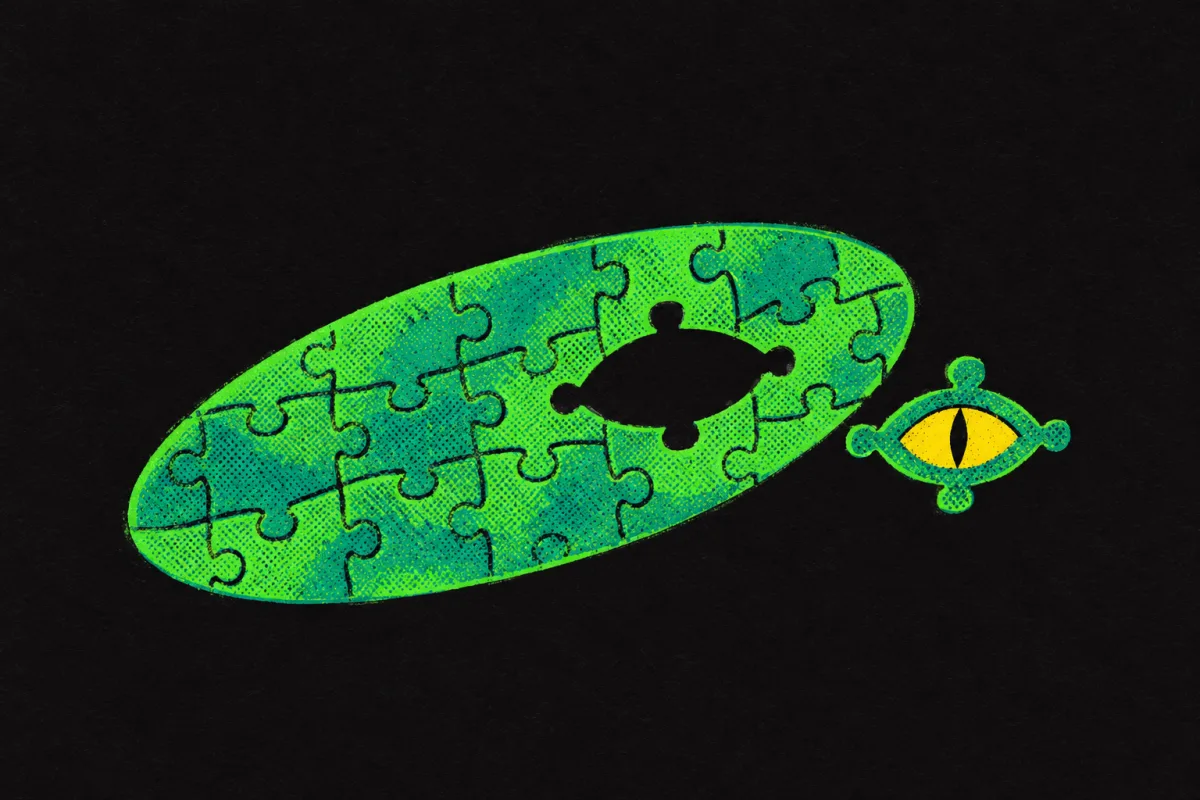
Cat eyes on a human face don’t look like a sticker. According to the paper, the transferred features blend into the face with no visible seam. When someone turns their head or steps back, the borrowed eyes shift as naturally as real ones would. The face stays whole and believable. It just has the wrong eyes.
They aren’t generic cat eyes, either. Karl recognizes them as Luna’s, and the human features he sees on the cat belong to specific people he knows. Features sometimes jump from one person to another, too. The jumps across species are simply the hardest to miss.
Karl’s brain holds on to what he has seen, which doctors call palinopsia, and slips it into faces he meets later. That second step has its own mouthful of a name: prosopometamorphopsia, or distorted face perception.
A poodle on the bus
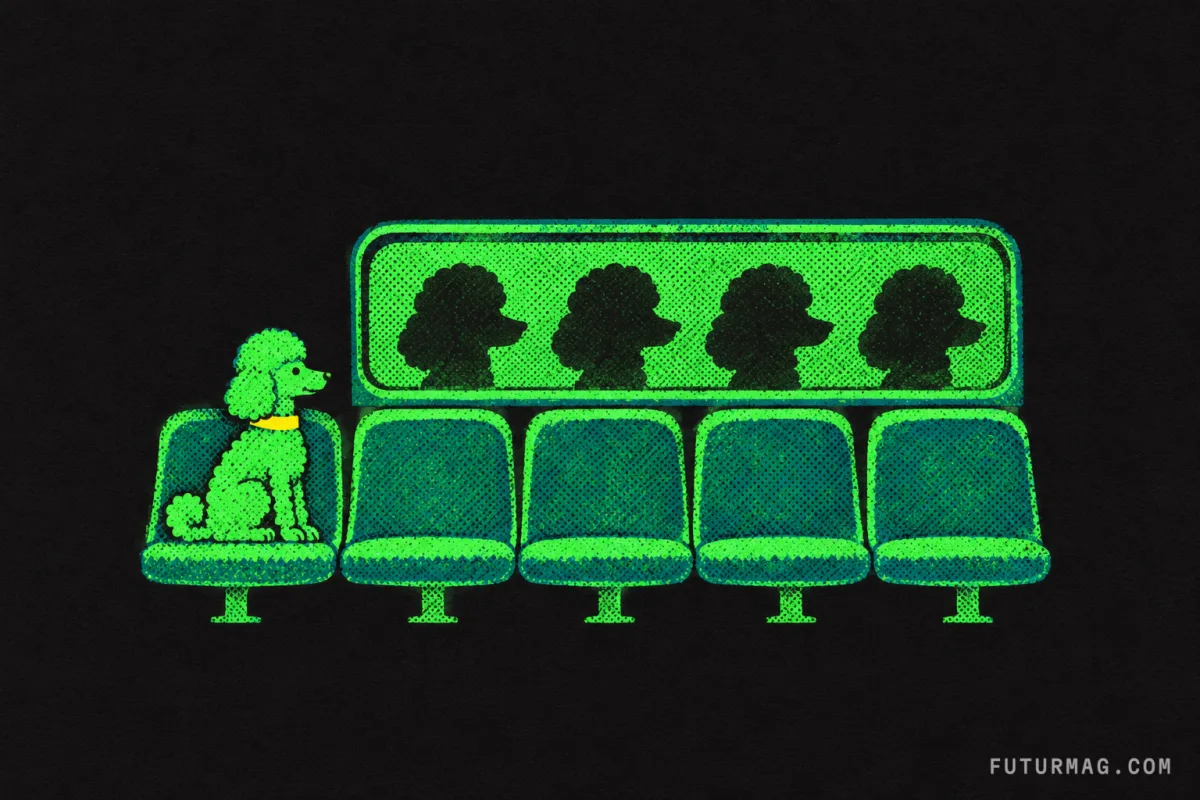
Duchaine’s team titled their paper “Forty years after poodle-face palinopsia,” after a case the same journal described in 1986. Nine months earlier, the woman at its center had suffered a stroke toward the back of the brain’s right hemisphere. One day on a bus, she looked at a poodle sitting on a passenger’s lap. When she looked away, every passenger had the poodle’s face. The vision followed her off the bus and faded only 30 minutes later.
For scientists, one detail mattered most. The poodle’s face appeared only on faces, never on other objects around her. The lesson: the brain handles faces differently from everything else.
In 1991, the neurophysiologists Otto-Joachim Grüsser and Theodor Landis included drawings of the scene in a book chapter on face-perception disorders. Duchaine fed a line drawing based on their illustration into ChatGPT 5.5 and got something close to a photograph: an ordinary bus with passengers in their seats, each wearing a poodle’s face.
// Two cases, 40 years apart
The poodle, 1986
A woman nine months after a stroke. The poodle’s whole face replaced the passengers’ faces. One episode was described, and it ended after half an hour. The dog was a stranger’s, seen moments earlier.
Luna, 2026
A man after temporal lobe surgery. Usually only part of a face moves: in the episodes described, the eye region, sometimes with the color and texture of the skin around it. The rest of the face stays put. Episodes have recurred for two years and last for hours. Every borrowed feature belongs to his own cat or to someone he knows.
A drawer full of eyes
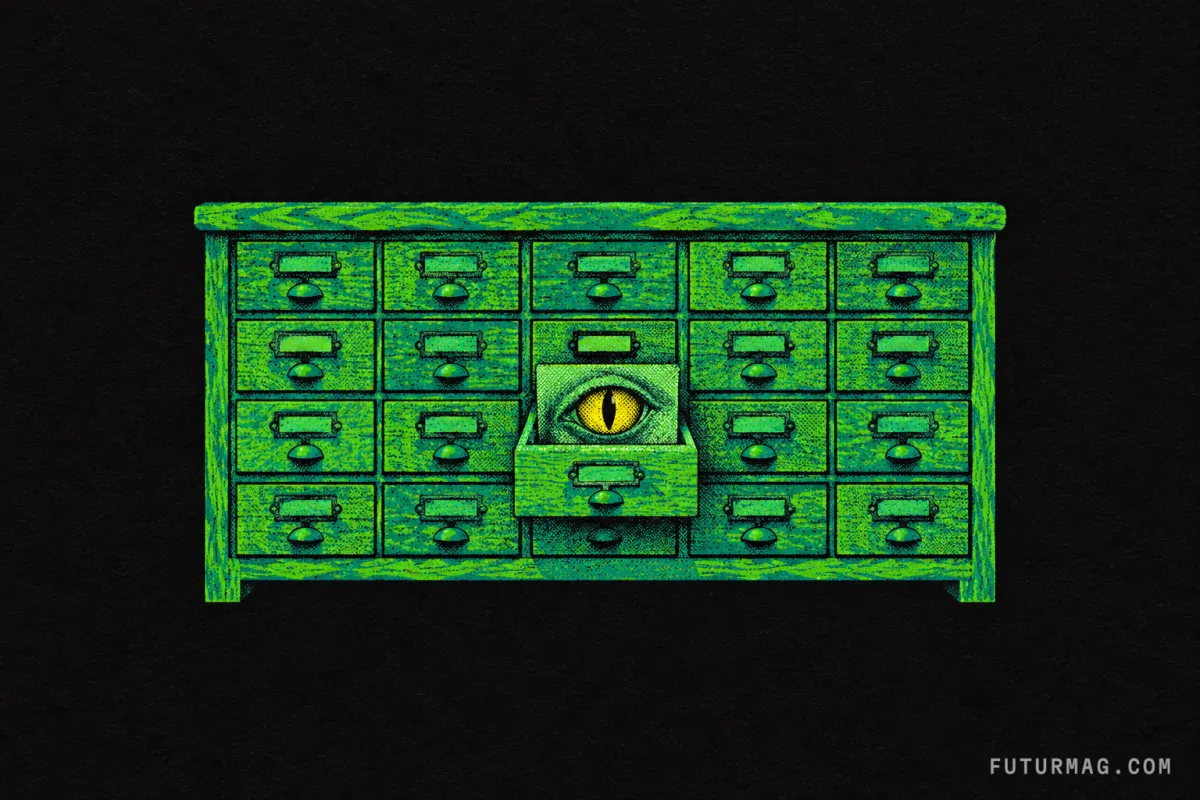
That difference is the real finding. The poodle suggested the brain stores a face as a single unit. Karl’s case points to something finer: the brain breaks faces into parts, remembers who owns each one and can pull out a single part on its own. “Our brains break faces into components and match them against features stored in memory,” Duchaine told Gizmodo.
Think of a police sketch kit. Eyes, noses and mouths sit in drawers, and every drawer carries its owner’s name. Normally the brain takes out whatever fits the face in front of it and puts it right back. In Karl’s case, the drawer holding that morning’s eyes seems to jam open, and for hours his brain keeps reaching into it.
Why did this start after surgery? The right temporal lobe does much of the work of recognizing faces, and the rear part of Karl’s is gone. An MRI scan in the paper shows a cavity where it used to be. The authors describe the mechanism: his brain keeps pulling specific features of specific faces back out of long-term memory. What their four-page report doesn’t say is why removing that patch of temporal lobe set off the glitch.
How to draw what someone else sees
The hard part with patients like Karl is finding out what they actually see. Most of them see the distortions on screens and paper as well. So a patient can’t check a doctor’s drawing: the drawing looks warped too. Duchaine and his colleagues made that point in The Lancet in 2024.
Back then, the lab had found a rare exception. A 58-year-old man had spent 31 months seeing faces he called “demonic”: stretched features with deep grooves across the forehead, cheeks and chin. In photos and on screens, the same faces looked normal. The researchers showed him a person alongside a photo of that person, taken in the same room under the same light. He looked back and forth and described the difference, and they edited the photo until it matched what he saw in person.
That trick won’t work for Karl, whose episodes come and go on their own. So the new pictures don’t show what he sees during a side-by-side check. They show what he remembers seeing. ChatGPT 5.5 made one from his spoken description: a familiar woman’s eyes set into Luna’s face. It made the other from a sketch Karl drew himself, a human face with cat pupils and stripes. Then came months of revisions. Karl pointed out what was off and made some edits himself in Kimi K3, a Chinese AI model, until he felt the images matched what he had seen.
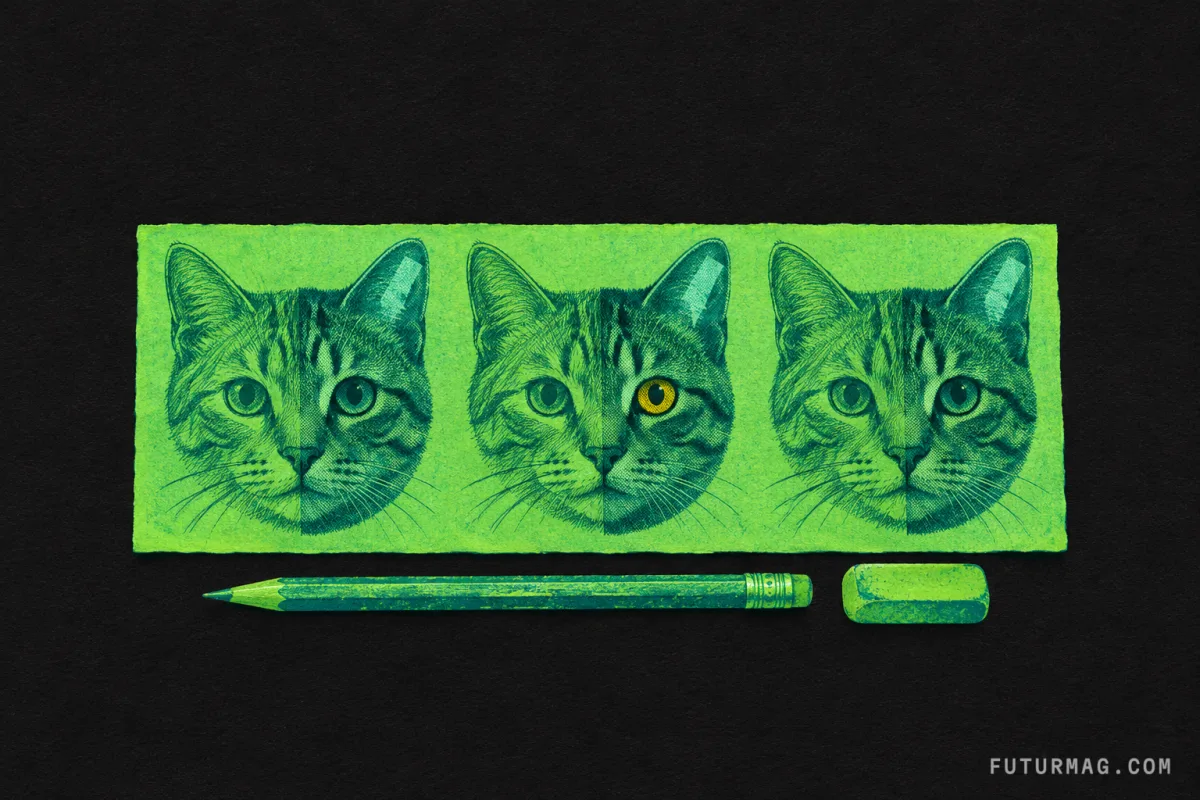
The face stays whole and believable. It just has the wrong eyes.
“AI provides researchers like us with the ability to generate more accurate visualizations of what people are experiencing,” Duchaine says in the college’s November 9 press release. The caveat matters as much as the pictures: they are reconstructions built from memory and words, not measurements, and only Karl can check them.
81 cases in a century, 275 messages in five years
In 2021, a team led by Dutch psychiatrist Jan Dirk Blom gathered every published case of prosopometamorphopsia from a century of medical literature. They found 81. Over the past five years, roughly 275 people with face distortions have contacted Duchaine’s lab through its website on the disorder. The condition, it seems, is more common than the journals suggest.
Some of them, Duchaine says, were told they had a psychiatric problem, and a few were even put on antipsychotics, when the real trouble lay in visual perception. This is where the pictures earn their place. “People have cat eyes” sounds like a hallucination. A photorealistic image shows a specific, stable distortion that a neurologist can compare with other cases. Duchaine also sees the images as a way for patients themselves to show doctors, friends and family what faces look like to them. And patients can help make them, the way Karl spent months fixing his.
Usually the brain stitches a familiar face together from ready-made parts so neatly that the seams never show. Since his surgery, Karl’s seams do. Especially on the mornings when Luna is the first face he sees.