// Contents
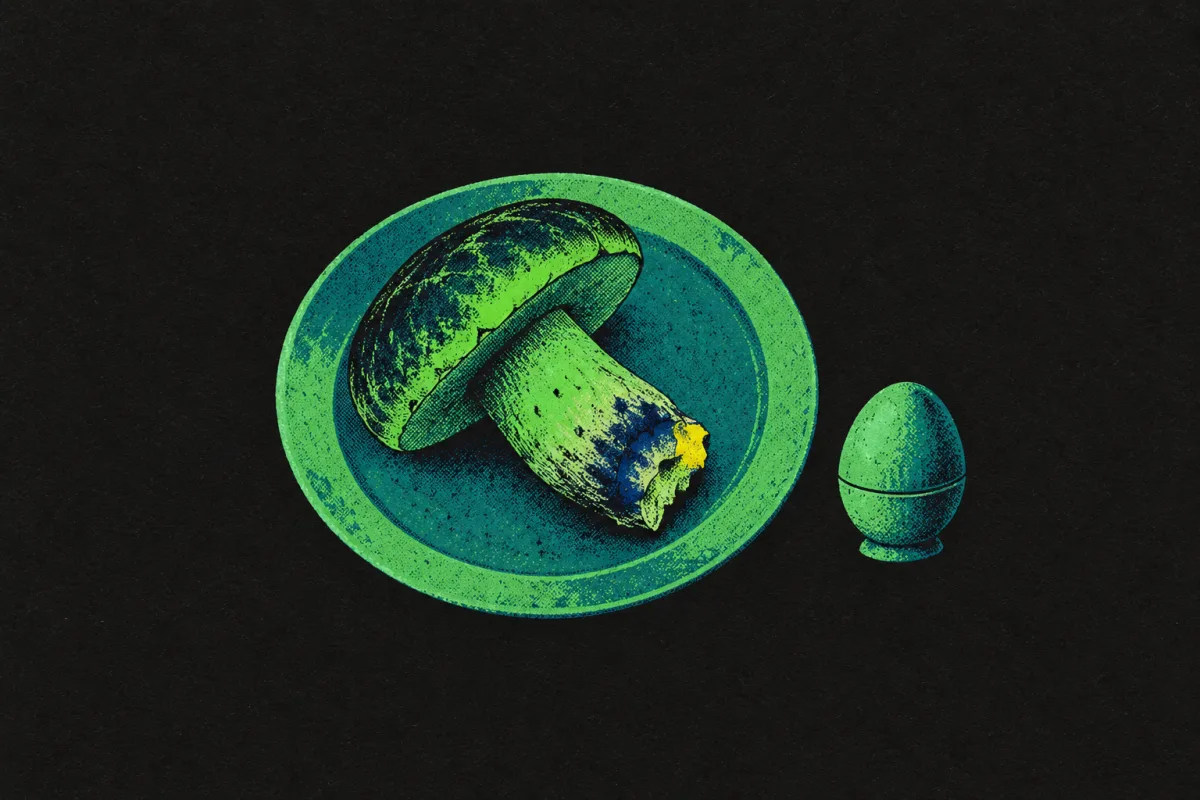
Restaurants in China’s Yunnan province keep a kitchen timer for one particular mushroom. The pan goes on the heat for fifteen minutes, and diners are asked not to touch the dish until the timer rings. The reason for the strictness is odd: an undercooked mushroom shows people tiny humans half a day to a day later. Dozens or hundreds of figures, from a few centimetres to thirty centimetres tall, stroll across the table, tumble off its edge and walk around the plates instead of through them.
Locals call it jian shou qing, “turns blue in the hand”, because the flesh changes colour where it breaks. Its scientific name is Lanmaoa asiatica, and it has been a puzzle for almost a century. In June 2026, mycologists at the University of Utah showed that similar stories from China and the Philippines trace back to the same species. In the 1960s even Albert Hofmann, the chemist who discovered LSD, tested similar mushrooms from New Guinea and found nothing in them. Now researchers have found neither psilocybin in jian shou qing nor the genes needed to make it.
Little people who play by the rules
Doctors call these visions lilliputian hallucinations, after the tiny inhabitants of Lilliput in Gulliver’s Travels. Usually they are a rare symptom of illness. With jian shou qing they are the rule. According to hospital records from Yunnan cited by doctoral student Colin Domnauer, about 96% of patients who sought medical help after such a meal saw little people. The visions, Domnauer said in an interview, last several days, sometimes weeks.
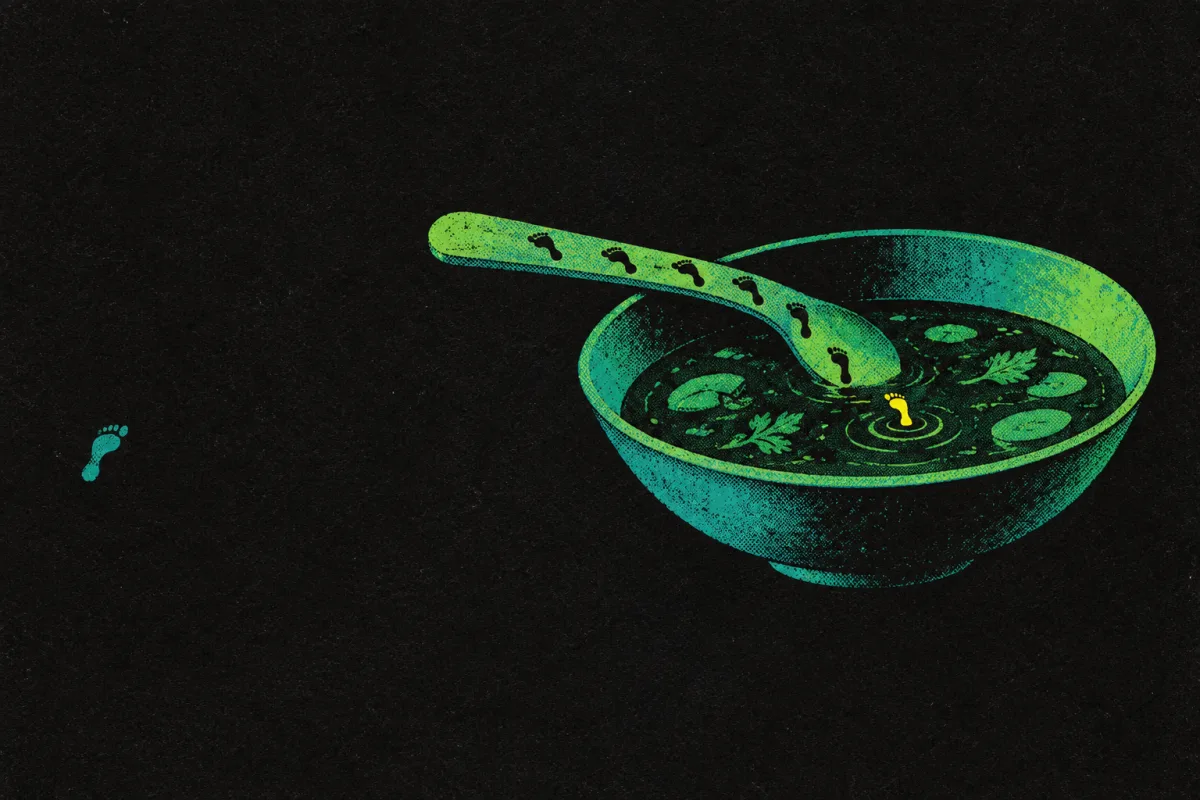
People who have never met each other describe the same details. About 90% talk of figures resembling elves, clowns or fairies in bright clothing, between 3 and 30 centimetres tall. Domnauer retells on the museum’s blog the story of one Yunnan professor. He lifted a tablecloth and saw hundreds of little people underneath, marching like soldiers. When he lifted the cloth higher, their heads came off and stuck to its underside while the bodies kept marching in place. The professor even measured them: about two centimetres. In another account, a person eating soup saw the figures leap from the spoon into the bowl and swim in it. When he took another spoonful, they were still visible inside his mouth.
The strangest part is that the visions obey physics. “They’re not walking through walls or anything,” Domnauer says. Patients’ Lilliputians behave the same way: the Dutch psychiatrist Jan Dirk Blom, who studied hundreds of described cases, counted that in 97% of them the figures “lived” in the real surroundings, on the floor, a table or a blanket.
Ninety years of “mushroom madness”
A similar mushroom is mentioned as early as a 3rd-century Daoist text: eat it raw, it warns, and you will “see a little person”. Western scientists only heard of the little people in 1934, from the highlands of Papua New Guinea. Locals ate a wild mushroom called nonda, and some of them developed what outsiders named “mushroom madness”. One elder said he had seen tiny people with mushrooms around their faces.
// Timeline
- A Daoist text mentions a mushroom that, eaten raw, lets you “see a little person”
- Reports of “mushroom madness” from Papua New Guinea
- Samples of suspect bolete mushrooms reach Albert Hofmann, and he finds no active compound
- Similar poisonings are described in Yunnan
- Chinese mycologists describe Lanmaoa asiatica from market specimens
- Domnauer brings back samples of the sedesdem mushroom from the northern Philippines
- Mycologia publishes the paper linking the Yunnan and Philippine mushrooms
In the 1950s and 1960s, anthropologists and mycologists took up the mystery. They narrowed the suspects down to a few boletes, relatives of the porcini. Samples went to Albert Hofmann, who had isolated psilocybin and discovered LSD. If anyone could find a psychoactive compound in a mushroom, it was him. Hofmann found nothing.
After that the subject went quiet. Researchers concluded that “mushroom madness” was more likely a social phenomenon than a chemical one: people expected visions because that was the custom, and so they had them. The explanation seemed reasonable until the 1990s, when similar stories arrived from Yunnan, thousands of kilometres from New Guinea. In 2008 the American mycologist David Arora devoted a paper in Economic Botany to Yunnan’s “little people”. But which mushroom was to blame stayed unclear: Lanmaoa asiatica was only described from market specimens in 2015.
One species, two thousand kilometres apart
Domnauer first heard about the mushroom in a class taught by mycologist Tom Bruns, and made it his dissertation topic in Bryn Dentinger’s lab at the Natural History Museum of Utah. In 2024 he learned that a community in the Cordillera mountains of the northern Philippines eats a wild mushroom called sedesdem. According to residents, it too brings little people, who even have their own name there: ansisit.
Domnauer travelled there with local guides and collected specimens. As he writes, nobody had studied the region’s fungi scientifically before. DNA analysis showed that sedesdem and Yunnan’s jian shou qing are one species, Lanmaoa asiatica. More than two thousand kilometres of sea and mountains separate the two places, and the mushroom had been thought to grow only in China.
Two communities that know nothing of each other, and eat the mushroom differently, describe the same thing. “That indicates that these bizarre psychological effects aren’t cultural manifestations or coincidences,” Domnauer said in the university’s press release.
Of the 17 Lanmaoa species the team counted, only L. asiatica appears to cause visions. Its closest relative grows in North America. Nobody has reported visions after eating it, though they could simply have gone unnoticed: hardly anyone eats that mushroom.
The New Guinea mushroom remains unverified. Dentinger tried to collect it in Papua New Guinea, but unusually dry weather got in the way.
No psychedelics, not even in the genes
The best-known hallucinogenic mushrooms make one of two substances: psilocybin, like “magic” mushrooms, or ibotenic acid, like fly agaric. To build such a molecule, a mushroom needs genes, a kind of recipe for the enzymes that assemble it step by step. The L. asiatica genome lacks not only the finished substance but the recipe page itself, not even a distant match. Chemical testing found nothing either. “We found absolutely no trace of them,” Domnauer says.
Now remember the restaurant timer. Cooking destroys the unknown substance, which is why a well-cooked mushroom counts as a delicacy in Yunnan. The researchers compare raw and cooked samples and look for what disappears with heat. According to Domnauer, they have narrowed the active part of the extract down to a handful of candidates. Mice given the mushroom extract behaved noticeably differently from controls, though a mouse’s behaviour cannot tell you how close that is to a human vision.
Domnauer allows that the culprit may not be an alkaloid at all, the class that includes almost every known hallucinogen, but a large protein. Proteins often fall apart when heated, so the idea at least does not argue with the kitchen timer. For now it is a hunch, not a result.
Why the brain draws little people
For medicine the finding matters for more than its exotic flavour. Lilliputian hallucinations accompany many illnesses. In 2021 Blom pulled together 226 described cases, and half came down to three causes: schizophrenia, alcohol use disorder and loss of vision. In 8% of cases the patient died, but these were people whose visions accompanied an underlying illness. Blom states plainly that these hallucinations are not as harmless as traditionally assumed.
How the brain produces them is not fully understood. One explanation Blom considers is that the brain’s visual areas, deprived of their usual input, start drawing on their own. Put simply, it is like a screen that, when the signal is weak, shows its own pictures instead of blank space. No wonder vision loss is among the leading causes.
The trouble is that such visions are hard to study. They arrive without warning, in sick and elderly people, and cannot be summoned in a lab. Jian shou qing is different. “It reliably produces this effect, whereas those conditions very rarely trigger it,” Domnauer explains. If the molecule is found, neuroscientists will for the first time have a way to switch lilliputian hallucinations on to schedule and watch which parts of the brain are working. For now, Blom writes, doctors treat not the visions themselves but the illness behind them, and such a molecule could reveal the visions’ own mechanism.
While Dentinger’s team works through the extract fraction by fraction, cooks in Yunnan keep frying the mushroom for exactly fifteen minutes. Without knowing it, they have long been running the experiment the scientists are only now starting: testing how much heat it takes before an unknown molecule stops showing people Lilliputians.