// Contents
A bass pulse lasted about 10 milliseconds. It set three spots in a guinea pig’s inner ear vibrating almost in sync. A technique eye doctors use to examine the retina made that movement visible. George Burwood and his colleagues described the experiment in Science Advances on November 20, 2026.
Where the bass goes
Georg von Békésy won the Nobel Prize in 1961 for his work on the mechanics of the inner ear. In his Nobel lecture, he recalled resting his forearm against a large, water-filled model of the cochlea, the spiral organ that senses sound. He felt the vibration along a patch just 2 to 3 centimeters long, even though a wave with a broad peak traveled down the whole membrane. When he raised the frequency, the patch moved closer to the source of the vibration.
In the cochlea itself, hair cells in the vibrating tissue turn that motion into signals for the auditory nerve. The pitch determines where the wave peaks.
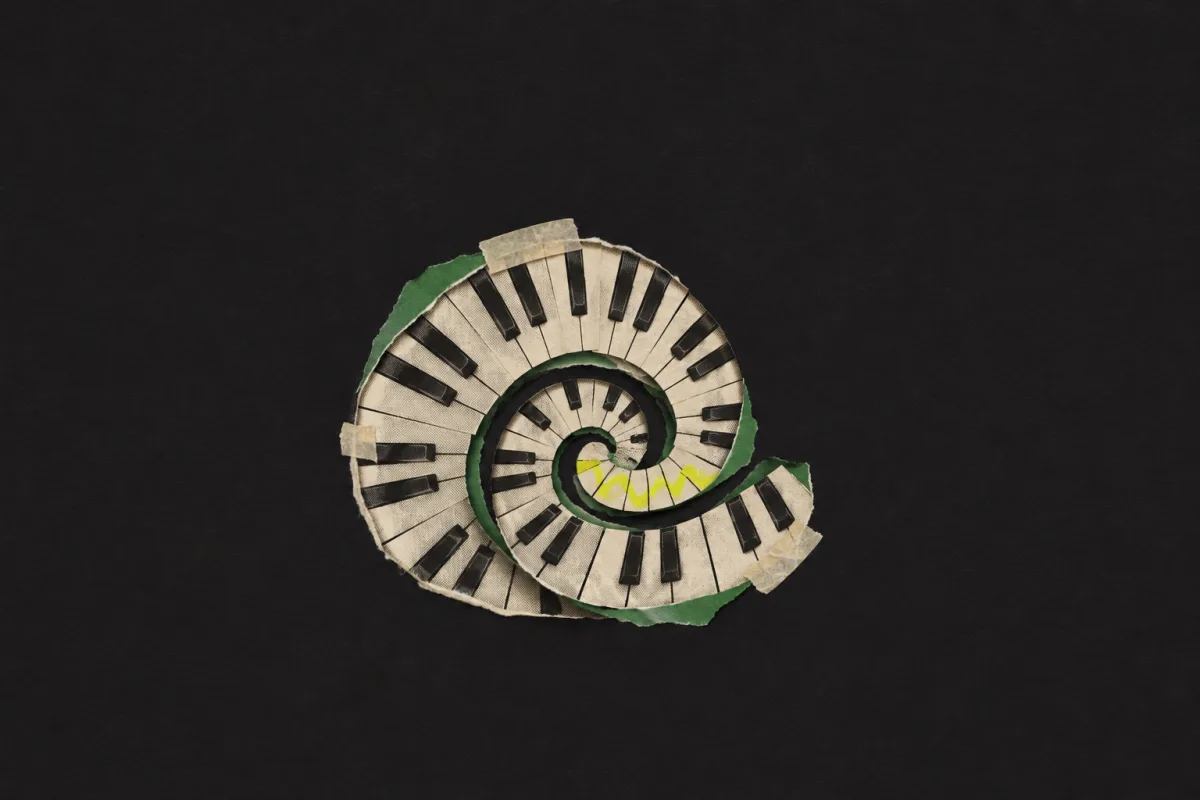
Picture a piano keyboard curled into a spiral. High notes make the wave peak near the entrance. Low notes make it peak closer to the tip. That’s how the frequency map works along much of the cochlea. At the tip, the tissue is hard to reach and barely moves when the sound is quiet.
Seeing past a heartbeat
Burwood’s team adapted optical coherence tomography, a technique used in eye clinics, to measure movement inside the cochleas of live guinea pigs under anesthesia. A tiny mirror directed infrared light toward the tip of the spiral. The researchers tracked the movement of the tissue by measuring the light it reflected.
Breathing and heartbeats made the surrounding bone and the delicate tissue move together. The team measured both at the same time. Using the bone as a reference, the researchers could subtract that shared motion from the recording.
Three spots deep in the spiral
The team had spotted similar responses in different places in a 2022 study. This time they recorded lower-frequency vibrations. The middle spot was especially sensitive at two different frequencies. When the team played a quiet sound made up of 15 frequencies, both peaks turned up in eight of nine cases. A simple map predicted one peak.
A separate test examined timing. The team played the short pulse, which had a peak in its spectrum around 100 hertz. Across nine experiments, the researchers found no statistically significant difference in the dominant frequencies of the vibrations at the three spots.
The researchers also compared when the first two peaks in motion arrived after the pulse. The spot nearer the base peaked first, with a statistically significant lead over the spot nearest the tip. For the second peak, the researchers found no significant timing differences. The delays never followed the expected pattern of growing longer closer to the tip.
What to send down the wire
Location matters for a cochlear implant. A microphone picks up sound, and a line of electrodes inside the cochlea delivers electrical pulses to different parts of the auditory nerve. Many people can follow speech on the phone with an implant. Picking out one speaker in a room full of conversation can be harder.
Burwood suggests that an implant may need to do more than choose where to send each pulse and how strong it should be. The study measured tissue movement in guinea pigs. It would take tests in people to see whether a different pattern of stimulation helps them tell low sounds apart.