// Contents
“It was my secret in my student days that my plans were for this problem in decades,” Levent Alpöge recalled. On November 20, 2026, the Anthropic mathematician released a proof of the Riemann hypothesis that he had found with Claude. The usual research paper would have to wait. Alpöge published a library of 17 million lines in Lean, a language for writing proofs a computer can check. He explained his choice in a note accompanying the archive.
A day later, the Lean and Mathlib communities said they had independently verified both the statement of the classical Riemann hypothesis and Alpöge’s proof. The logic held. Alpöge still had to explain how he and Claude arrived at the proof. The team closed its announcement by saying it looked forward to that account.
What zeros reveal about prime numbers
Bernhard Riemann published a short paper on prime numbers in November 1859, setting out a hypothesis that mathematicians would try to prove for more than a century and a half. A prime is a whole number greater than one that’s divisible only by one and itself. The list starts with 2, 3, 5, and 7. The primes thin out as the numbers grow. Riemann found a link between counting primes up to a given number and finding the zeros of a function that now bears his name. The Clay Mathematics Institute has an early draft and an explanation.
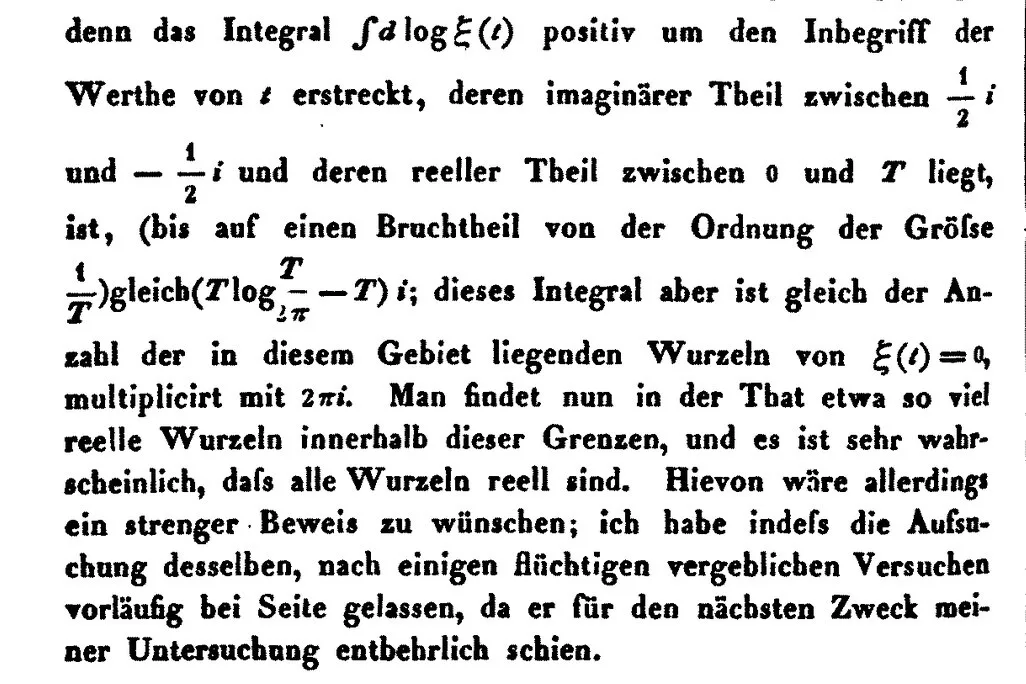
The prime number theorem gives an estimate of how many primes lie below a given number. Riemann’s hypothesis puts a limit on how far those estimates can be off. On a graph the claim looks simple. Plot the inputs that make the Riemann zeta function zero and set aside the predictable ones. Every point left should lie on the vertical line with a horizontal coordinate of one-half.
Riemann checked the first few zeros by hand. Computers can check far more, but the next unchecked point could still be off that line. A proof has to cover the whole infinite set.
The computers had two jobs
A research paper can call on a familiar theorem and move on, leaving the reader to supply some of the details. Lean needs mathematical definitions and the rules for using them in a form its checker can read. Take a school algebra problem. Before canceling a common factor on both sides of an equation, you have to know the factor is nonzero. A proof checker needs a reason to accept that condition just as it needs a reason to accept the final answer.
First the reviewers had to pin down what the code claimed to prove. Those 17 million lines form a library with many intermediate results. The reviewers took the statement of the Riemann hypothesis from Mathlib, a shared collection of definitions and theorems for Lean. Experts in Lean and number theory had already vetted the statement. The reviewers put it in a file independent of Alpöge’s code. They ran two tools to see if the statement matched his final theorem. It did. Change “every” to “some,” and a flawless proof could leave several points off the line. That’s the sort of difference the separate statement check could catch.
Next came the proof itself. Rebuilding the library independently produced the same proof file. Several programs with independently written checking engines confirmed that the result followed from the rules and axioms. MIT mathematician Andrew Sutherland documented both checks in his report. Lean’s own kernel, the part of the program that checks the logic, had already accepted every compiled module. As of the November 22 report, that kernel was still running a separate check on the exported proof. One of the independent programs took about 28 minutes to check around 62 gigabytes of data.
Update, November 26, 2026. The full check of Alpöge’s original export passed on November 25. Luke Sernau’s team released two rewrites proving the same five theorems: a compact edition of about 76,000 lines of Lean and a more readable one of about 300,000. Both passed independent checks. The Clay Mathematics Institute still lists the problem as active.
The Lean and Mathlib statement certified the classical hypothesis. Sutherland’s checks also covered the generalized version for Dirichlet L-functions, a family whose nontrivial zeros are supposed to satisfy the same condition as those of the Riemann zeta function.
How did they find the proof?
Alpöge steered Claude toward a case where two techniques from a simpler example might fit together. Claude surprised him by proposing a step he hadn’t considered. The proof drew on more areas of number theory than Alpöge had imagined as a student. He released the Lean files while he was still working through the mathematics around the proof, as he explained in his note.
A mathematician reading a proof wants to see what makes it work. What made the hardest step possible? Which idea might work on the next problem? These questions go beyond checking whether each step follows from the last. Mathematician Terence Tao pointed readers to a discussion where people were trying to reconstruct the strategy behind the proof.
On November 21, University of Waterloo mathematician Michael Rubinstein posted a 164-page working guide to the classical case. His guide shows how the Riemann hypothesis follows from two supporting estimates and an inequality that compares weighted sums over primes. Rubinstein derives the estimates from published theorems. For the key inequality, he draws on Alpöge’s Lean library to explain parts of the proof in familiar mathematical prose. The second version of Rubinstein’s guide runs to 265 pages. It is still a working draft: it reduces the key inequality to conditions whose proofs remain in the Lean development.
This is an unusual way to establish that an AI system got something right. Ask a chatbot to explain an answer, and you may have to check both the answer and its reasoning against sources open to interpretation. Alpöge’s reviewers could state the exact claim independently and give several programs the complete argument. They could test the result while mathematicians were still figuring out which ideas made it possible.
The million-dollar prize has its own clock
The Clay Mathematics Institute lists the Riemann hypothesis as one of its Millennium Prize Problems. Each carries a million-dollar prize. As of November 23, 2026, Clay still listed the hypothesis as unsolved on its problem page. A solution must appear in a qualifying publication. Clay will consider it only after at least two years have passed and mathematicians have broadly accepted it. An archive on the author’s site cannot by itself start that clock under Clay’s prize rules.
One detail in Alpöge’s note gives a sense of what remains to explain. Claude proposed setting the length of a chain of operations to the square root of the upper limit of a sum. Quadruple that upper limit and the chain gets twice as long. Alpöge singled out this move as an example of how the model surprised him. Mathematicians still have to work out what it does for the proof as a whole.