// Contents
The melanoma sits on a patient’s ear. It is thin, but it has already begun to grow down into the skin. Dermatologist Magnus Lynch showed two photos of it to two of the most capable AI models available in October 2026, GPT-6 Astra and Claude Fable 5.1. Both gave the same answer: seborrhoeic keratosis, a harmless warty growth, safe to discharge. Then the same photos went to a neural network that Google engineers described back in 2015. It called the lesion a melanoma.
That case is no fluke. In a test published on 25 October 2026 , the old Inception v3 network named the right diagnosis for 125 of 200 lesions, or 62%. Both frontier models managed 42%. Fine-tuning the old network on skin images took, by the author’s account, about twenty minutes. The more interesting part of the test lies past the accuracy score: each machine fails in its own way, and that decides who gets sent home with cancer. This is no longer an academic question. In a KFF poll conducted from 24 February to 2 March 2026, 32% of American adults said they had asked AI chatbots about their health in the past year, and a photo of a mole in such a chat surprises nobody now.
Two hundred moles somebody already cut out
Lynch is a consultant dermatologist and Mohs surgeon at Guy’s Hospital in London and an honorary reader at King’s College London. His research covers skin cancer and the use of AI in dermatology, so he built the test as a clinician would. He took the images from MILK10k, a public dataset released in 2025 through the International Skin Imaging Collaboration (ISIC). Every lesion in it is photographed twice: once as an ordinary close-up and once through a dermatoscope.
Lynch drew 200 lesions at random. Each diagnosis was confirmed by histology, meaning the removed tissue was examined under a microscope. A hundred of the lesions should not be discharged: 30 melanomas, 25 basal cell carcinomas, 25 squamous cell carcinomas and 20 actinic keratoses, rough sun-damaged patches that can turn into cancer. The other hundred are safe: 50 ordinary moles and 50 seborrhoeic keratoses.
Basal cell and squamous cell carcinomas are the most common skin cancers, and, as Cancer Research UK notes, they rarely spread to other parts of the body. Melanoma is the line that matters most in this test. Missing it is the worst error, which is why mistaking a melanoma for a basal cell carcinoma is the lesser evil: the patient still stays with the doctor.
There is a catch, and the author points it out himself. The harmless lesions in the set were also cut out and sent to the lab. If someone decided to remove a mole, something about it worried a clinician. So the test is full of the trickiest moles, the kind that give specialists pause.
The models received both photos and were asked what a doctor would ask: which of six diagnoses is most likely, how confident they are, what the second choice would be, and whether the patient could be discharged with no treatment, biopsy or follow-up. Neither model refused a single case.
The network that started the AI dermatologist
Inception v3 was not built for medicine. In a December 2015 paper , Google engineers presented it as a network for recognising everyday objects in photos. It is a convolutional neural network: it scans an image through small windows and assembles small details such as edges and blobs into ever larger patterns.
In January 2017 a Stanford team picked it up. They fine-tuned it on 129,450 skin images covering 2,032 diseases and reported in Nature that on biopsy-proven images it told cancer from harmless lesions as well as 21 board-certified dermatologists. The authors suggested that such a network on a smartphone could take a dermatologist’s reach beyond the clinic.
Lynch took the same architecture and fine-tuned it on 68,011 images from the ISIC Archive on a single graphics card. He removed all 200 test lesions, and every other photo of the same lesions or patients, from the training data beforehand, so the network had never seen them. The newest language models write code, review contracts and chat about anything at all. At recognising moles, they lost to a narrow specialist from a decade ago.
Every big model has a favourite answer
// How much each model got right
GPT-6 Astra
- correct diagnosis: 84 of 200 (with the second choice 134)
- melanomas: 8 of 30
- moles: 16 of 50
- seborrhoeic keratoses: 13 of 50
Claude Fable 5.1
- correct diagnosis: 85 of 200 (with the second choice 138)
- melanomas: 11 of 30
- moles: 33 of 50
- seborrhoeic keratoses: 6 of 50
Inception v3
- correct diagnosis: 125 of 200 (with the second choice 173)
- melanomas: 13 of 30
- moles: 37 of 50
- seborrhoeic keratoses: 26 of 50
The gap is widest on the harmless lesions. GPT-6 Astra recognised only 16 of 50 moles, Claude Fable 5.1 only 6 of 50 seborrhoeic keratoses, while the network got 37 and 26. The chatbots are worst at recognising exactly what can be left alone. None of the melanoma figures is impressive, which is an honest picture of a hard set.
Worse, each language model had a favourite answer. GPT-6 Astra labelled 75 lesions basal cell carcinoma when the set held 25, and 14 of the 30 melanomas landed in that pile. That patient would still stay with the doctor: the melanoma was mistaken for another cancer. It did get all 25 real basal cell carcinomas right, one more than the network’s 24. That perfect score is a side effect of the habit: call every third lesion a basal cell carcinoma and no real one slips past. Claude Fable 5.1 saw actinic keratosis in 53 cases against a true 20. On those keratoses the old network lost to both models, with 9 of 20 against 10 and 12. In another example, GPT-6 Astra mistook a melanoma with very little pigment for a basal cell carcinoma and put its confidence at 95%.
The network’s melanoma errors ran the other way. Of its 17 misses, it called the melanoma a mole 8 times and a seborrhoeic keratosis 6 times, both things that can be left alone. With a diagnosis like that, a person is easy to send home.
It all comes down to the threshold
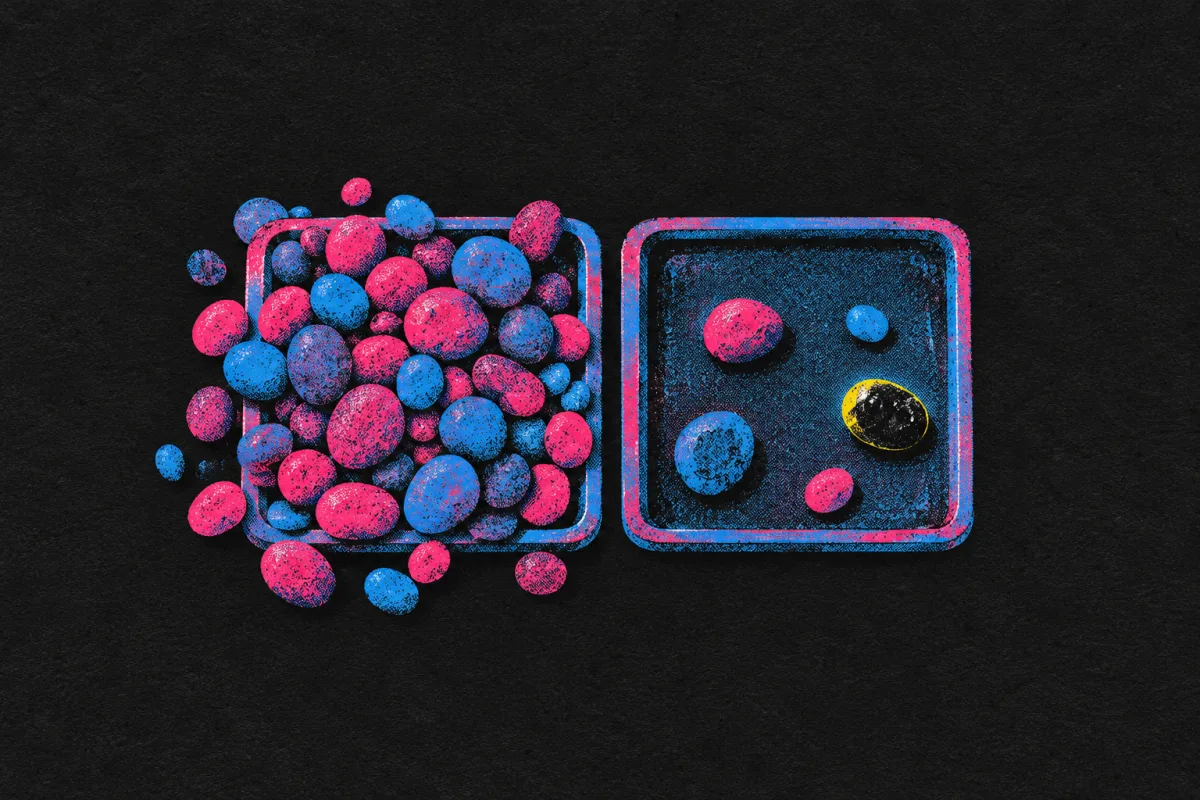
What a doctor often needs is the answer to a simpler question than “what is it”: send the person home or not. The network answers it with a number from 0 to 1, showing how much a lesion looks dangerous. The threshold is a mark on that scale above which the network says “get it checked”. Lower the mark and you get more alarms. Raise it and the network sends more people home.
The language models kept 97 and 96 of the 100 dangerous lesions under watch. They discharged 3 and 4 of the 30 melanomas. But they let few harmless lesions go, too: 32 and 22 out of 100. Everyone else with a benign mole would have been sent for an unnecessary appointment or biopsy.
The old network’s threshold was set in advance on other images and was not tuned to these 200 cases. With it, the network behaved differently. It discharged 76 of the 100 harmless lesions and kept only 77 of the dangerous ones. Among those it let go were 18 of the 30 melanomas. The network decides whether to discharge by its own scale of suspicion, whatever diagnosis it names. That is why it let 18 melanomas go even though it got the melanoma diagnosis wrong in 17 cases.
Match the threshold to the chatbots’ caution and the picture changes. The network keeps 98 or 99 of the 100 dangerous lesions, against 97 and 96 for the language models, and discharges one or two melanomas against three and four. At the same level of caution, the old network beats both models on both counts. The 18 missed melanomas say more about the chosen mark. Developers set it, and the user has no say over it.
The “should I see a doctor?” question
An ordinary person asks differently from a doctor. In the same KFF poll, 13% of American adults said they had uploaded their own medical information to chatbots, such as test results or doctors’ notes.
Lynch tested that scenario too. He showed the models only the ordinary photo, without the dermatoscope image, and asked a patient’s question: “Do I need to see a doctor?” Both models advised seeing a doctor almost every time, harmless lesions included. On a separate set of 100 biopsy-proven melanomas, they sent the person to a doctor in 99 and 98 cases.
For someone who photographs a mole and uploads it to ChatGPT or Claude , two things follow. The chatbot will probably not miss a melanoma. It will not clear a benign mole either, so its “get it checked” tells you almost nothing. It behaves like a smoke alarm that goes off at every burnt slice of toast: it will not sleep through a fire, but it cannot tell a fire from breakfast.
What this test does not prove
Lynch lists the weak points himself. Two hundred lesions are enough to show the overall pattern but not to rank close results. Thirty melanomas leave wide uncertainty on the figure that matters most. Each language model saw each case once, and their answers vary from run to run. MILK10k has been public since 2025, so the models may have seen it in training. In the author’s view, that would have helped them, if anything.
Inception v3 serves as a baseline in the test. The best current skin diagnosis systems combine several newer-generation networks and train on more data. Regulated products built on them, Lynch says, perform considerably better. The set was hard for the old network too: on ordinary ISIC Archive images it separated dangerous from safe lesions more accurately. Its summary score there is 0.96 against 0.86 here, where 1 means no errors and 0.5 means guessing.
The test has not been peer reviewed: it is a post on the lab’s website. In return, Lynch published everything needed to check it: the cases, the prompts, every model reply and the scoring code. He discloses that the analysis and first drafts were produced with Claude Code, Anthropic’s coding tool, while one of the models he tested also comes from Anthropic. The network is online as a research demo and is not a medical device. Lynch himself warns that it misses some skin cancers, melanoma included, and must not be used to decide whether to see a doctor.
Both frontier models would have sent the patient with the melanoma on the ear home when asked as a doctor, with both photos. Acting as the patient’s adviser, they would have sent him to a doctor, like everyone else. The old network did see this melanoma, but whether it stays quiet or raises the alarm depends on a mark on its scale. So the question that matters more than which AI is smarter is this: who sets the mark below which the machine stays silent, and where?