// Contents
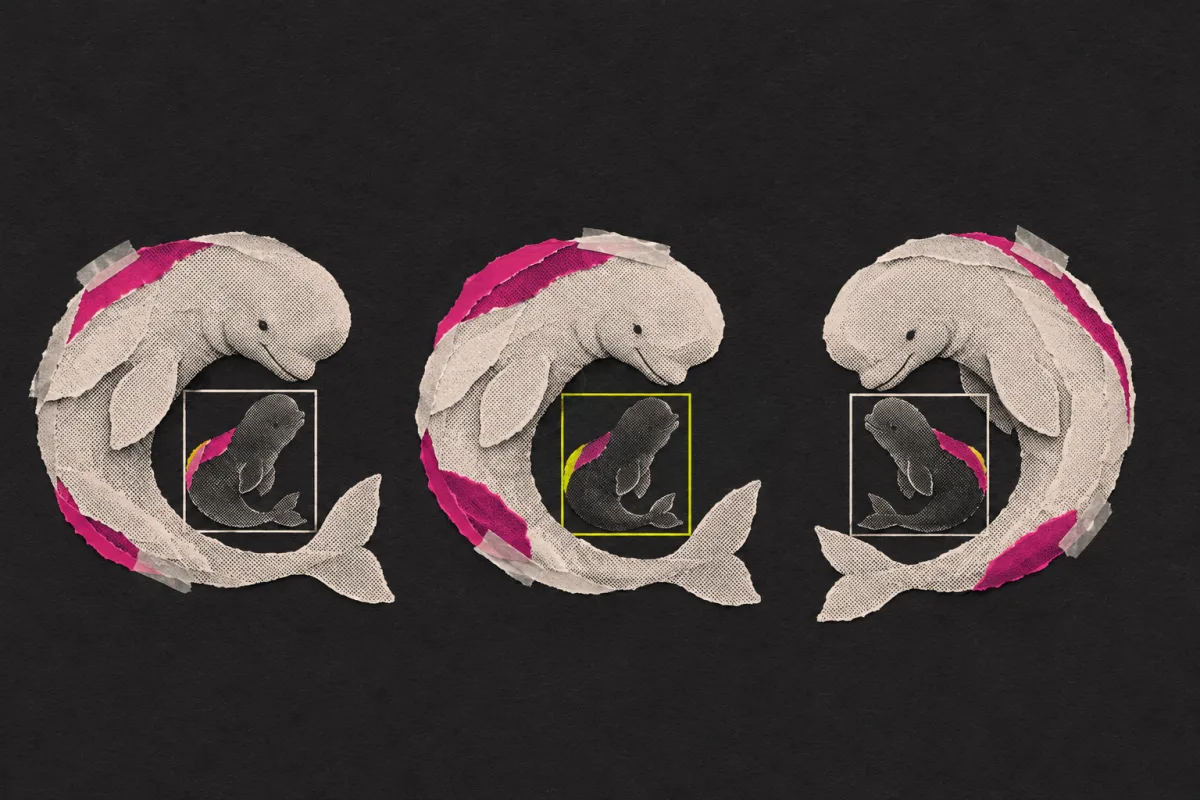
Four beluga calves swim through a single frame of Arctic drone footage. One model drew a box around a single calf. Its rival picked out three. The researchers started with pretrained models and gave each 34 frames that biologists had marked. Only the model that picked out three could also learn from thousands of frames whose labels the researchers withheld.
On the full test set, SEMI-DETR found 27.8% of the calves biologists had marked. YOLO11s found 1.3%. Those figures are averages across five sets of training examples. Even SEMI-DETR missed almost three of every four calves the biologists marked. Florida Atlantic University highlighted the experiment on November 19, 2026.
A beluga grows into its white coat
In an aerial photograph by Greg O’Corry-Crowe and Cortney Watt, two mothers swim with their calves through a shallow Arctic estuary. The pale backs of the adults stand out against the water. The calves are harder to see. Belugas start out dark gray or brown and grow paler with age, according to Canada’s status assessment.
A calf can also disappear behind a bigger whale. Sunlight glints off the water. Ice can look like the pale back of an adult. The smallest calf in the test set measured a single pixel across and two pixels high.
Study co-author Greg O’Corry-Crowe hopes tools like this will let his team examine more footage than it can get through by hand. Seeing calves in more footage could help biologists estimate how many young whales are joining the population.
The team gathered 7,655 drone frames over two Arctic summers. Biologists drew boxes around the whales they could see and identified calves by how small they were next to adults in the same frame. Some frames held no whales at all. The busiest held 31.
What AI can do with unmarked footage
For their study, published September 4, 2026, the team set aside 855 frames from videos neither detector saw during training. The 34 labeled frames used for training made up 1% of the labeled training pool. The team gradually increased the number of labeled frames to see how the detectors performed with more guidance.
For YOLO11s, every training frame came with a biologist’s answer: how many whales were visible, where they were, and which were calves. Frames without that answer stayed out of its training. SEMI-DETR could learn without seeing the biologists’ labels on the extra frames, an approach called semi-supervised learning. One version of the model, the “teacher,” proposes boxes on those frames. Some of its guesses become extra practice for a second version, the “student.” The teacher updates more slowly than the student, so its suggestions stay steadier from one step to the next.
Another detector that learned from its own guesses fell behind YOLO11s on the overall score for detecting adults and calves. When SEMI-DETR trained with 34 labeled frames, only about half the boxes it drew around suspected calves matched the biologists’ labels. A biologist would still have plenty of boxes to check against the footage.
From drawing boxes to counting whales
YOLO11s and SEMI-DETR both got better at finding calves as they saw more labeled frames. With 1,709 labeled training frames, the most the team tested, SEMI-DETR picked out roughly two in every three calves marked on the test frames. A new survey could go differently. Murky water can obscure an animal’s outline, whales can dive deeper, and ice and glare can fool the detector. An estimate of the population would also have to account for whales that disappear from the camera’s view.
Take one of the calves SEMI-DETR spotted in that first frame. If it’s still visible in the next frame, the detector might draw another box around it. The researchers suggest adding tracking so the detector can link those boxes and count the calf once.