// Contents
“Would you be so kind as to solve the following question?” versus “You poor creature, do you even know how to solve this?” Two researchers at Penn State put openers like these in front of the same questions for ChatGPT. The very rude versions got 84.8% right; the very polite ones, 80.8%. The preprint made the rounds under headlines along the lines of “Want better answers? Be a jerk.”
On November 12, 2026, a rule with the opposite spirit takes effect at Anthropic. The company’s updated usage policy bans “sustained and needless abusive or cruel behavior” toward its Claude models. The ban sits in the same section as harassing people, glamorizing self-harm and glorifying violence. On paper, tormenting a chatbot at length for no reason now belongs on the same list as bullying.
It sounds like a joke, but the story behind the rule is serious. And up close, the payoff from rudeness shrinks: four points on 50 questions means two extra correct answers, and two other studies found the opposite or nothing at all.
What counts as cruelty to software
Anthropic announced the change on October 8, giving users a month to adjust. From the start, it said the rule targets extreme cases: someone who keeps tormenting the model “with no discernible purpose.”
?Will I get banned for cursing at Claude when it gets something wrong?
No, as long as it’s frustration and not hours of cruelty for its own sake. Swearing at a wrong answer, arguing back, dark themes in fiction, stress-testing the model and research are all explicitly outside the rule.
?What actually happens if someone breaks the rule?
Anthropic says its main tool is the model’s own ability to end the conversation. That chat then stops accepting messages, but other chats are unaffected, and a new one can start right away. The general enforcement clause still applies too: if the company suspects a violation, it may warn the user or throttle, limit, suspend or terminate access.
The hardest question is still open: where legitimate frustration ends and “needless” cruelty begins. Moneywise, a personal finance site, asked Anthropic for comment and got no reply.
The exit button came before the ban
Before releasing Claude Opus 4 in 2025, Anthropic tested how the model handled unpleasant users. In simulations it was allowed to end a conversation, and it did, cutting off chats where people pushed it toward harm. When real users demanded dangerous content, the model showed what the company called “a pattern of apparent distress.”
Those tests grew out of a research program Anthropic calls “model welfare.” In April 2025 the company admitted it doesn’t know whether AI systems could be conscious and set out to find cheap precautions. In August 2025 Claude Opus 4 and 4.1 got an exit button: the ability to end a conversation with a user who keeps demanding harmful content or abusing the model.
“Apparent” is the word that matters. Anthropic does not claim Claude suffers. It claims the model behaves as if something were unpleasant, and that nobody can yet check whether any experience lies behind that behavior. The exit button is a last resort. Claude has to try several times to steer the conversation back first, and it must not leave if the person might harm themselves or others.
A chair, Pascal and a suspicion about training
Being rude to Claude is like being rude to a chair or a desk, according to Joseph Carlson, founder of the stock research service Qualtrim. He was one of the tech founders and investors whose responses Moneywise collected. Carlson says he has never been cruel to an AI, but he finds the rule strange.
Scott Stevenson, CEO of the legal AI startup Spellbook, went further. He sees no sign of consciousness in AI and warned that granting models human-like empathy is “one of the most dangerous things we could do,” because it would make AI better at manipulating people. Venture capitalist Bill Gurley took the rule as a hint that Anthropic trains on user chats. “Otherwise, why would it matter?” he asked. The announcement itself says nothing about training.
Support came from an unexpected corner. Aaron Levie, CEO of the cloud storage company Box, doesn’t think AI is conscious either, but he pointed out that models learn from the data they see. Being nice to AI, he said, is an “easy Pascal’s wager.”
OpenAI CEO Sam Altman made the same point earlier, as a joke. In April 2025 someone asked him how much electricity users’ “please” and “thank you” cost the company. “Tens of millions of dollars well spent — you never know,” he replied.
In the 17th century Blaise Pascal argued that belief in God pays off even if the odds are small: the stake is tiny, and the possible payoff is enormous. The math here is the same.
If the model has no inner states, you lost a few polite words. If it does, you didn’t become its tormentor.
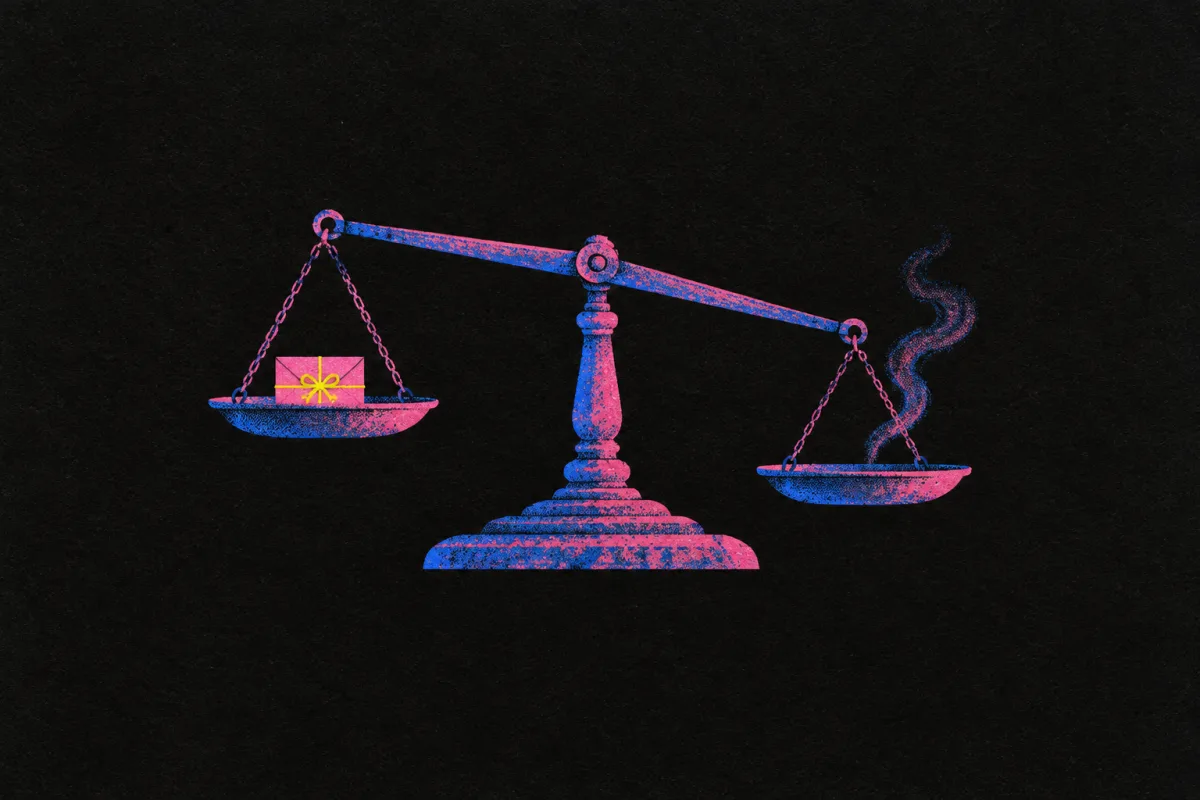
What rudeness buys, by the numbers
The loudest claim came from Google co-founder Sergey Brin. In May 2025, at the All-In Live event in Miami, he said in an interview that models “tend to do better if you threaten them … with physical violence.” He showed no method. Daniel Kang of the University of Illinois called such claims mostly anecdotal. “Systematic studies show mixed results,” he said. Here is what those studies found.
The first is the Penn State paper from the top of this story. Om Dobariya and Akhil Kumar, an information systems professor, posted “Mind Your Tone” in October 2025. They took 50 multiple-choice questions in math, science and history and rewrote each one in five tones: very polite, polite, neutral, rude and very rude. That made 250 prompts for ChatGPT running GPT-4o. Each set ran ten times, and the results were averaged.
Very rude prompts got 84.8% right, neutral ones 82.2%, very polite ones 80.8%. That’s where the two extra answers out of 50 come from. The paper has not been peer reviewed, it tested a single model, and the authors admit the sample is small.
Back in 2024, researchers at Waseda University and RIKEN, Japan’s national research institute, found the opposite. They tested an earlier generation of models, including GPT-3.5 and Llama 2, in English, Chinese and Japanese. Impolite prompts often hurt performance, and excessive politeness guaranteed nothing. The best level of courtesy differed by language. The authors suggest the models copy the speech norms of the cultures whose text they learned from.
A third study, revised in March 2026, tested three models from OpenAI, Google and Meta on exam-style questions in many languages. Neutral and very polite prompts generally scored higher than very rude ones. But the gap was statistically significant, meaning bigger than chance alone would produce, only in some humanities tasks. Google’s model barely reacted to tone at all. The authors’ overall verdict: in typical mixed use, modern models largely shrug off tone.
Who the rule is really training
Taken together, the studies give a simple practical answer. When it comes to accuracy, modern models barely care about tone, so there’s no reason to be rude to get a better answer.
That leaves habits. Even after rudeness won them a few points, the Penn State authors weren’t worried about hurting the machine. They were worried about us: insulting language toward AI, they warned, could reinforce harmful communication norms in people.
Anthropic’s rule will touch a tiny share of users, the ones who open a chat specifically to torment the model. Everyone else won’t feel it at all, and swearing at a wrong answer is still allowed. But the rule raises a question the industry can’t answer yet, and it is more about us than about Claude. If it ever turns out that models do have something like experiences, will we want to know how we spoke to them all these years?