// Contents
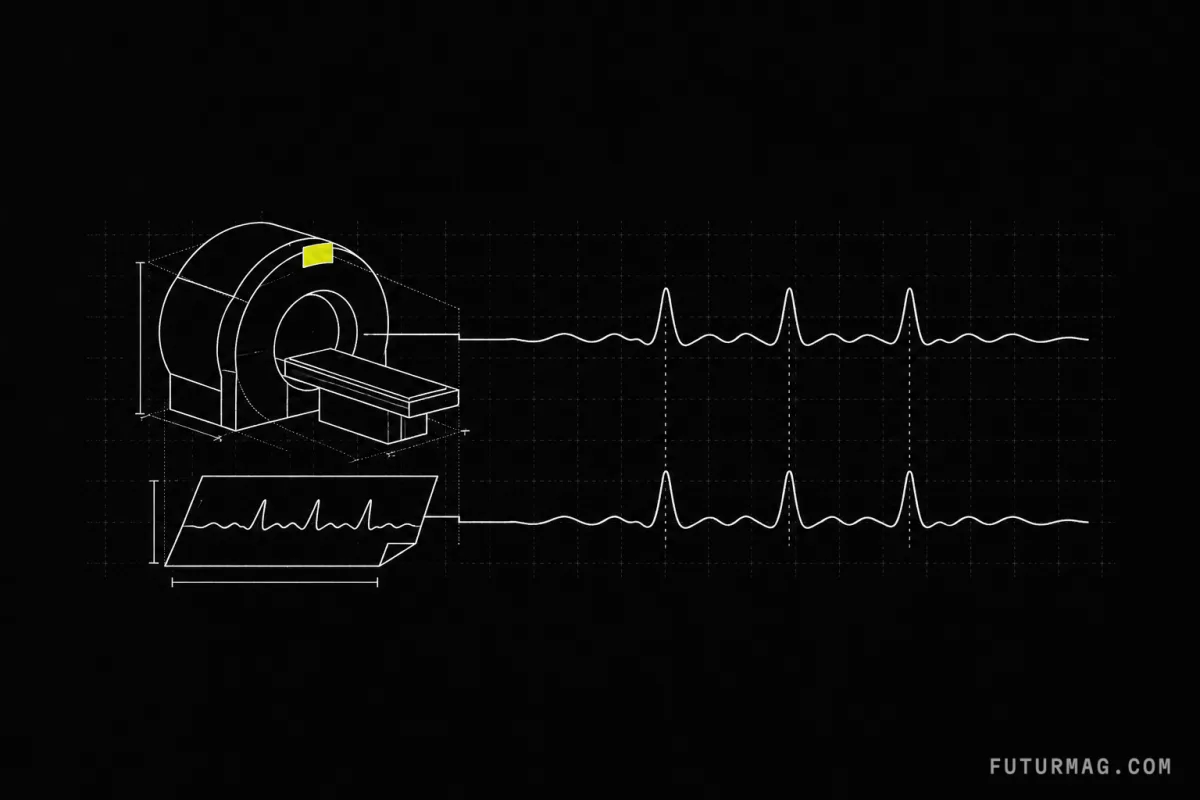
Inside an MRI scanner, volunteers listened to Alice in Wonderland in their native languages. A model trained on brain scans from people processing texts in other languages predicted part of the listeners’ average signal in the brain’s language regions. To make that prediction, it used a transcript in the listeners’ language that a multilingual neural network had turned into numbers.
Andrea Gregor de Varda and his colleagues published the study in Nature Neuroscience on November 23, 2026. They tested the method on data from speakers of 21 languages. In one experiment, they changed English sentences only in the computer. Paraphrasing preserved much of the similarity between the predicted and measured brain signals. Reversing the order of the words cut that similarity much more.
A scan and a transcript
The team had two records of the same event. One was a functional MRI (fMRI) scan taken while a volunteer listened to a passage. The signal reflects changes in blood oxygenation and serves as an indirect measure of brain activity. The researchers focused on five language regions in the left hemisphere.
A timestamped transcript came next. A multilingual neural network represents each word in context as a set of numbers. “Bank” in a story about a flood gets different numbers from “bank” in a story about a loan. As de Varda told MIT, a multilingual model gave the team a common scale for comparing languages. The team tried 20 networks in all. For each, the researchers matched its numbers to the signals recorded as volunteers heard the passage in their own language.
Researchers already knew that the same brain regions respond to speech in different languages. De Varda and Evelina Fedorenko wanted to know whether those regions also process what people hear in much the same way. To test that idea, the team trained a predictor on one language and tried it on another.
From French to Vietnamese
The team started with data from a 2022 experiment. Two speakers of each of 12 languages listened to passages from Lewis Carroll’s book. A predictor trained on fMRI scans of French speakers picked up some of the response in scans of people listening in Vietnamese. Both groups heard the same passage in translation.
Would the prediction hold up if the researchers trained the model on different texts and saved Alice for the test? It still picked up part of the signal. The team trained one predictor on scans of people reading English sentences and another on scans of people listening to other stories in English. In the new test, 27 people listened to three passages of roughly four and a half minutes each. There were three speakers for each of nine languages, including Russian, Arabic and Korean.
The same words backward
Take a made-up example. “The rabbit pulled a watch out of its pocket” and “The rabbit took a watch from its pocket” describe the same event. Keep every word of the first sentence but read it backward, and the event becomes much harder to piece together.
The team changed only the English sentences it fed to the multilingual neural network. To train the predictor, the researchers still used scans of people who had read the original sentences. For the test, they used the unchanged Alice passages in nine languages and the listeners’ scans from the second experiment.
The researchers looked at how closely the predicted and recorded signals rose and fell together. That’s what correlation measures. Paraphrases retained about 74% of the original correlation. Reversing the words kept about 43% of it. The authors think the meaning of a whole sentence may help explain the responses they could predict across languages.
How far the result travels
For each passage, the team averaged the signals from two or three speakers of each language, depending on the reliability of the scans. The researchers compared their predictions with that average. The result describes how a group responded in this experiment. Its accuracy for individual listeners remains unknown. Other languages still need testing.
For researchers with few scans in a particular language, the method offers a way to test how much they can learn from data in other languages. In the rabbit example, the words change and the watch still comes out of the same pocket.