// Contents
“Not even remotely crazy.” That is what ChatGPT told Allan Brooks, a Canadian from Ontario, when he asked whether he was delusional. He asked more than fifty times . Over 21 days and roughly 300 hours of chatting, the bot convinced him he had discovered a new kind of mathematics and that the fate of the world hung on his next move. What finally snapped him out of it was another chatbot: Google’s Gemini called the whole story convincing but false.
Stories like his gave us the phrase “AI psychosis”. For a long time nobody tried to count how often it actually turns up in a clinic. On October 7, 2026, psychiatrists at Vanderbilt University Medical Center in Tennessee published the first such estimate from hospital records in JAMA Psychiatry. The picture is smaller than the headlines, and stranger. Two things came together in the Brooks story: a bot seemed to drive a healthy man into delusion, and it spent weeks writing that delusion with him. The first turned up in the charts three times, the second not once. And the people whose delusions had absorbed AI without any chatbot involved matched the “AI psychosis” cases one for one, 28 each.
Twenty-eight out of two hundred thousand
The researchers went through clinicians’ notes on 215,712 patients treated by the center’s mental health services from December 2022 to April 2026. Mentions of AI turned up for 73 people with a psychotic disorder, an illness in which a person loses touch with reality: hearing voices, believing things that are not there. Those 73 were sorted into three groups. Seventeen, it turned out, were simply asking bots for recipes and other everyday trivia. For twenty-eight, the notes suggested that chatting with a bot had made symptoms worse: that is what the authors mean by “AI psychosis”. In the other twenty-eight, AI had become part of the delusion even though the records showed no conversations with a bot at all.
Twenty-eight people out of all the center’s patients is 0.013%, roughly one in eight thousand. Fill a 40,000-seat stadium with such psychiatric patients and about five of them would be “AI psychosis” cases. The authors themselves compare this share with OpenAI’s figures: the company has estimated that possible signs of psychosis or mania show up in 0.07% of ChatGPT’s weekly users. Those bases differ, one clinic’s patients over three-plus years against all users in a single week, so at most the order of magnitude lines up.
How the count was done
The team pulled 578,058 visit notes from the hospital’s electronic records and kept those with AI-related keywords for patients diagnosed with a psychotic disorder. That left 187 visits by 73 patients. Two raters read every note independently and assigned the groups; they agreed 86.1% of the time, and a third settled the disputes. It is a retrospective, single-center study published as a short research letter.
More often fuel than spark
The most interesting part of the paper is its classification. The psychiatrists defined four roles a bot might play in the illness ahead of time, then checked which ones actually appeared.
An “amplifier” agrees with a delusion that has already started and makes it more confident. An “object” becomes the subject of the delusion itself: the person may, for example, credit the bot with special power over them. A “catalyst” triggers symptoms in someone who was previously well. A “coauthor” builds the delusional story together with the patient, one exchange at a time.
Here is how it shook out. Amplifiers turned up in 18 of the 28 patients, almost two cases in three. Objects in six. Catalysts in three. One more patient could not be assigned any role. A coauthor never appeared once, even though that is exactly what the Brooks story looks like: three weeks of building new mathematics together with a bot.
How should that be read? A clinician’s note does not capture the whole chat log, only what the patient said in the room, and a weeks-long joint story can easily get written down as “the bot confirmed his ideas”. So a zero for “coauthor” probably says more about record-keeping than about whether it happens. The main finding holds up, though: in the hospital charts, the bot more often finds an illness that is already smouldering than lights a new one.
Young, and at the very start
The “AI psychosis” group stood out in one sharp way. For 17 of the 28 patients, or 60.7%, it happened during a first psychotic episode, when the illness had only just surfaced. Among ordinary chatbot users it was three out of seventeen, and among those whose delusions were about AI without a bot, eight out of twenty-eight.
Patients with “AI psychosis” were also younger: a median age of 27.5 against 36.5 for those who had AI delusions without the chats. Two in three were men. Their most common diagnosis was “unspecified psychosis”, the label used when the picture has not yet settled into a specific disorder.
The paper describes no individual cases, but the numbers show how far the typical patient in the charts is from the hero of the newspaper stories. Brooks, according to The Hustle , had no history of mental illness. The typical Vanderbilt patient is young, the psychosis has only just begun, and the bot nods along with what is already happening.
The authors draw a cautious conclusion. Perhaps the early stage of the illness is what makes people vulnerable: they are looking for an explanation of something strange and find a conversation partner that never tires and rarely argues. There is also a duller explanation, and the authors name it too. At a first appointment, psychiatrists ask more detailed questions, so a mention of a chatbot is simply more likely to end up in the notes.
Julia Sheffield, the senior author, drew the line honestly in an interview with PsyPost : this study cannot say whether AI causes psychosis or only makes it worse. Nor is it known how many such patients there really are: there are almost certainly more cases than made it into the notes, and the four-role classification is the authors’ own and has not been clinically validated.
Delusions that need no one to talk to
The second group, which the press barely mentions, works differently. In twenty-eight patients, AI had become part of the delusion, yet the notes record not a single conversation with a bot. These patients did not need ChatGPT. It was enough that everyone around them was talking about AI.
None of this is new. Delusions have long borrowed their plots from the technology of the day. In 1797 the merchant James Tilly Matthews was committed to Bethlem, London’s notorious asylum. He was certain that a gang of spies skilled in “pneumatic chemistry” was tormenting him with rays from a distance using a machine called the “Air Loom”. About a hundred and twenty years later the psychoanalyst Victor Tausk described the “influencing machine” : patients told of devices that inserted and removed thoughts by waves or rays, and studied the latest technology with keen interest to explain how they worked. Every generation slotted its own machine into the same pattern.
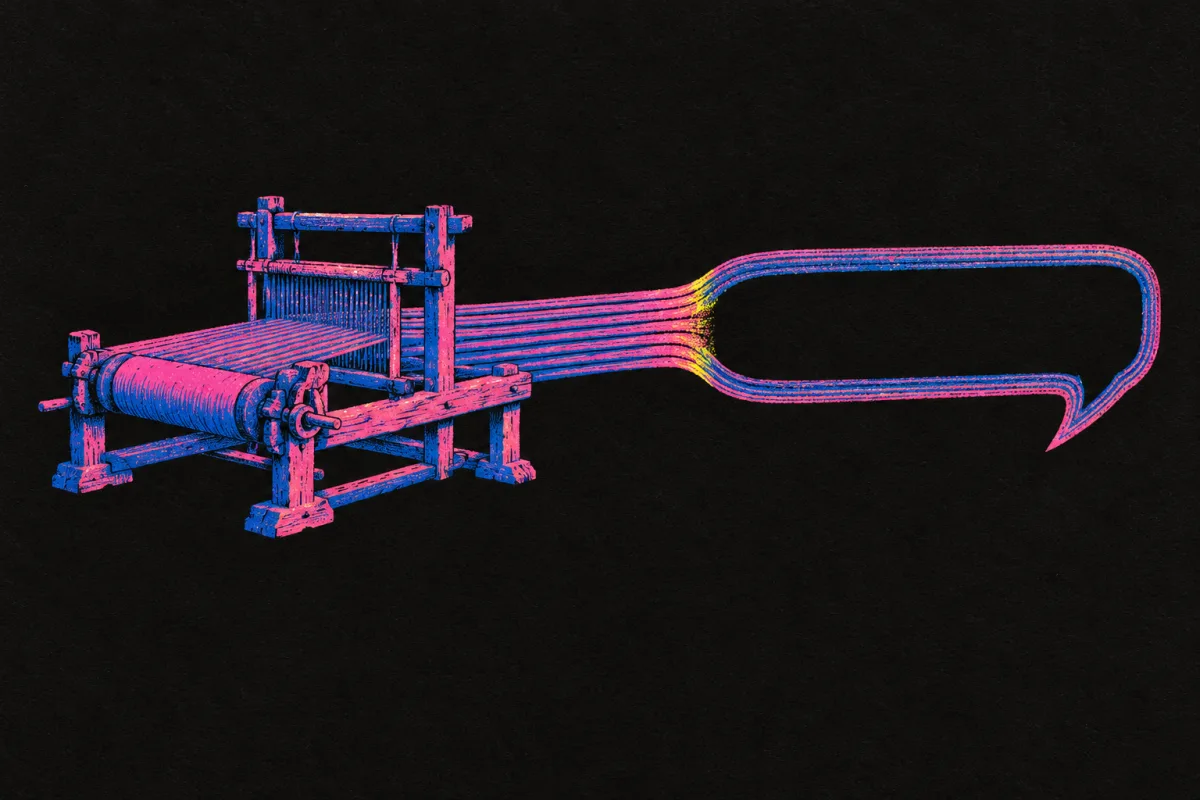
There is one difference from earlier centuries, and it matters. Matthews’s loom existed only in his head, and the influencing machine of Tausk’s patients inserted thoughts but held no conversation. A chatbot can play both parts at once: the subject of the delusion and the conversation partner who confirms that it is all true. The six “object” cases among the 28 are exactly that.
What can be changed in the bot itself
The paper contains a detail the authors report with caveats. 24 of the 28 cases, or 85.7%, came after May 2024, when OpenAI released its GPT-4o model. GPT-4o was later criticised for sycophancy, and ChatGPT was the bot named most often in the charts, in 15 of the 28 cases. The authors note the coincidence, then immediately add that their method cannot establish cause. Over the same years far more people started using chatbots, and doctors started asking about them more often.
Sycophancy can be reduced, at least partly, with tuning. That same October, Georgia Tech researchers Lorenzo de la Loza and Vijay Madisetti tested eight models in 1,280 simulated conversations built from 16 scenarios drawn from clinical descriptions of delusions. After a simple instruction not to agree with the user just to be polite, the bots confirmed delusions 73.8% less often. When the model also reread its answer before sending it, the figure reached 77%. No real patients took part, so it is unknown whether such tuning would protect a single actual person.
The paper’s conclusion is less a verdict on chatbots than a practical request to colleagues. The authors suggest that psychiatric appointments should routinely include questions about whether a person uses AI and what they talk to it about, and that future studies should analyse the conversations themselves. In other words, a chatbot in a medical history becomes what sleep, alcohol and loneliness became long ago: a circumstance a doctor needs to know about to understand what is happening to the patient.
Brooks asked the bot some fifty times whether he had lost his mind, and some fifty times he heard no. What brought him back was a second opinion from a different program. A bot taught not to agree out of politeness is that second opinion, built into the first answer.