// Contents
Some 173 million smartphones priced under $100 shipped worldwide in 2025, IDC counted . These are first phones: for a teenager, for elderly parents, for someone getting online for the very first time. Analysts track them as shipments, meaning the number of phones manufacturers send out to stores and carriers. In the second quarter of 2026, shipments of cheap smartphones fell by almost 60%. Demand didn’t vanish. The memory these phones are built from did: AI data centers took it.
The scale is easy to picture. Nvidia’s B300 accelerator, the workhorse of today’s AI servers, carries 288 GB of memory . That is as much RAM as 72 budget phones with 4 GB each. For the phone itself, memory has become the biggest expense: in handsets under $200 it now accounts for almost 60% of the cost of all components, Omdia estimates. The screen, camera, battery and case together cost less than the memory chips.
// A year of memory for AI
Three factories for the whole planet
The working memory in almost everything, from laptops to fridges with screens, comes from essentially three companies. Samsung, SK Hynix and Micron together control about 90% of the global market. Over the past year all three have redirected the overwhelming share of their supply toward AI data centers rather than consumer electronics, Ramon Llamas, IDC’s research director for mobile devices, told Rest of World . The logic is simple: data centers pay more and take everything the fabs can make.
AI accelerators need a special kind of memory called HBM, or High Bandwidth Memory. Its chips are stacked into a tall tower and placed right next to the processor so data can move faster. The catch is that HBM is greedy. Each gigabyte of it costs a fab roughly three times as much silicon as a gigabyte of regular DDR5: the same wafer yields a third as many bits. Micron calls it a three-to-one ratio. Every gigabyte sent to a data center strikes three gigabytes off the plan for consumer devices.
How many phones fit in one accelerator
Now for some napkin math. Take a typical “$100 phone”. The Redmi A5 with 4 GB of RAM and 128 GB of storage sold in the Philippines in 2025 for 4,099 pesos, about $74.
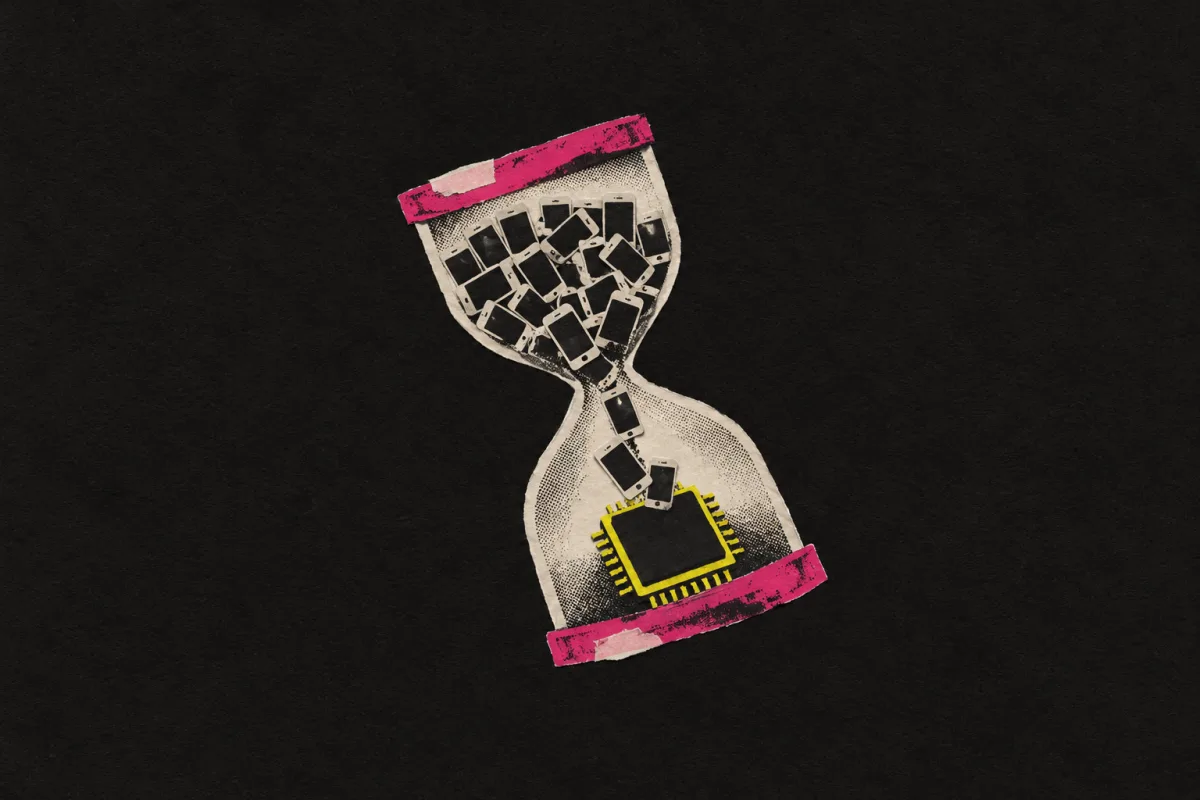
By capacity that is the same 72 phones, but adjust for three-to-one and the chip uses as much silicon as roughly 216 budget phones would. A standard server holds eight of these accelerators, about 2.3 TB of memory in total, or more than 1,700 phones’ worth of silicon. And a data center is built from thousands of servers, not one.
The assumptions behind this estimate
- Phones use mobile LPDDR memory, while Micron’s three-to-one figure compares HBM with DDR5. For mobile memory the ratio may differ somewhat, so treat the result as an order of magnitude.
- 4 GB of RAM is the upper end for cheap models; some ship with 3 GB, which would push the phone count higher.
- Flash storage (those 128 GB) is left out, although it has also become more expensive.
The numbers are rough; the conclusion isn’t. Memory is now scarce, and the maker decides who gets it: a cloud giant paying top dollar, or the assembler of a $74 phone whose profit is counted in cents.
Who pays for someone else’s AI
A phone like the Redmi A5 can’t stay the same in 2026. The maker has two options: raise the price or cut the specs. Counterpoint analysts observe that brands are doing both: less storage, simpler cameras and, in some price bands, a return of 4G-only models instead of 5G. “Low-end phones are becoming uneconomic to manufacture,” IDC vice president Bryan Ma told CNBC .
So a phone for someone’s first step online is getting pricier because somebody else is chatting with a neural network. The pain lands hardest on those with the least money. The mobile operators’ association GSMA estimates that, as of late 2025, for the poorest fifth of people in low- and middle-income countries, a basic smartphone already costs almost half a month’s income, 44%. In sub-Saharan Africa it is three quarters, 76%.
Prices are rising everywhere, but unevenly. Existing models have become about 15% more expensive since the start of 2026, according to the same Counterpoint price tracker, and new launches arrive roughly 25% pricier than last year’s. The jump is most visible in price-sensitive markets: in India, phones went up 21%.
By comparison, US prices rose only 5%, yet the cheap segment shrank by almost two thirds there too. Sales of sub-$100 phones fell 64% in Q2 2026: some brands stopped shipping them, others raised prices.
The bottom isn’t in yet
The third quarter of 2026 drew the line. Global smartphone shipments fell 22% to 255.3 million units , the worst result in IDC’s records. Chinese brands that lived on cheap models were hit hardest. Nabila Popal, IDC’s senior research director for devices, believes the market has not yet hit bottom. IDC doesn’t expect a recovery before 2028, and for the whole of 2026 it forecasts a 16.7% decline , to just over a billion phones.
There is a small consolation. Memory is getting pricier more slowly: according to IDC, in Q3 costs rose by a “low double-digit” percentage over the previous quarter, compared with 50% to 100% per quarter before. Back in September, Bryan Ma warned CNBC that a slowdown would be no reversal: if the shortage eases, prices will stop climbing so fast, but they won’t come back down. The same shortage is hitting computers too: global PC shipments fell 21% in the third quarter.
The $40 phone still lives on paper
The industry knows what it is losing. In March 2026 the GSMA and six major operators announced a pilot of 4G phones priced at $30–40 in six African countries: the DRC, Ethiopia, Nigeria, Rwanda, Tanzania and Uganda. The announcement itself admitted that expensive memory makes the lower price hard to reach, and asked governments to drop duties and taxes on entry-level smartphones. There are no reports yet of such phones going on sale.
The stakes are bigger than the gadget market. Rest of World reckons that roughly 800 million people’s path online is now at risk: the GSMA expects them on mobile internet by 2030, while the cheap phone they were supposed to get there on is disappearing from shop counters.