// Contents
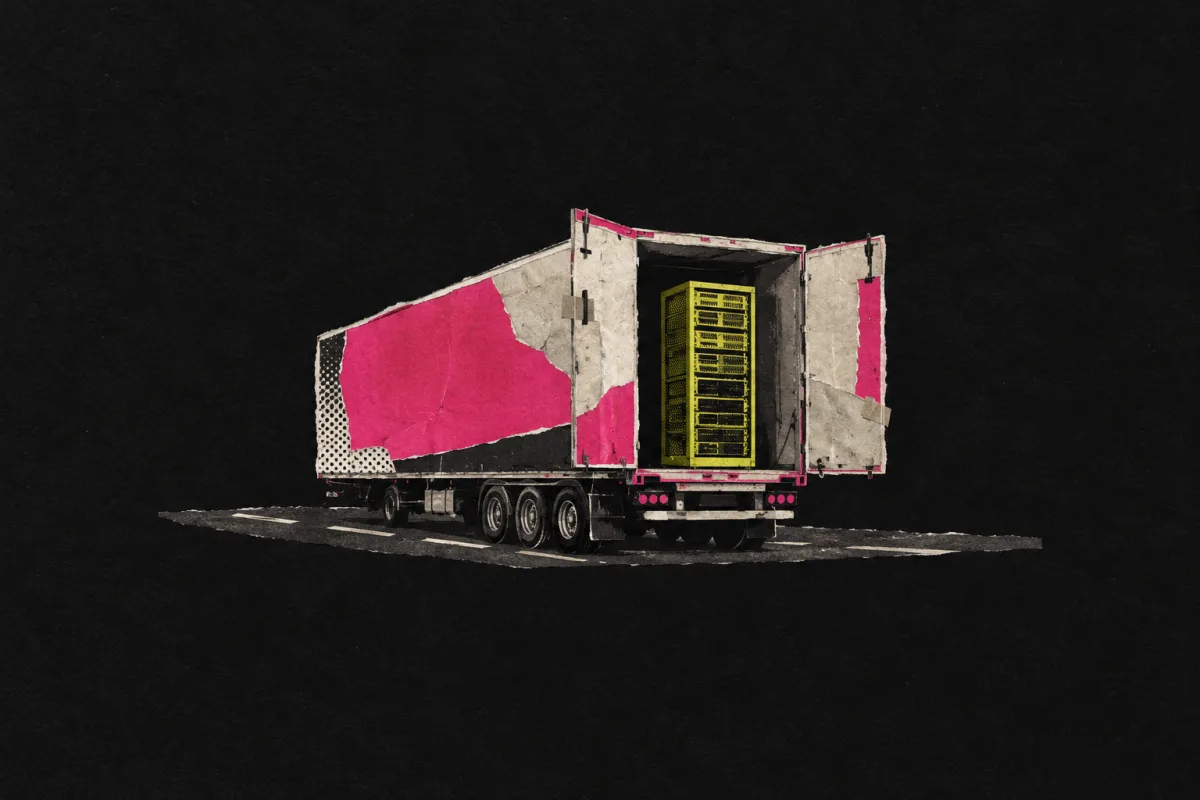
In early June 2026, a trailer carrying roughly $13 million worth of server equipment was heading east on an American highway toward Fayetteville, Georgia, home to one of the largest data center developments in the country. The load was seriously guarded: an unmarked car followed behind it, carrying police officers hired as an escort. Somewhere on the interstate another vehicle slammed into that car, the escort stopped, and the trailer kept going. It later turned up in a lot. The pallets of servers were gone.
“The accident was not an accident,” private cargo theft investigator Gerardo Pachuca told NBC News. Soon it happened again, this time to a $10 million load bound for Texas: the escort was rammed, and the trailer’s GPS tracker started reporting false coordinates. According to the industry experts and investigators NBC spoke with, more than $100 million in data center equipment has vanished from US roads since June.
The ramming sounds like a scene from an action movie, and every outlet led with it. In this story, though, it is the exception. These loads usually leave quietly. The thieves don’t chase the truck. Someone hands it to them, with perfectly good paperwork.
Gold bars on pallets
Why servers, all of a sudden? Because they are now some of the most concentrated value that ever rolls down an ordinary road. A single flagship AI server rack costs about $3 million, according to Overhaul, a company that tracks shipments and sells services to protect them. A standard trailer of those racks is an eight-figure load. Until it is bolted into a data hall, that money travels on the same highways as furniture and soda.
Keith Lewis, head of operations at the risk analytics firm Verisk CargoNet, compared the cargo to gold bars and said it is far easier to steal than robbing a bank. Gold bars, at least, usually ride in armored trucks.
It isn’t only GPUs. The lists of stolen goods include complete servers, memory modules, drives, routers, and fiber and copper cabling. Memory has become more expensive because data centers are buying so much of it, and the higher price made it a better target for the black market too. Thefts of data center equipment, chips and components are up 34% since 2024, and Overhaul’s October 21 report puts this year’s losses above $150 million. Individual losses regularly exceed $30 million, and thefts of this kind of equipment now happen every week, the company says.
The escort guards against the wrong threat
Investigators call the ramming trick bump-and-run. Scott Cornell, who has investigated cargo theft for more than 30 years and chairs TAPA Americas, walked through both cases in an interview with FreightWaves. His conclusion is surprisingly mundane: the trick only works if the truck driver is in on it.
An honest driver whose escort gets hit will stop and call 911. A bought driver just keeps driving. Even a police escort only protects the load from strangers on the road, while the threat is sitting in the cab. Cornell traces both successful hijackings to the same failure: nobody properly vetted the drivers before handing them the freight.
Cornell himself warns against turning two incidents into a national trend. The rammings are memorable because they are loud. Most of the money disappears another way.
How to steal a truck without stopping it
According to Overhaul, deception played a part in 92% of high-value technology shipment thefts. The FBI explained how the quietest method works back in the spring: on April 30, 2026, the bureau issued a warning about cyber-enabled cargo theft.
Imagine a scammer breaking into a delivery service’s email and quietly changing the address on your order. The courier does nothing wrong: he takes the parcel wherever he is told. Trucks work much the same way, in three steps. First, a broker (the middleman who finds a truck for a load) or a carrier gets an email that seems to come from a familiar company, with a link about a “carrier agreement.” The link installs remote management software, and the scammers quietly read along: what is shipping and when it gets picked up. Then, posing as a real carrier, they take the job and put their own delivery address on the bill of lading.
Next, the cargo is moved onto another truck with a complicit driver. The FBI estimates that cargo theft in the US and Canada cost nearly $725 million in 2025, and the average theft grew about a third more valuable: thieves have become pickier.

There is a bitter irony here too. According to NBC’s reporting, as summarized by Hardware Busters, sources flagged AI-generated identity documents as one way to put the right accomplice behind the wheel. A neural network draws the license that drives away the hardware for neural networks.
Sometimes even less is needed. Cornell recalled a case in which expensive tech freight was handed to a small hotshot auto hauler, a firm that normally moves cars on a short trailer. It took on specialized freight without suitable equipment and far from its usual territory. A minute with a search engine would have shown that. Nobody spent the minute.
A one-way ticket
Stolen servers rarely show up on online marketplaces. The buyer is usually lined up in advance, before the theft. Cornell estimates that six or seven out of every ten loads stolen in the US now leave the country. Disguising a load, he says, takes nothing more than falsified paperwork. Stolen televisions become plain “general electronics” on the bill of lading after a cross-dock transfer, and with documents like that, nobody is eager to break the seal on the trailer and check.
The final destination is often a place where Washington has banned sales of advanced chips. Speaking to Fortune, Overhaul executive vice president David Warrick named China, Russia and Iran and described the groups as international syndicates that run like big corporations. The demand is real: according to the Financial Times, cited by Fortune, the black market price of Nvidia’s RTX 6000 Pro workstation card in China more than doubled after the start of 2026.
// Timeline
- Thieves take more than $7 million in Nvidia chips from a California warehouse, a day before their scheduled delivery to a Supermicro site in San Jose.
- A truck carrying about $15 million in semiconductors and Apple products disappears in Reno. The empty trailer is found two weeks later, 280 miles away in California.
- The FBI warns of a wave of cyber-enabled cargo theft through hijacked broker and carrier accounts.
- After ramming the escort, thieves make off with $13 million in servers bound for Georgia. Soon after, a $10 million load headed to Texas vanishes the same way.
- Scott Cornell tallies $110.6 million in known data center freight thefts since June 3.
- Overhaul puts this year’s AI hardware theft losses above $150 million.
Who picks up the bill
The direct loss is only part of the bill. Verisk warns that delays and downtime can cost companies several times the value of the stolen equipment itself. A data center missing its racks won’t open on schedule, and replacements are hard to buy quickly in the middle of a memory and chip shortage.
The numbers deserve a grain of salt. The $100 million cited by NBC’s sources, Cornell’s $110.6 million and Overhaul’s $150 million were counted by different people over different periods. Public summaries of Overhaul’s report don’t show how many thefts sit behind its total, and protecting freight is exactly what the company sells. Still, everyone who works this market sees the same direction.
The fixes sound almost boring. Cornell recommends secure digital bills of lading alongside the paper ones, and checking what a carrier normally does before releasing freight: its equipment, history and geography. The FBI asks companies to confirm every shipment request and pickup through a separate channel, because a familiar name or email address proves nothing. And the response has to be fast, since most stolen loads head abroad. “It’s all about time,” Cornell says.
Sand with a logo
In late September 2026, thieves stole two trailers from the Fremont, California, yard of PlusAI, and one of them carried the Nvidia logo. PlusAI builds software for self-driving trucks and really does run on Nvidia chips. The trailers, however, held none. Each carried about 20,000 pounds of sand, which the company uses to make test trailers weigh as much as real freight.
The thieves broke in, found nothing of value and abandoned the trailers. Fortune reports that a friend of PlusAI’s vice president of legal spotted them outside an office in nearby Newark that same day and sent a photo. “This was a first,” said Lauren Kwan, the company’s vice president of marketing: PlusAI had never had a tractor or trailer stolen before.
Whether the logo drew the thieves in is unknown. But if it did, then in a story about thieves who fool everyone else, this was the rare case where the thieves got fooled.